
US Navy and U2: What Connection?

The US Navy and U2 in the same article! Huh?

That’s right.  It’s true. Check it out for yourself.

The Leader to Leader Institute just posted an article on its website that Jason Pankau and I wrote for the Summer edition of the Leader to Leader Journal. The article features the stories of the US Navy’s former Chief of Naval Operations (CNO) Admiral Vern Clark, and Bono, the lead singer of the rock band U2.  The article is about the topic of connecting with “core employees” to boost strategic alignment, employee engagement, productivity and innovation.  Here is a link to the article entitled “To Boost Performance, Connect with the Core.”

Develop Loyalty: Connect with Your Customers

Now for something completely different! InDesign magazine asked me to write an article about what I might do if I owned a jewelry store. I would be following a similar article written by Ivanka Trump (who actually owns a jewelry store).

It should come as no surprise that I immediately saw this as an opportunity to talk about the importance of the force of connection and how it contributes to the success of retail businesses. Here’s a link to the article entitled “If I Owned a Jewelry Store.”

Adams Family Character

IMG_0964This weekend, my wife Katie and I went for a rare getaway to Boston, about a three hour drive from our home in Connecticut.   Our primary interest was to see the home of the Adams family, not of the television sitcom fame, however. We were interested in seeing the other Adams family, John and Abigail Adams, and their son John Quincy Adams.  Katie and I much admire the Adams’s for their character, their faith and the positive impact they had America.

As it turned out, Sunday was the birthday of John Quincy Adams.  When we visited the tombs of the Adams’s we saw a wreath on John Quincy Adam’s tomb sent from President Obama.

The highlight of the trip for me was seeing the Mendi Bible that was given by the Mendi men to John Quincy Adams in thanks for representing them in their successful case to win their freedom, a case that went all the way to the U.S. Supreme Court.  The Mendi Bible is kept in a safe except on the weekend of John Quincy Adams’s birthday when it is on display in the Adams’s library adjacent to their home in Quincy, Massachusetts.

The tour guide let me read a copy of the letter the Mendi Men presented to John Quincy Adams at the time they gave him the Bible. The letter expressed their gratitude to President Adams, how much the Bible meant to them during their time in prison and how they continue reading it now that they are free. President Adams wrote back to the Mendi that “it was from that book that I learnt to espouse your cause when you were in trouble.”

The story of the Mendi men was captured in Stephen Spielberg’s highly acclaimed movie “Amistad,” which I encourage you to see.   In 2007, Deval Patrick, Massachusett’s first African-American governor, was sworn in using the Mendi Bible (you can read about it in this Boston Globe article.)
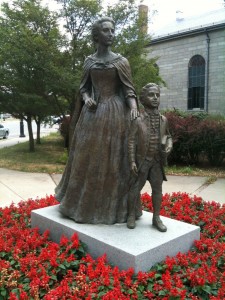
IMG_0968Near the church where the Adams’s are entombed, there is a statue of young John Quincy at around nine years old holding the hand of his mother Abigail.  She was a remarkable woman of faith, wisdom and courage.  Knowing the stories of John and Abigail Adams it should come as no surprise that their son went on to become America’s sixth president and later a defender of liberty and justice in the case of the Mendi’s.  As historian David McCullough wrote,

“While there are indeed great, often unfathomable forces in history before which even the most exceptional of individuals seem insignificant, the wonder is how often events turn upon a single personality, or the quality we call character.”

The Adams’ family was a tremendous example of strength of character in action.  I was encouraged learning more about them.

Learning about and celebrating the stories of individuals who have good character is one way we can be encouraged to live up to their example. By developing habits that reflect strength of character in our lives and teaching the stories of role models such as the Adams’s to our children we help them develop good character too.

Best Practice Institute Employee Engagement Webinar

On July 14, 2010 at 12:00 pm EDT, Michael and Jason Pankau will join the Best Practice Institute to present a 45 minute webinar on creating a work environment to maximize employee engagement and strategic alignment.   Following the webinar there will be a 15 minute period for Q&A.

During the session, Michael and Jason will cover:

  • Six universal human needs to thrive at work
  • Three core elements of a culture that motivates employees to give their all
  • Best practices of leaders who energize the people they lead
  • Why task and relationship excellence are necessary to achieve sustainable superior performance.

You can register for the webinar at this link.

LeaderLab Podcast Interview

Jason Pankau and I were recently guests on LeaderLab’s podcast interviews available online or at iTunes. LeaderLab’s podcasts are hosted by David Burkus. David’s past guests on LeaderLab’s podcasts have included Marshall Goldsmith, Daniel Pink and Steve Farber. Check it out.

Who Has Your Back?

William SewardOne reason so many leaders fail is that they become isolated.  We all need good friends who “have our back,” as my friend and business colleague Jason Pankau likes to say.  Good friends tell us the truth, they are willing to speak up if they believe we are wrong, and they support and encourage us through the inevitable difficult seasons we all experience in life.

A couple summers ago, I shot the above photograph of the William Seward statue in New York City’s Madison Square Park knowing that one day I would write about him. Seward was a onetime political rival of Abraham Lincoln’s who became a member of Lincoln’s cabinet and one of Lincoln’s best friends.  Doris Kearns-Goodwin wrote about their friendship in her wonderful book Team of Rivals. Frequently, Lincoln went to Steward’s residence in Washington D.C. where the two men talked for hours. Seward’s friendship was a lifeline for Lincoln during his struggles with depression, challenging periods he faced during the Civil War, his wife’s mental illness and the grief he felt following the death of his son.

Ask yourself if you have a few good friends who have your back at work and in life outside of work.  If you do, why not reach out to them and let them know how much you appreciate their friendship.  If you don’t have close friends, take out pen and paper then write down the names of individuals who have the potential to become good friends. Consider the following questions when selecting potential good friends:  Is he trustworthy?; Does he share your interests and values?; Does he live near you so that you can meet on a regular basis? Now that you have a few names, prioritize them then reach out to see if they are willing to meet you over a meal or coffee.  If the meeting goes well, ask if he would consider meeting on a regular basis. In my next post, I’ll write about the types of interactions that will make your meeting time with good friends worthwhile for each of you.

NASA JSCI’m dedicating this post to one of my best friends, Jason Pankau.  Here is a picture of us when we spoke recently at NASA’s Johnson Space Center in Houston, Texas (Jason is on the right side of the picture). We are standing in front of the Mission Control center for the International Space Station.

The Need to Respect Legitimate Authority and One’s Colleagues

With the recent firing of General McChrystal as commander of American forces in Afghanistan over his insubordination, I thought it would be an ideal time to reproduce here what I wrote in Fired Up or Burned Out about one of the greatest military leaders in history, America’s Army Chief of Staff, General George C. Marshall.

Marshall created a culture that stands in stark contrast to the culture created by General McChrystal as reported in a Rolling Stone magazine article entitled “The Runaway General.” Defenders of McChrystal argue he was speaking truth to power.  General Marshall was known for speaking truth to power but, unlike McChrystal, he recognized the need to respect legitimate authority and to always be respectful in dealing with the people he interacted with whether they were fellow soldiers, diplomats or representatives of foreign governments.

Because Marshall possessed humility of character, he knew that he was not always right and had to defer to the decisions of his superior in the chain-of-command then put extra effort into executing such decisions. As a result, Marshall had the complete confidence of the leaders he reported to such as General John “Blackjack” Pershing and President Franklin Deleno Roosevelt.

Marshall should be one of the role models all leaders strive to emulate. The title of the chapter I wrote about General Marshall was  “Soldier of Peace.”  You can read it below.

Has Jim Goodnight Cracked the Code of Corporate Culture?

Today, The Economic Times in India published an article I wrote about Jim Goodnight and SAS Institute.  The article is based on an interview I conducted with Goodnight at Giant Impact’s Leadercast conference in Atlanta.  You can read my article at The Economic Times‘ website or below.    

Creative Conversations: Boosting Creativity in Meetings

How do you boost creativity in meetings?  The key here is to tap the “corporate mind.”

The root work of “corporation” is the Latin word “corpus.”  It means “body.”  The definition of “corporation” is “a body of people acting as a single entity and authorized as such under the law.”  To maximize creativity requires getting a group of people together who in a sense represent the corporate body then helping them feel safe so that they will share their ideas and opinions.

Because individuals have diverse thinking styles, experiences and temperaments, they will naturally have different perspectives and come up with different ideas that contribute to constructing a creative new solution, product, process or new business opportunity.  As such, it is ideal to have a group that is large enough to generate diverse ideas but not so large that it becomes unwieldy.  Eight to ten individuals should be sufficient for most issues.  With issues that are more complex, and/or require broader support and implementation, you may want to have broad participation (an issue I will write about in a later post).

Here are few ways to structure a meeting and create a safe environment so that creativity will be maximized: