

“A company is stronger if it is bound by love rather than by fear,” the late Herb Kelleher, co-founder, CEO, and Chairman of Southwest Airlines, once said.
When Kip Tindell, retired co-founder and Chairman of The Container Store, first heard Kelleher’s declaration more than 40 years ago, he was, in his own words, “completely taken by it.” In Uncontainable, Tindell explains how he and his leadership team intentionally built an “employee-first” culture that reflected love—and he credits that culture as a major source of the company’s success.
I still remember the first time I heard the word love used in a corporate setting. I was about to teach a leadership workshop at Lockheed Martin Aerospace when the unit’s leader—retired Vice Admiral of the U.S. Navy Charles W. (“Willie”) Moore Jr.—told the room full of mostly men that they needed to love the people they were responsible for leading. You could have heard a pin drop. Coming from a decorated Navy aviator, the L-word was completely unexpected.
Is it really okay to talk about love at work? Won’t that make HR nervous?
The VIA Institute on Character defines the character strength of love this way: to value close relationships with others, to be warm and genuine toward people, and to give and receive affection. In this sense, love has nothing to do with romance. It’s about genuine care, connection, and commitment.
Moore told a story about his mother who flourished from loving and being loved by the people in the church she attended. He added that many people were not involved in a loving faith community and feel lonely as a result. He explained that with so many lonely people in society many leaders underestimate their importance in the lives of the people they lead. In an era marked by widespread loneliness, work has become one of the few places where people can regularly experience positive human connection.
Beyond addressing loneliness, love makes a measurable difference at work. Think of a boss you’ve had who genuinely cared about you—and one who was indifferent. Which boss were you more likely to give your best effort for? Most people would say the boss who cared.
“People first… Love ‘em up” is a phrase that Alan Mulally said consistently at work for decades—as general manager of the multi-year project to develop the 777 aircraft at Boeing, as CEO of Boeing Commercial Airplanes, and as CEO of Ford Motor Company as he led the turnaround that brought Ford back from the brink of bankruptcy to become one of the most profitable automotive companies in the world. When he retired from Ford in 2014, Mulally was named by Fortune magazine as one of the top three leaders in the world. “People first… love ‘em up” heads the list of expected behaviors that are foundational in Mulally’s Working Together Leadership and Management System.
I’ve had extensive conversations with Mulally as part of research for my next book on Connection Culture and I asked him about using the word love in the work context. He believes that leaders need to genuinely care for those they lead and show them that they matter. He told me he would say to colleagues: “We’re going to create value for all the stakeholders and the greater good by working together. That means that every one of you is really important and we’re really glad that you decided to join us. Even more, we respect you so much. You’re a human being and you are worthy of respect and love. We’re going to treat you that way. … We’re going to include you on everything because we respect you. … We care what you think.” In addition to actively and consistently including people, he talked about leaders thanking people for their involvement, showing they appreciated them, and celebrating them.
Why Love Matters at Work
Love inspires performance and resilience.
Research summarized in Adam Grant’s Give and Take shows that when people see how their work benefits others, performance improves and burnout declines. Leaders who connect people to the human impact of their work bring out higher levels of effort, accuracy, and persistence. In a medical setting, it is easy to see the work being done as an expression of love and care; in a manufacturing setting, it may be emphasizing how your product is improving someone’s life or that the company’s commitment to product safety and quality is an expression of love.
Love pulls people together.
Teams grounded in care and connection are more likely to support one another during adversity rather than splinter under pressure. Unity makes a team more agile and adaptable so that it becomes a performance and competitive advantage when challenges arise.
Love reduces conflict and stress.
When love is present, people assume positive intent, overlook minor offenses, and extend grace. Supportive relationships also reduce chronic stress, a major contributor to burnout and poor health.
Relationship Excellence Enhances Task Excellence
Critics sometimes argue that love makes organizations soft. In reality, the best leaders combine love with high standards. Clear goals, meaningful metrics, and accountability reinforce that excellence and results matter.
What critics miss is that relationship excellence enhances task excellence. When people care about one another and about those they serve, they work harder, collaborate better, and care more deeply about quality. Gallup research consistently shows that the quality of workplace relationships matters more to engagement than the specific work people do.
In the 2nd edition of Connection Culture: The Competitive Advantage of Shared Identity, Empathy, and Understanding at Work, we share inspiring stories of how great leaders loved the people they led and achieved extraordinary results, including Admiral Vern Clark (Chief of U.S. Naval Operations, 2000-2005), Frances Hesselbein (CEO of the Girl Scouts of the U.S.A), Lin-Manuel Miranda (who wrote the music, lyrics, and script of the award-winning Broadway musical Hamilton and starred in the titular role), and the media mogul Oprah Winfrey.
Few leaders are willing to use the L-word. But when you hear one who does and who walks the talk, pay attention. You may be witnessing the kind of leadership that builds not only strong cultures but lasting competitive advantage.
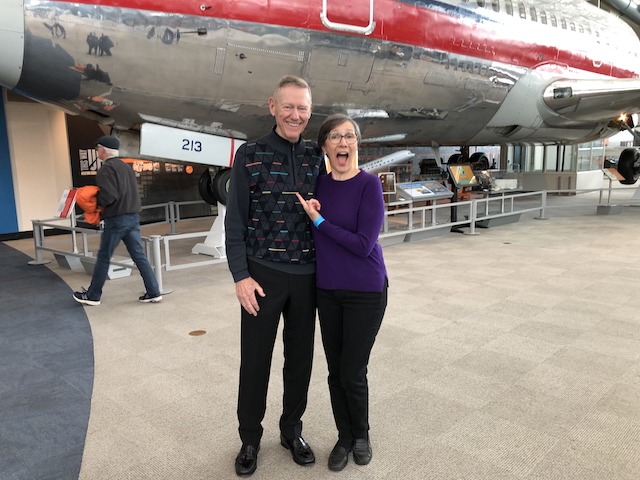
Image: A photo I took of my wife and colleague, Katie Stallard, hamming it up with Alan Mulally, retired CEO of Boeing Commercial Airplanes and Ford Motor Company, when we were with Alan and friends touring the Museum of Flight in Seattle.


