Developing Connections When People are Geographically Remote

At the heart of building community is developing a bond of connection among the members of a group. In other words, when the members of a group feel positive emotions related to being understood, respected, appreciated, and included by their group’s leaders and fellow members, it forms a bond that strengthens cooperation and commitment among group members.

Emotions are important to organizational effectiveness. Research by the Corporate Executive Board has shown that emotional factors are four times as effective as rational factors when it comes to the amount of effort employees put in their work. Emotional factors include how an employee feels about his organization’s identity and the people he works with whereas rational factors include what an employee thinks about his compensation.

Typically, an organization’s managers and stars feel emotionally connected while three-quarters of all employees do not. What happens to those who don’t feel connected? They stop caring. They stop giving their best efforts. They stop fully communicating and, as a result, decision-makers don’t get the information they need to make optimal decisions. This disconnection results in a gradual spiraling down of performance that may eventually threaten an organization’s survival.

Connection is grounded in human needs. I’ve found that two of these needs, recognition and belonging, can be partially met through participation in online communities. The need for recognition is in our DNA. It’s almost as if we have a “recognition battery” that needs to be charged regularly but the curious aspect of this battery is that its plug-in is located at a spot on our back that we can’t quite reach. As such, we rely on the people around us to charge our recognition battery. If it’s charged, we are energized; if not, we become drained and lose energy.

In addition to recognition, we have a need to feel that we belong to a group — to be in a place where “everyone knows your name,” as the popular theme song of the old comedy television show Cheers stated. Positive interactions on a regular basis with members of a group bring about this feeling of belonging.

There are a number of online capabilities that organizations can put place to help meet the needs for recognition and belonging, and bring about feelings of connection.

Online Personal Profiles that allow people to express their personal identities through posting photographs, hobbies and interests outside of work provide recognition. When co-workers inevitably comment on these personal expressions of identity, it provides recognition and a sense of belonging that makes people feel more connected. Giving employees a place to express who they really are helps them avoid feelings of isolation that occur when they begin to feel like cogs in a machine. Also related to personal identity are affinity groups such as book clubs and alumni groups. These groups can be encouraged and supported with online intranet websites and social media that increase connection among people with shared interests outside of work.

Social Media can be used to inform employees and invite them into conversations about corporate issues. Leaders who mine the resulting body of content for good ideas, implement them, and give credit where credit is due will discover that this helps employees feel more connected. This practice will also improve decision-making and innovation as decision makers gain access to new information and participants to identify new business opportunities, process improvements and product possibilities.

Podcasts and Webcasts are helpful tools to facilitate connection by reaching employees who have visual and auditory learning styles. They can also be used to increase awareness of thought leaders and experts in an organization. For example, Polly Pearson, former Vice President of Employment Brand and Strategy Engagement at EMC, interviewed thought leaders and experts on an internal webcast entitled “Culture Talk.” Polly helped several EMC employees to become internal bloggers and eventually to blog externally. As a result, EMC developed more than 40 bloggers.

These are but a few of the online means that can be utilized to foster connection among the members of an organization. By helping everyone to feel connected, organizations will increase the employee engagement, strategic alignment, productivity, innovation and overall performance.


Happiness at Work Podcast

alter logoJason Pankau and I were guests on a podcast for clients of The Alter Group, one of America’s leading real estate development firms.  The podcast host was Tom Silva, Vice President of the Alter Group. Our topic was happiness at work, leadership, employee engagement and employee motivation. You can check it out at this link or download it on iTunes.

Coach Rex Ryan Connects with Jets

Rex-Ryan


Check out this great article entitled “Channelling Churchill, Ryan Inspires His Team” on New York Jets’ football coach Rex Ryan  The article makes several important points that support the conclusion we came to from our research on leaders who produce sustainable superior performance.  Our research concluded that sustainable superior performance comes when leaders develop task excellence and relationship excellence.  Rex Ryan is doing this by connecting with his players on both emotional and rational levels. He connects rationally by communicating and leading his team to implement effective strategy and tactics.  This produces “task excellence.”  Ryan’s passion and authenticity helps him connect on an emotional level.  This helps produce “relationship excellence.” Ryan communicates simple, relevant and memorable themes with phrases such as “burn the boats” and “how dare you?” He tells memorable stories to illustrate his points.

The Jets are a decent team but not a great team, yet.  They just pulled off a big playoff win by defeating the Indianapolis Colts.  Given what I’m seeing, I expect the Jets are on the rise as Rex Ryan and team continue to develop a Connection Culture with Vision, Value and Voice.

Upcoming Leadership Events

Below are links to several leadership events that Jason Pankau and I will be speaking at or participating in.

On January 27, I’ll join Dean Homer Erekson of the Neeley School of Business at TCU where we will discuss leadership and employee engagement as part of the Tandy Leadership Speakers Series.

On February 10-11, I’ll be in London participating in the HTB Leadership Conference.

On March 4-6, I’ll be in at the Homestead resort in Virginia where my colleague Jason Pankau will speak at the New Canaan Society Annual Retreat.

On March 7-9, I’ll be speaking about leadership, employee engagement, productivity and innovation at the National Human Capital Summit in Atlanta.  I hope you’ll check it out and consider attending.

On March 10-11, Jason Pankau and I will be speaking about Connection Cultures, leadership, employee engagement, productivity and innovation at the Learning for Life Conference in Reno, Nevada.

Signals We Send in Relationships

Thanks to my friend Deborah Mills-Scofield for sending me this article from Science Daily entitled “Exploring How Partners Perceive Each Others Emotion During a Relationship Fight.”  It looks at how expressions of hard, flat or soft emotion are perceived and how such perceptions affect relationships.  This research suggests that a leader’s ability to express appropriate emotions at appropriate times is important to keep people feeling connected to the them (and emotional connections are essential to employee engagement and alignment).

Motivate Employees Now

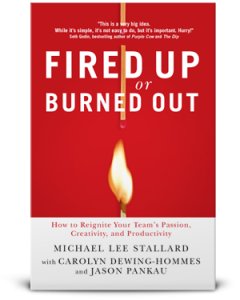
Fired_Up_or_Burned_Out_Book_CoverThis morning appeared as a guest on my friend Jim Blasingame’s nationally-syndicated “Small Business Advocate” radio program where we talked about leadership, employee engagement and productivity.  During the program, Jim and I discussed how the three core elements of a Connection Culture — Vision, Value and Voice — motivate employees to give their best efforts and align their behavior with organizational goals.  One of the ideas I shared was to bring employees together to read and discuss a management book including how it applies to their business.  To get them started,  I offered a free download of the digital version of Fired Up or Burned Out to listeners who sign up for my email newsletter.  To sign up for the newsletter and access the free book download click on this link.

Pixar’s Competitive Advantage? A Connection Culture

IMG_0504

At the Technical Academy Awards ceremonies held in Hollywood, the Associated Press reported that it wasn’t the host, actress Jessica Biel, who attracted the most attention. Instead, it was an understated, bespectacled, computer engineer named Ed Catmull. When Catmull’s name was announced to receive an Oscar for his lifetime of work in computer animation, the crowd went wild, whistling and whooping. And rightly so. The impact Catmull and his collaborators have had on Hollywood may last for decades to come.

Ed Catmull is the president of Pixar and Disney Animation Studios. He has rejected the traditional Hollywood star system and its often toxic work environment and replaced it with an environment that emphasizes community and long-term relationships. Catmull described it this way in a Harvard Business Review article he wrote: “[Pixar has] an environment that nurtures trusting and respectful relationships and unleashes everyone’s creativity…the result is a vibrant community where talented people are loyal to one another and their collective work, everyone feels that they are part of something extraordinary, and their passion and accomplishments make the community a magnet for talented people…”

What is it about Pixar’s environment that attracts talented employees and helps them produce outstanding movies such as the blockbuster hits Toy Story, Finding Nemo, The Incredibles, Ratatouille, and WALL-E that have made Pixar the envy of Hollywood?

Overcoming Leadership Myopia

Howard Behar and Michael Lee Stallard

American leaders need to wake up and smell the coffee. Research from two well-respected organizations makes it clear that we have a big collective blind spot that’s dragging down productivity, innovation and economic performance. Earlier this year, a Conference Board research report showed that job satisfaction is at the lowest level since the organization began measuring it more than 20 years ago. The report went on to show this has been a long-term downward trend rather than a temporary decline due to the Great Recession.

Another well-respected organization, the Corporate Executive Board, came out with a research report last year that showed 90 percent of employees are either not aligned with organizational goals or not engaged and giving their best efforts. It’s nearly impossible to pull out of difficult economic seasons when nine out of ten employees are just showing up for the paycheck. We need everyone to pull together in the same direction to lift us out of this slump. What can be done?

Maximize Employee Engagement, Alignment and Productivity

Jason Pankau and I are speaking about maximizing employee engagement, alignment and productivity on several upcoming webinars. The webinars are based on ideas in our book Fired Up or Burned Out: How to Reignite Your Team’s Passion, Creativity and Productivity (Thomas Nelson).

Here are the names of the organizations hosting the webinars along with the respectives dates and links to sign up:

December 7, 1:00 PM EST for Linkage

December 7, 3:00 PM EST for the Human Capital Institute sponsored by the ITAGroup

December 15, 12:00 PM EST for the New Talent Management Network

Get to Know Colleagues’ and Customers’ Stories


Here’s a stirring video from Chick-fil-A to remind us that every human being has a story. In our endeavors to develop
Connection Cultures we encourage people who work together to get to know one another’s stories and to reach out and learn customers’ stories, if at all possible. Learning the stories of the people in your life is just one aspect of Human Value, the second element of a Connection Culture. When you know a person’s story, it helps you empathize and connect with them. It’s also more difficult to grow extremely disconnected with someone when you know their story.