Employee Engagement Conversation w/Michael Bungay Stanier

It was my good fortune to be a guest on Michael Bungay Stanier’s Great Work podcast interviews series to discuss employee engagement and leadership. Michael is the founder and Senior Partner of Box of Crayons, a firm that provides coaching and training services to organizations.  He authored the book Do More Great Work and writes the Great Work blog.  I find Michael so knowledgeable and interesting.  He was the 2006 Canadian Coach of the Year, a Rhodes Scholar at Oxford University, holds a Masters of Philosophy from Oxford, and law and arts degrees with highest honors from the Australian National University. You can listen to our conversation at this link.

Here’s to Positive Role Models

While growing up did you have role models in your life who had a profoundly positive effect on you? Perhaps it was a teacher who believed in you and pushed you to strive, a parent of one of your friends who consistently provided encouragement or a coach who modeled great leadership, teaching you to work hard and play fair. I’m fortunate to have had positive role models and mentors in my life who brought out the best in me and I’ve tried to play that role for younger people in my community.

I was reminded about positive role models recently while watching a remarkable television program called Friday Night Lights. I really want to encourage you to check out this award-winning and critically-acclaimed drama. This show is gritty and real.  I don’t want to give away the story but suffice it to say the writing, acting and production of this show are extraordinary, a far cry from many of the vacuous programs on today.  You can rent the first three seasons at your local video store and the fourth season will be broadcast soon on NBC (if you have DirecTV, you can watch the fourth season now on Wednesdays at 9:00 PM Eastern).

While I’m not an avid football fan (and you don’t have to be to enjoy this show), I love this drama for its inspiration, entertainment and the values it promotes. The primary examples of great role models on display are in the characters of coach Eric Taylor and his wife Tami. Eric is the high school football coach in a football-crazy West Texas town that, incidentally, is based on Odessa, Texas, where I worked for Texas instruments in my first job after college.  Tami is a guidance counselor who becomes the high school’s principal in later episodes.   Eric and Tami are both leaders who inspire the kids to achieve excellence in their academic and athletic endeavors, and in their relationships and personal character. The show’s adult and teenage characters face the types of heart-wrenching trials and temptations that we all face in life, whether it’s the sickness or death of a loved one, a friend who needs us during a busy and demanding time in our life, or the lure of doing something we know is wrong for the sake of status or financial gain.

The above video clip includes images from Friday Night Lights set to Coldplay’s song “Fix You.”   The images coupled with the song’s music and lyrics capture the spirit of Friday Night Lights. I hope you’ll check it out. You’ll be glad you did.

Strengthen Employee Brand, Employee Engagement, Employee Retention and Strategic Alignment

401px-CNO-Vern-Clark-2005


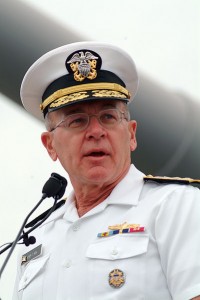
When organizational cultures value people, they achieve higher rates of employee engagement and retention.  They also benefit from stronger employer brand (as the word spreads that they value people) and tighter strategic alignment (when employees who feel valued want to advance the organization’s interests).  I just wrote a post about this topic for the Human Capital Institute’s blog. In the post, I tell the story of how Admiral Vern Clark, Chief of Naval Operations (CNO) for the U.S. Navy, increased the element of Human Value in the Navy’s culture and the effect it had on first term reenlistment rates. You can read more about it
at this link or below.

Out-behave Your Competitors

John Wooden, the legendary UCLA basketball coach, once said character is more important than reputation because reputation is who people think you are but character is who you really are.  Last night at a packed event in Manhattan I heard LRN’s Dov Seidman make the case that in a connected world “how” we do what we do is every bit as important as what we do.  In other words, with everyone able to blog, take pictures or shoot video of you on their phones then upload the content on the world wide web (that becomes easily accessible via Google), an organization’s character (or “how” an organization does what it does) has become much, much more important.   Dov went even further and said that wise organizations will out-behave their competitors to gain a competitive advantage.

Following are some points I wrote down during the discussion Dov Seidman had with New York Times columnist Tom Friedman:

Historically we never imputed character to an organization but in a flat, connected world we can.

Today you can’t manage your reputation as you could in the past. You must earn it.

New leaders know you can’t have power over people.  Today you can only have power through people.

Out-behave is not presently a word in the dictionary.  Dov encouraged the audience to help change that.

The paradox of success.  When you pursue success, happiness eludes you.  When you pursue significance, you discover happiness.

I’ve been working on an article about Wall Street entitled “Goldman Is Great, But Is It Good?”  The article explores what it would take to make a better, healthier, more effective Wall Street.  Many of Dov’s ideas about getting the “hows” right are germaine to Wall Street’s future.

What do you think?  Has the internet made corporate character more important?  Should organizations strive to out-behave their competitors?

Michael Lee Stallard speaks, teaches and writes about leadership, employee engagement, productivity and innovation at leading organizations including Google, GE, NASA, Lockheed Martin, General Dynamics and the Darden Graduate School of Business at the University of Virginia. Most recently, Michael and his colleague Jason Pankau filmed a 90-minute program for Linkage’s Thought Leaders Series that will be released in January of 2010. Michael wrote the guest editorial for Talent Management magazine’s January 2010 edition and last month his article on how the force of connection boosts productivity and innovation was featured as the lead article in the UK’s Developing HR Strategy Journal. Click on these links to learn more about Michael and Jason in the media and their speaking engagements.

What’s Your Work “Experience of a Lifetime”?

IMG_0449This is the mother ship, or at least that’s what I’ve always called the world headquarters of Morgan Stanley located in New York City’s Times Square. It was here that a significant moment in Wall Street history occurred on June 30, 2005. John Mack had been reinstated as Chairman and CEO by the firm’s board. On that day, when Mack and his wife Christy appeared at a meeting with hundreds of Morgan Stanley employees, they gave him a standing ovation. They knew this was an inflection point in the storied firm’s history. The man standing before them embodied their collective hopes that the firm would return to its former self by restoring a culture that was its greatest asset and the primary source of its competitive advantage.

Mack’s departure in early 2001 had come about as a result of Morgan Stanley’s merger with Dean Witter in 1997. Phil Purcell, Dean Witter’s CEO, became CEO of the combined firm and eventually pushed Mack out. Morgan Stanley’s reputation and culture suffered as a result of Purcell’s leadership style. I experienced the culture change first-hand. The book Blue Blood and Mutiny: The Fight for the Soul of Morgan Stanley describes this period in great detail and Joe Nocera of The New York Times wrote an excellent article about it entitled “In Business, Tough Bosses Are the Ones Who Finish Last.” Thanks to the vocal opposition to Purcell put up by former and current employees of Morgan Stanley, he was thrown out.

My introduction to Morgan Stanley came in 1996 when it purchased Van Kampen Investments where I worked reporting to the firm’s president and heading business and product development. As part of the team to integrate Van Kampen into Morgan Stanley, I commuted weekly to New York for a period of time. I was also part of a joint project to assess business opportunities in Japan. In 1998, I accepted  an offer to become chief marketing officer for Morgan Stanley’s Private Wealth Management Group. I was slightly apprehensive about moving to New York and joining this firm whose employees were known for their blue blood pedigrees. After all, I had grown up in the industrial town of Rockford, Illinois; my grandfathers had worked for a coal mine in the Appalachians; and I was the first in my family to go to college. I was intolerant of any hint of favoritism based on privilege rather than merit. I would soon learn that my concerns were unfounded.

Morgan Stanley was born as a result of the Great Depression. In 1934, the federal government forced the separation of investment banking and commercial banking pursuant to the Glass-Steagall Act and J.P. Morgan became two separate firms: J.P. Morgan and Company retained the commercial bank business and Morgan Stanley was created for the investment banking business. Both firms kept the values that J.P. Morgan himself summarized as doing first class business in a first class way.

From all I could see, this accurately described Morgan Stanley’s cultural DNA. The firm prized its reputation as first class. People at Morgan Stanley worked hard, were for the most part honest, and were typically engaged in philanthropic endeavors to help make the world a better place. Those who didn’t share the firm’s values weren’t considered to be “one of us” and they were thrown out if they lied, cheated or stole, or respectfully guided out if they didn’t live up to the firm’s standards of excellence. For me, Morgan Stanley’s values reflected my own and I was thrilled to be there and work alongside such outstanding colleagues.

The values that Morgan Stanley’s culture embodied included excellence in its every endeavor; open and, for the most part, civil debate on issues; and meritocracy in pay and promotions. It was a partnership culture in the very best sense and it had remained that way even after it converted from a legal partnership to become a publicly owned corporation in 1986. The energy and enthusiasm at Morgan Stanley was off the charts. I thought I had died and gone to heaven. My boss, John Straus, the head of Private Wealth Management, gave me the autonomy I needed to lead my department and get the job done. His door was always open when I needed his guidance or help navigating the politics that is part of every large firm. No one worked harder than John. My colleagues and I were inspired by his passion to create something great. I challenged the people I was responsible for leading to help Private Wealth Management reach its first billion dollar revenue year in history, a goal that we achieved  two and a half years later. It was one the best experiences in my professional life. Working at Morgan Stanley during those years was for me an experience of a lifetime.

Over time, as Phil Purcell and his loyalists exerted their control, that highly engaging environment soured. Former Morgan Stanley employees left in droves. John Straus left and, some months later, I did too. The experience was so eye-opening and disappointing to me that it was one of the catalysts for me to write the book Fired Up or Burned Out: How to Reignite Your Team’s Passion, Creativity and Productivity.

I’ve given a lot of thought to what made Morgan Stanley so successful. I know it was the firm’s people and culture. People were fired up because they worked in a Connection Culture. Another way to describe Morgan Stanley’s culture is that it was, as I wrote earlier, a partnership culture. David Sirota describes a partnership culture in his excellent book that I highly recommend entitled The Enthusiastic Employee and in this interview he did with Knowledge@Wharton.

How about you? Have you been a part of a Connection Culture or Partnership Culture where you felt connected to the firm’s mission, values, reputation, your colleagues and your day-to-day work? If so, what fired you up about it? I would like to hear about your work “experience of a lifetime.” Just post it in the comment section below.

(Note: on January 1st, 2010 James Gorman will succeed the retiring John Mack as Morgan Stanley’s CEO. John Mack will continue to be the firm’s chairman. To John Mack, I would like to say thank you for your leadership. And to James Gorman, congratulations and best wishes. Lead Morgan Stanley in a way that reflects the mindset of its founder who said  “…at all times the idea of doing only first-class business, and that in a first class way, has been before our minds.”  MLS)

Michael Lee Stallard speaks, teaches and writes about leadership, employee engagement, productivity and innovation at leading organizations including Google, GE, NASA, Lockheed Martin, General Dynamics and the Darden Graduate School of Business at the University of Virginia.  Most recently, Michael and his colleague Jason Pankau filmed a 90-minute program for Linkage’s Thought Leaders Series that will be released in January of 2010.  Michael wrote the guest editorial for Talent Management magazine’s January 2010 edition and last month his article on how the force of connection boosts productivity and innovation was featured as the lead article in the UK’s Developing HR Strategy Journal. Click on these links to learn more about Michael and Jason in the media and their speaking engagements.


Can the Force of Connection Save this College?

Buck Smith, a 74-year-old, grandfatherly man, is leading a remarkable turnaround at Davis & Elkins College, a small liberal arts school in West Virginia, one of America’s poorest states.  Key to Smith’s strategy is strengthening the connection among everyone who is part of the college community.  Check out Buck Smith’s story in an inspiring and enlightening article that appeared in The Chronicle of Higher Eduction entitled “Turnaround President Makes the Most of His College’s Small Size.”  As you read the article, look for the three elements of a connection culture: Vision (Inspiring Identity), Value (Human Value) and Voice (Knowledge Flow).  For those of you who are unfamiliar with Connection Cultures, read the free, downloadable Connection Culture Manifesto published by changethis.com and available at this link.

Thanks to Dr. Al Bowman, president of Illinois State University, for sharing this article with me.  Dr. Bowman is another college president who is leading a turnaround.   I’ll be writing about it soon.  Stay tuned.

The Blind Side

I highly recommend seeing The Blind Side, a movie about Baltimore Ravens’ offensive tackle, Michael Oher.  It’s worth the price of the ticket alone to see Sandra Bullock’s tour-de-force performance as Michael’s adoptive mom, Leanne Tuohy.  What I especially like about the movie is that it shows how the right social environment helps people thrive in life.

I don’t want to give away the story so let me just say in a nutshell that it was Leanne Tuohy who reached out to Michael.  It would have been easy for her to ignore him, but she didn’t. Instead, Leanne felt compassion for a young man who was wearing shorts in the winter and hanging around a high school gym just to stay warm.  She took the time to get to know him and his life’s story.  While others saw him as “Big Mike,” a quiet, giant, African-American young man from the Memphis ghetto, Leanne Tuohy saw him as a thoughtful boy with a big heart and protective instincts to match.  She called him “Michael,” a name he much preferred to “Big Mike.” Leanne’s insights helped Michael discover who he really was deep down inside and who he could become. These insights helped Michael see himself as a protector who “has the back” of his family and those he loves. It should come as no surprise then to learn that Michael Oher thrived in football as an offensive tackle responsible for protecting his teammates from the defense.

The Blind Side shows how the social environment we live in shapes us for good or ill.

Employee Engagement Conferences

On October 26-28, I’ll be the chairperson for the Human Capital Institute’s Employee Engagement Conference in Boston, Massachusetts.  HCI has lined up some great speakers for the event. I hope you’ll check it out and join us.

As a reminder, another great conference on employee engagement will be held in Chicago on October 14. “Think Tank” is sponsored by the Forum for Performance Management and Measurement, the research center for the Medill Integrated Marketing Communications program at Northwestern University’s Medill School of Journalism. At this conference, I’ll be giving a keynote speech on the links between leadership, employee engagement, productivity and innovation. You can learn more about the program by clicking on employee engagement.

Employee Engagement: Assessing the Evidence

Frequently I’m asked if I can produce research that proves employee engagement affects economic profits.  My answer: social science research can’t prove it with certainty but the sheer amount of evidence makes it “beyond a reasonable doubt” that some causation exists.  The challenge with social science research is that it’s impossible to isolate the effect of one factor.  To get a sense for some of the supporting research, take a look at these links to research summaries from Winning Workplaces and DDI (see “Building the Business Case” on pages 5-6).

Leadership Speaker for ASTD and Linkage

I’m thrilled to announce that I’ll be speaking for two of the world’s leading organizations in the training and development field. On July 23rd I’ll be speaking about how Connection Cultures relate to leadership, employee engagement, productivity and innovation in an hour long presentation via Webex to members of ASTD (the American Society for Training and Development).  ASTD is the world’s largest association dedicated to workplace learning and performance professionals with 80,000 members from more than 100 countries. 

On December 10, I will be at the headquarters of Linkage Corporation near Boston to record an 90 minute presentation on Connection Cultures that will be made available on demand to Linkage clients.  Linkage is a global organizational development company that specializes in leadership development.   More than 200,000 leaders and managers have attended Linkage programs since 1998.