Jason Pankau and I are presenting a 60 minute webinar for Communitelligence about the “Connection Edge” that leaders such as Steve Jobs, Ed Catmull and A.G. Lafley employ to boost strategic alignment and employee engagement. The 60 minute webinar will be held on June 9 at 2:00 PM Eastern. You can sign up at this link. Use the promotion code “smallbiz” to receive a $100 discount.
Sustainable Organizations: The Ideas of Martin Seligman
In an earlier post, I wrote that the ideas of thought-leader Dov Seidman, CEO of LRN and author of How, are likely to have a profound effect on organizations in the years to come. In this second post on thought leaders affecting the evolution of organizations, I highlight the work of Martin Seligman.
Seligman, a psychology professor at the University of Pennsylvania, founded the positive psychology movement when he became president of the American Psychological Association. There isn’t adequate space in this post to provide an overview of positive psychology, so for those who are interested in learning more, I highly recommend reading an article co-authored by Seligman entitled “Positive Psychology: An Introduction” and a New York Times’ Magazine article entitled “Happiness 101” that describes how the positive psychology movement is growing.
Positive psychology has identified 24 character strengths that it believes — and a growing body of research shows — affect human flourishing. These character strengths are universal. Religious thinkers and moral philosophers throughout the ages have advocated them. Political, social and economic cultures that have been sustained for long periods of time have these values and systems that don’t (i.e. coercive utopian systems such as communism and fascism), fail because the values they promote work against human flourishing.
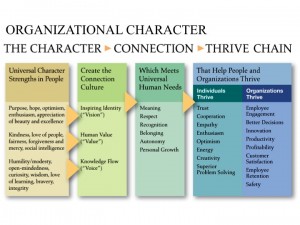
Our research at E Pluribus Partners identified a “Character > Connection > Thrive Chain” (see below) that posits organizations and individuals thrive because they are comprised of people who embrace and behave in ways that reflect the character strengths and in doing so create “Connection Cultures” which meet universal human needs such as meaning, respect, recognition, belonging, autonomy and personal growth. Learn more about positive psychology and the Character >Connection>Thrive Chain on pages 116-130 of the free digital book download of Fired Up or Burned Out.
Recent research from The Conference Board and the Corporate Executive Board make it clear that employee engagement is at dismal levels but eventually leaders will discover that embracing and behaving in ways that reflect the 24 character strengths creates Connection Cultures and develops the corporate character strengths necessary to produce sustainable organizations.
(To enlarge the diagram below, click on it once until it appears then click on it a second time for an enlarged version.)
StrategyDriven Podcast: Employee Engagement
Recently I was a guest on the StrategyDriven podcast with host Nathan Ives. We discussed leadership, employee engagement, productivity and innovation. You can hear the podcast at this link.
Leaders of the New Century
On June 23, I’ll be filming a few video segments for the Leader to Leader Institute’s “Leaders of the New Century” project that includes Allan Mulally of Ford, Sir Richard Branson and Tony Hseih of Zappos. Next week the Summer edition of the Leader to Leader Journal comes out. It includes an article that Jason Pankau and I wrote entitled “To Boost Productivity and Innovation, Connect with the Core.” The article is about how great leaders don’t just focus on star performers, they are intentional about connecting with employees at large. Examples in the article include Ret. U.S. Chief of Navy Operations Admiral Vern Clark and Bono, the lead singer for the rock band U2.
Summer: A Season to Connect
Summer is an excellent time to be intentional about strengthening the relationships in your life, including your relationships at work. Think about the people you need to have good relationships with to perform your job well (I call these “Critical Connections”) then consider the present state of each relationship. If some of these Critical Connection relationships are not strong, you need to take action to strengthen them.
Once you’ve identified your Critical Connection priorities, spend time with these individuals over meals or coffee. Ask them questions unrelated to work so that you get to know them as human beings. Asking questions of another human being, then listening carefully to their reply so that you can understand and empathize with them, demonstrates that you value them as human beings. Understanding and empathy reflect the essence of connection.
Here are are a few questions to consider asking when you meet with your Critical Connections:
Where did you grow up?
What are your interests outside of work?
What are your favorite movies and television shows?
What are you favorite books?
Who are your favorite musicians?
Who are your heroes?
Where did you go to college and what did you study?
What events in your life shaped you as a person?
Who has had the greatest impact on your life and why?
What is the best advice you received?
These questions should give you plenty to talk about and help you strengthen your connection with the people you rely on at work.
SkillSoft to Film Videos on Employee Engagement, Strategic Alignment

This summer I will be filming training videos on employee engagement, strategic alignment, productivity and innovation for SkillSoft, the largest public company in the world that is solely focused on e-learning. Skillsoft has 10 million licensed users that represent 55 percent of the Fortune 500 and 24 percent of the Global 2000 organizations in business, government, and education. Jason Pankau and I are excited about this opportunity to work with yet another world-class partner to take our work and ideas on The Connection Culture from our book Fired Up or Burned Out to a new audience.
Organizations today are in desperate need of improving employee engagement and strategic alignment. The Conference Board released a report in January 2010 saying its research showed employee engagement is at its lowest point since the organization began surveying. Another well-repected organization, The Corporate Executive Board, released research last year that showed 90 percent of employees are either not engaged and giving their best efforts or they are not aligned with organizational goals.
“Interpersonal Connectedness” One Factor in Metric to Replace GDP
There is a movement to replace GDP as a statistical measure of national success and well-being. In “The Rise and Fall of GDP,” that appeared in The New York Times Magazine, Jon Gertner describes this effort. Gertner writes about the U.S. Government Accountability Office (GAO) developing a “key national indicators” system that will be available online. (Last year I spoke at the GAO’s headquarters in Washington, D.C. about The Connection Culture: A New Source of Competitive Advantage.) The article goes on to say that “interpersonal connectedness” is one of the components being considered.
Including connection as a component in a measure of national success would be wise. What’s measured is what gets done. David Brooks, also of The New York Times, effectively supports my view. He argued in “The Limits of Policy,” that it would be wise for government leaders to “try to use policy to strengthen relationships.”
What Are “Sustainable Values”?
In my last post, I wrote about “sustainable values,” i.e. the beliefs and behaviors that produce an inspiring identity, human value and knowledge flow in groups that help people thrive individually and collectively. In other words, when a group embraces and behaves in ways that are consistent with sustainable values, it leads to sustainable superior performance.
In our work, we recommend that leaders of organizations promote the universal character values celebrated by religious thinkers and moral philosophers throughout history. Cultures that have these values exhibit superior strategic alignment, employee engagement, productivity, innovation and overall performance. Researchers that are part of the American Psychological Association’s positive psychology research effort identified these values as helping people flourish and a body of large body research is developing in support of that view. Here’s a list of the values and their definitions:
Tom Friedman, Dov Seidman: Need For “Sustainable Values”
Check out Tom Friedman’s column in today’s New York Times at this link. Friedman cites Dov Siedman’s belief that in an interconnected world we need “sustainable values” more than ever. I couldn’t agree more. In past posts I’ve written about Dov, his book entitled How and LRN, the company he founded to promote principled leadership.
In our work at E Pluribus Partners, we promote universal character values and virtue as essential for people to thrive, individually and collectively. Our “Character > Connection > Thrive Model” (see below) lays out the rationale. In a nutshell, individuals who believe and behave in ways that are consistent with Universal Character Values (also known as character strengths), create “Connection Cultures” that meet universal human needs to thrive. You can learn more about Connection Cultures, Universal Character Strengths and Virtues by reading this free manifesto published by changethis.com entitled The Connection Culture: A New Source of Competitive Advantage.
Webinar: Jobs, Catmull, Lafley Have the “Connection Edge”
Jason Pankau and I are presenting a 60 minute webinar for Communitelligence about the “Connection Edge” that leaders such as Steve Jobs, Ed Catmull and A.G. Lafley employ to boost strategic alignment and employee engagement. The webinar will be held on June 9 at 2:00 PM Eastern. You can sign up at this link.