In an earlier post, I wrote that the ideas of thought-leader Dov Seidman, CEO of LRN and author of How, are likely to have a profound effect on organizations in the years to come. In this second post on thought leaders affecting the evolution of organizations, I highlight the work of Martin Seligman.
Seligman, a psychology professor at the University of Pennsylvania, founded the positive psychology movement when he became president of the American Psychological Association. There isn’t adequate space in this post to provide an overview of positive psychology, so for those who are interested in learning more, I highly recommend reading an article co-authored by Seligman entitled “Positive Psychology: An Introduction” and a New York Times’ Magazine article entitled “Happiness 101” that describes how the positive psychology movement is growing.
Positive psychology has identified 24 character strengths that it believes — and a growing body of research shows — affect human flourishing. These character strengths are universal. Religious thinkers and moral philosophers throughout the ages have advocated them. Political, social and economic cultures that have been sustained for long periods of time have these values and systems that don’t (i.e. coercive utopian systems such as communism and fascism), fail because the values they promote work against human flourishing.
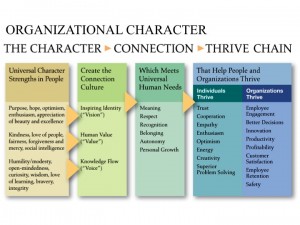
Our research at E Pluribus Partners identified a “Character > Connection > Thrive Chain” (see below) that posits organizations and individuals thrive because they are comprised of people who embrace and behave in ways that reflect the character strengths and in doing so create “Connection Cultures” which meet universal human needs such as meaning, respect, recognition, belonging, autonomy and personal growth. Learn more about positive psychology and the Character >Connection>Thrive Chain on pages 116-130 of the free digital book download of Fired Up or Burned Out.
Recent research from The Conference Board and the Corporate Executive Board make it clear that employee engagement is at dismal levels but eventually leaders will discover that embracing and behaving in ways that reflect the 24 character strengths creates Connection Cultures and develops the corporate character strengths necessary to produce sustainable organizations.
(To enlarge the diagram below, click on it once until it appears then click on it a second time for an enlarged version.)