Honoring Dr. King: When U2 Wouldn’t Back Down

All that is necessary for evil to triumph is for good men to do nothing.

– Attributed to Edmund Burke

In honor of the Reverend, Dr. Martin Luther King, Jr., I’m posting an article I wrote that was published in The Economic Times in India and in the American Management Association’s Moving Ahead.  The article in part describes the time before a concert in Arizona when U2 received a letter that stated Bono, the band’s lead singer, would be killed if the band played the song Pride, which honors the life and legacy of the Rev. Dr. Martin Luther King, Jr.  The FBI told U2 it believed the threat was not a hoax.

Although I don’t know for certain, I suspect that Bono reflected on Dr. King’s choice to speak out in the face of death threats.  Dr. King had the courage of his convictions and was willing to risk death to push back the evils of prejudice.  Now, Bono had to decide if he too was willing to speak out against evil and risk death because of it.

The Indifferent Workplace

Recent research from the Corporate Advisory Board shows that 90 percent of employees are not engaged or their behavior is not aligned with organizational goals. Certainly, the recession and layoffs have contributed to this state of malaise in the workplace. It’s not the only cause, however. Jealousies, personal rivalries, silo behavior, and incivility have also harmed the spirits of people at work. The primary culprit, I believe, is indifference.

The Indifferent Workplace is one where people are so busy attending to tasks that they largely ignore one another. The predominant attitude in the Indifferent Workplace is that work is work and my real life is outside of work. Never shall the two meet. To adopt this mindset is to compartmentalize one’s life. Humanity is relegated to life outside of work. Work is all task. The problem is that life goes on at work too. We spend much of our waking hours at work. Recent neuroscience research shows that the environment we live in affects us down to the gene transcription level. For good or ill, we pass these changes on to our progeny. If our work environment doesn’t have meaning and healthy social interaction where we get to know the people we work with as human beings, rather than always interacting with them as human doings, it has a negative effect on our physical and mental health as well as our performance.

This year, I want you to join me in pushing back the forces of indifference at work. When you pass people in a hallway or see them in an elevator, make eye contact and say hello. Purchase a notebook and write down the names of the people you most frequently come in contact with at work. Periodically ask each person to go to lunch or meet you for coffee. Learn where they were born and grew up, what their interests are outside of work, who they admire and what movies, music and television shows they like and why? Also learn how you can help them. Write what you learn about them in your notebook and it will help you remember. If they are facing a difficult time in life, reach out to help or encourage them in some way. Send them a note or do something to delight them. One of my favorites is a gift card to Starbucks or something fun like a package of Ben and Jerry’s ice creams ordered through www.icecreamsource.com (they arrive in a box with dry ice).

As human beings the busyness of life can make us drift toward indifference. For that reason, we must be intentional about valuing people and fighting the creeping forces of indifference. Left unopposed, indifference breeds dehumanization, incivility and violence. Finally, I encourage you to read or listen to Holocaust survivor and Nobel Laureate Elie Wiesel’s speech “The Perils of Indifference.” It provides insight about indifference from one who has witnessed it at its extreme, felt it’s sting and thoughtfully reflected on its nature and dangers.

Strengthen Employee Brand, Employee Engagement, Employee Retention and Strategic Alignment

401px-CNO-Vern-Clark-2005


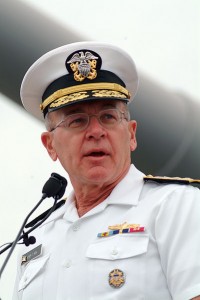
When organizational cultures value people, they achieve higher rates of employee engagement and retention.  They also benefit from stronger employer brand (as the word spreads that they value people) and tighter strategic alignment (when employees who feel valued want to advance the organization’s interests).  I just wrote a post about this topic for the Human Capital Institute’s blog. In the post, I tell the story of how Admiral Vern Clark, Chief of Naval Operations (CNO) for the U.S. Navy, increased the element of Human Value in the Navy’s culture and the effect it had on first term reenlistment rates. You can read more about it
at this link or below.

Community Celebrations

DSC_0085


Connection and community are strengthened by celebrations.  Yesterday, I attended a community celebration of sorts, the Fiesta Bowl Parade in Phoenix, where my daughter Sarah (third from the left in the above picture) participated as a cheerleader for TCU.  Arizona Republic reporter Connie Sexton and I spoke about the importance of community celebrations, which she mentioned in her article entitled “
Fiesta Bowl Parade Lifts Spirits.”

Connecting Up: Our Need for Transcendence

What do many scientists at NASA and engineers at Google have in common with a doorman at Memorial Sloan-Kettering Cancer Center (MSKCC)?  The answer: they are fired up about the importance of their work and have a passion and energy that drives them to be a force for the cause.  Employees at NASA are fired up that they are exploring space.  Google employees are fired up because they are organizing information and making it accessible to the world.  I learned  this when I met employees at NASA and Google.   I spoke at both organizations earlier this year.

The doorman I refer to at MSKCC is named Nick.  When my wife Katie and I were walking down 53rd street in NYC in 2004 and we got within eyesight of the MSKCC  entrance, Nick locked his eyes on her and greeted her like a returning friend.  This in in Mid-town Manhattan where no one makes eye contact! Nick knows cancer patients when he sees them, probably from the wigs they wear.   It felt like the healing began within eyesight of MSKCC.

Katie was at MSKCC for high dosage chemo treatments she needed to treat advanced ovarian cancer.  Late last year her oncologist told her it that given favorable test results and five years in remission it was unlikely she would have a recurrence.  Words can’t express how overjoyed we were to hear that news. When we told Nick, he gave Katie a big hug and said how proud he was that she persevered.  We learned that Nick was a cancer survivor too and he attributed his survival to the treatments he received at MSKCC.  Is it any wonder then that this man is so passionate about his work at MSKCC.  You have to see Nick to believe it and you can if you stop by MSKCC’s entrance on 53rd Street across the street from the Citigroup building.  He’s a big guy with a dar complexion and blue eyes. Tell Nick you read about him.  Don’t worry that it may seem strange.  Former cancer patients and their family members regularly stop by to say hello to Nick. That’s how beloved he is.

Nick’s example shows that people are fired up if their work reflects the eternal values of the transcendent: truth, beauty and goodness.  MSKCC’s work reflects goodness and is expressed in it’s tagline “The Best Cancer Care, Anywhere.”  Apple’s passion for the aesthetic design and ease of use of its products reflects beauty. Work in the fields of journalism, research, theology and the academy reflect truth-seeking.

Truth, beauty and goodness are eternal values that reflect transcendence.  Human beings need the truth, beauty and goodness of transcendence to meet our need for meaning in life.  If you can find time over the holidays, reflect on the need for the transcendent values of truth, beauty and goodness in your own life. Below are links to some of my favorite essays, speeches and articles that touch on transcendence. Let me encourage you to print them out, read them and consider their relevance to your life and the lives of those you love.  

HR: Order Takers or Game Changers?

The best HR leaders are game changers.  They develop conviction about what constitutes a high-performance work culture. They are a force that helps develop the values and processes necessary to make a high-performance work culture come to life.  The departments they run are NOT staffed with the type of order-takers Keith Hammonds described in his wildly popular Fast Company article entitled “Why We Hate HR.”

I recently wrote an article that describes a game changing strategy HR leaders should consider in light of today’s widespread employee disengagement.  The article was just published as the lead article in the UK’s Developing HR Strategy journal.  It’s entitled, “The Force of Connection: Boost Employee Engagement, Productivity and Innovation.”  You can download it at this link.

Obama Leads Learning Organization

In this morning’s New York Times, David Brooks in his column entitled “The Analytic Mode,” argues that President Obama leads a learning organization.  I completely agree.  In the past I’ve argued that President Obama is an intentional connector in part because he is a bridge builder who accords respect to his political opponents and because he solicits the ideas and opinions of his advisors then considers them before making decisions.  This leadership approach creates Connection Cultures that keep members of his administration feeling connected so that they give their best efforts, align their behavior with organizational goals and take the risk to communicate information, especially information the president may not want to hear but needs to hears. President Obama might also be described as an “integrative thinker” who employs a “design thinking” approach.  What do you think?

Here are links to resources that will help you consider the wisdom of President Obama’s approach in general and specifically with respect to the decision to commit additional troops to Afghanistan.

David Brook’s NY Times column entitled  “The Analtytic Mode

Speech I recently gave at Google on Connection Cultures and the “The Force of Connection

Dean Roger Martin of The University of Toronto’s Rotman School of Management on the Integrative Thinker and Design Thinking

For some perspective on a president’s decision to increase troops, listen to this Bill Moyer’s program that includes taped conversations President Johnson had with his advisors prior to committing troops to Vietnam.

Free Slide Presentation Download

This week I spoke in Toronto as part of Rotman School of Management’s Leadership Experts Series and Jason Pankau and I spoke at Northwestern University’s Forum for People Performance Management and Measurement in Chicago.   The presentations addressed leadership, employee engagement, productivity and innovation.  Above is free download of our slides from the Northwestern presentation.

HSM: Enabling Mosaic Thinking at #WBF09

Chagall Mosaic Chicago


Today I’m attending day 2 of the World Business Forum at Radio City Music Hall in NYC at the invitation of HSM, the forum’s sponsor.  I’ve joined a list of leading bloggers (see below) who are covering the forum.  I’m a big fan of this event because it exposes me to a broad diversity of people and ideas.  The speakers are certainly interesting. Every bit as thought-provoking are the conversations I’ve had with fellow bloggers and forum attendees.   These individuals are mostly from the U.S. although I’ve met several who came from abroad.  They come with differing interests, experiences, perspectives, thinking styles and temperaments.  Reading the bloggers posts and interacting with them inevitably helps me see new perspectives.  I encourage you to check out their blogs at the links below.

Being intentional about seeking out the opinions and ideas of others outside your present social networks is wise.  Opportunities and problems, especially complex ones, are like mosaics.  The more tiles you see in the mosaic, the greater likelihood you will integrate the tiles into patterns.  When patterns emerge it increases the probability of innovative thinking and optimal decision-making.  I keep an image of the Chagall mosaic (above) on my MacBook Pro desktop to remind me to be intentional about regularly interacting with people outside my own social networks. To do so is to immerse yourself into a rich and robust marketplace of ideas.

Links to World Business Forum Bloggers:

Free Download for GAO

Today I’m speaking at the U.S. Government Accountability Office (GAO) in Washington, DC.  The GAO is known as “the investigative arm of Congress” and “the congressional watchdog.” It supports the U.S. Congress in meeting its constitutional responsibilities and helps improve the performance and accountability of the federal government for the benefit of the American people.  (Note: The free download was open for two days which has now expired.)