

This month’s Leadership Carnival is hosted by Chris Young at MaximizingPossibility.com. It includes favorite blog posts from leadership bloggers. It’s a terrific group of leadership thinkers and I encourage you to check it out. Below is Chris’ post on the June Leadership Carnival.
Category Archives: Uncategorized
The Role of Business in the Pursuit of Happiness
Delivering Happiness is the rare book that gives us an inside look at one individual’s journey to find happiness and as a leader in business. Tony Hsieh, the CEO of Zappos, has written a thoughtful account of what he has learned from experiences in life, in business and from his studies of the fast growing field of positive psychology.
I highly recommend this book to leaders and others who want to see what an engaging work environment — or “Connection Culture” as I’ve described it in my writings — looks like. Not only will you learn about Hsieh’s thinking, you’ll see how he puts ideas into action.
Research: Employee Engagement = Connections

This month Jason Pankau and I will be speaking to leaders at NASA’s Johnson Space Center, Johnson & Johnson, the Internal Revenue Service and to church leaders at LifeSpring Network’s Conference on Connection Culture & Discipleship.
In recent presentations, we’ve emphasized the importance of research from The Conference Board that concluded after studying 30 definitions of employee engagement used by consulting firms, the best definition is as follows:
“Employee engagement is a heightened emotional and intellectual connection that an employee has for his/her job, organization, manager, or coworkers that, in turn, influences him/her to apply additional discretionary effort to his/her work.”
This definition is consistent with our research at E Pluribus Partners where we frequently heard respondents use the terms “connect” or “feel connected” to describe the emotions they experience in relation to their organization’s identity, the people they work with and their day-to-day work.
In our book Fired Up or Burned Out and in The Connection Culture Manifesto, we identify and describe the “force of connection” as
“a bond based on shared identity, empathy and understanding that moves self-centered individuals toward group-centered membership.”
After defining connection, we identify the “Connection Culture” as an environment producing emotional and rational connections that, as The Conference Board’s definition says, “influences [people] to apply discretionary effort to [their] work.”
The Connection Culture meets universal human needs for respect, recognition, belonging, autonomy, personal growth and meaning. When these needs are met, people thrive individually and collectively. The Connection Culture is ultimately grounded in character strengths and virtues. Learn more by reading the manifesto or go even deeper by reading our book. For the latest developments and examples about how to boost connection, stay tuned to blog posts here and consider following my tweets on www.twitter.com/michaelstallard.
Sustainable Organizations: The Ideas of Martin Seligman
In an earlier post, I wrote that the ideas of thought-leader Dov Seidman, CEO of LRN and author of How, are likely to have a profound effect on organizations in the years to come. In this second post on thought leaders affecting the evolution of organizations, I highlight the work of Martin Seligman.
Seligman, a psychology professor at the University of Pennsylvania, founded the positive psychology movement when he became president of the American Psychological Association. There isn’t adequate space in this post to provide an overview of positive psychology, so for those who are interested in learning more, I highly recommend reading an article co-authored by Seligman entitled “Positive Psychology: An Introduction” and a New York Times’ Magazine article entitled “Happiness 101” that describes how the positive psychology movement is growing.
Positive psychology has identified 24 character strengths that it believes — and a growing body of research shows — affect human flourishing. These character strengths are universal. Religious thinkers and moral philosophers throughout the ages have advocated them. Political, social and economic cultures that have been sustained for long periods of time have these values and systems that don’t (i.e. coercive utopian systems such as communism and fascism), fail because the values they promote work against human flourishing.
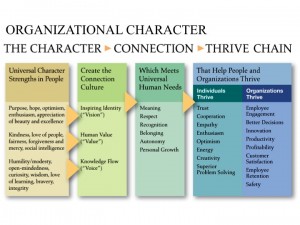
Our research at E Pluribus Partners identified a “Character > Connection > Thrive Chain” (see below) that posits organizations and individuals thrive because they are comprised of people who embrace and behave in ways that reflect the character strengths and in doing so create “Connection Cultures” which meet universal human needs such as meaning, respect, recognition, belonging, autonomy and personal growth. Learn more about positive psychology and the Character >Connection>Thrive Chain on pages 116-130 of the free digital book download of Fired Up or Burned Out.
Recent research from The Conference Board and the Corporate Executive Board make it clear that employee engagement is at dismal levels but eventually leaders will discover that embracing and behaving in ways that reflect the 24 character strengths creates Connection Cultures and develops the corporate character strengths necessary to produce sustainable organizations.
(To enlarge the diagram below, click on it once until it appears then click on it a second time for an enlarged version.)
StrategyDriven Podcast: Employee Engagement
Recently I was a guest on the StrategyDriven podcast with host Nathan Ives. We discussed leadership, employee engagement, productivity and innovation. You can hear the podcast at this link.
SkillSoft to Film Videos on Employee Engagement, Strategic Alignment

This summer I will be filming training videos on employee engagement, strategic alignment, productivity and innovation for SkillSoft, the largest public company in the world that is solely focused on e-learning. Skillsoft has 10 million licensed users that represent 55 percent of the Fortune 500 and 24 percent of the Global 2000 organizations in business, government, and education. Jason Pankau and I are excited about this opportunity to work with yet another world-class partner to take our work and ideas on The Connection Culture from our book Fired Up or Burned Out to a new audience.
Organizations today are in desperate need of improving employee engagement and strategic alignment. The Conference Board released a report in January 2010 saying its research showed employee engagement is at its lowest point since the organization began surveying. Another well-repected organization, The Corporate Executive Board, released research last year that showed 90 percent of employees are either not engaged and giving their best efforts or they are not aligned with organizational goals.
Tom Friedman, Dov Seidman: Need For “Sustainable Values”
Check out Tom Friedman’s column in today’s New York Times at this link. Friedman cites Dov Siedman’s belief that in an interconnected world we need “sustainable values” more than ever. I couldn’t agree more. In past posts I’ve written about Dov, his book entitled How and LRN, the company he founded to promote principled leadership.
In our work at E Pluribus Partners, we promote universal character values and virtue as essential for people to thrive, individually and collectively. Our “Character > Connection > Thrive Model” (see below) lays out the rationale. In a nutshell, individuals who believe and behave in ways that are consistent with Universal Character Values (also known as character strengths), create “Connection Cultures” that meet universal human needs to thrive. You can learn more about Connection Cultures, Universal Character Strengths and Virtues by reading this free manifesto published by changethis.com entitled The Connection Culture: A New Source of Competitive Advantage.

Has SAS’s Jim Goodnight Cracked the Code On Corporate Culture?
On Friday, I was granted a private interview with Dr. Jim Goodnight, co-founder and CEO of SAS. We met in Atlanta during the Chick-fil-A Leadercast where 50,000 individuals participated live or via simulcast from locations around the world.
Goodnight, who has a Ph.D in statistics, founded SAS more than 30 years ago with colleagues from North Carolina State University. Today, SAS is on a roll having achieved an enviable long-term record of revenue and profit growth. The firm was named number 1 on Fortune’s “Best Places to Work” list for 2010. Harvard Business School named Goodnight as one of the “20th Century’s Great American Business Leaders.” He was also recently named one of “America’s 25 Most Fascinating Entrepreneurs” by Inc magazine.
During the Leadercast program and prior to my meeting with Goodnight, author Jim Collins interviewed him on stage. Collins has written about the Level 5 leaders who experienced a catalyst in their lives — death of a loved one, near death experience, religious conversion — that developed humility in their character and made them better leaders. Collins seemed to be looking for something similar in Goodnight to explain SAS’s benevolent corporate culture where the average work week is 35 hours and the bucolic SAS campus has nearly every employee perk imaginable. Despite Collins’ attempts to draw out Goodnight, he hit a dead end. Typical of Goodnight, he answered several of Collins’ questions with a “yes” or “no.” When Collins asked Goodnight why most SAS employees were given offices rather than the standard cubicles that the typical software company employee has, Goodnight replied tongue in cheek that if an employee were watching porn from the privacy of his office it would not be the problem that it would be if he were in a cubicle out in the open. The audience responded with tentative laughter. They weren’t quite sure what to make of Goodnight.
Like Collins, I have known and written about many great leaders who experienced adversity that made them better leaders. Goodnight is a different breed, a leader who by all accounts has not gone through a Level 5-type transformation and yet has at least in some respects cracked the code on corporate culture. For every job opening, SAS receives 100 or more resumes. Over a business cycle, SAS’s employee turnover in the low single digits is a fraction of the software industry’s that at times reaches into the mid-20 percent plus range.
My interview with Goodnight and some additional research led me to believe that Jim Goodnight is among the most important role models for leaders to emulate today. This week I’m working on an article that explains why. If you have thoughts about Jim Goodnight or SAS’s corporate culture that you would like to share, please post them here or email me at mstallard [at] epluribuspartners [dot] com.
What Steve Jobs, Ed Catmull and A.G. Lafley have in common
Jobs, Catmull and Lafley connect with employees of their respective organizations, although they do so in distinctly unique ways. This is the topic of a webinar Jason Pankau and I will be doing for Communitelligence. You can learn more about it at this link. This topic is relevant today because Corporate Executive Board research shows that 90 percent of employees are either not engaged and giving their best efforts or they are not aligned with their organization’s goals. Research by both The Conference Board and the Corporate Executive Board shows that the solution to this problem to develop the emotional and rational connections that employee have with their organization’s mission and values, supervisor, colleagues and day-to-day work tasks. In the webinar, Michael and Jason show how great leaders do this.
Winning Workplaces’ Article on Connection
Winning Workplaces just featured an article that Jason Pankau and I wrote in its April newsletter and on its website. The article is entitled “To Boost Productivity and Innovation, Fire Up the People You Lead.” Check out the article and the Winning Workplaces website, it has great ideas, many written by one of our favorite bloggers Mark Harbeke. Mark is Winning Workplaces’ Director of Content Development.