Summer: A Season to Connect

Summer is an excellent time to be intentional about strengthening the relationships in your life, including your relationships at work. Think about the people you need to have good relationships with to perform your job well (I call these “Critical Connections”) then consider the present state of each relationship.  If some of these Critical Connection relationships are not strong, you need to take action to strengthen them.

Once you’ve identified your Critical Connection priorities, spend time with these individuals over meals or coffee. Ask them questions unrelated to work so that you get to know them as human beings. Asking questions of another human being, then listening carefully to their reply so that you can understand and empathize with them, demonstrates that you value them as human beings. Understanding and empathy reflect the essence of connection.

Here are are a few questions to consider asking when you meet with your Critical Connections:

Where did you grow up?
What are your interests outside of work?
What are your favorite movies and television shows?
What are you favorite books?
Who are your favorite musicians?
Who are your heroes?
Where did you go to college and what did you study?
What events in your life shaped you as a person?
Who has had the greatest impact on your life and why?
What is the best advice you received?

These questions should give you plenty to talk about and help you strengthen your connection with the people you rely on at work.
Relationship Excellence: Chick-fil-A’s Competitive Edge

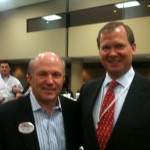
IMG_0924I just met and heard Chick-fil-A’s President Dan Cathy speak to a group at the Chick-fil-A Leadercast about values, faith, serving others and the competitive advantage of relationships.  It was an inspiring message and he is genuine and clearly passionate about the organization, its people, customers and what it represents.  Dan told the audience that he recently committed to his father, Chick-fil-A founder S. Truett Cathy, to keep the company private which will help preserve the values of this great organization.

Observing Dan speak, it’s clear that he connects with the employees of Chick-fil-A.  He spends more than half of his time on the road visiting stores and connecting with employees and customers.  He tells stories that move him and in so doing move the hearts of others.  He often uses objects that help people remember his points.  A large pepper grinder represents adding pepper to the customer’s experience by going the second mile to be friendly.  Chick-fil-A has won numerous awards for its exceptionally high level of customer service.

Sometimes when I hear corporate leaders talk I wonder if they walk the talk.  I’ve done some due diligence and feel highly confident that Chick-fil-A is the real deal.  Even my own mother who lives in Bristol, Virginia sings the praises of the local Chick-fil-A for their good people and positive influence on the local community.

In the coming weeks I’ll be interviewing Dan Cathy to learn more about his journey as a leader and his work at Chick-fil-A so stay tuned.

Micro-Connections Enhance Energy, Enthusiasm

Years ago when I lived in West Texas and worked for Texas Instruments, I was surprised that frequently when I passed another car on one of the long stretches of highway, the driver would wave at me.  People in that part of America typically make eye contact and say hello to passersby on the street.  If you did this in most large cities, especially in the Northern parts of America or coasts where I presently live (i.e. Greenwich, Connecticut), people would think you were strange.

Small actions to connect with people around you are called “Micro-Connections.”   These actions boost enthusiasm and energy in the work environment. Environments where people are friendly—where they make eye contact and say hello in hallways and elevators even thought they personally know one another well—are healthier and more pleasant environments.  Another type of micro-connector is asking questions that are unrelated to work to learn more about an individual.  Unrelated questions help us learn other people’s stories.  Micro-Connections treat people as human beings rather than human doings.  As Atul Gwande wrote in his book Better, asking questions unrelated to work “make the machine feel less like a machine.”

Little things can make a big difference.  Start trying these Micro-Connections out and watch what happens.Over time you will be energized and you’ll build trust and esprit de corps in your organization.

Employee Engagement, Connection in the Movie “Departures”

While looking for a video to watch a friend recommended Departures, a film by Yojiro Takita that won an Oscar for best foreign language film. I highly recommend it. The movie touches on issues of employee engagement, connection, identity and human value that I raise in my changethis.com Connection Culture Manifesto. There were moments that this film reminded me of the beautiful book Let Your Life Speak: Listening for the Voice of Vocation by Parker Palmer.

When you watch the film you’ll see a myriad of situations that relate to connection, including the protagonist Diago’s connection to his father, his wife, his employer, his former occupation and his new one, his clients, and his friends and acquaintances in the community.

Connection and the character values that support it resonate deeply with the Japanese, a topic that I will elaborate on in an upcoming blog post.

Duke Men’s Basketball’s Secret Weapon: The “Women K”

Duke men’s basketball team lead by Coach K are in The Final Four again.   What’s their secret?  According to Coach K, it’s what might be called the “Women K”: his wife Mickie and their three adult daughters.  Read all about it in this fabulous article entitled “Follow Me” written by Michael Sokolove that appeared in the February 2006 edition of Play magazine, a supplement of The New York Times.  If you read the article and Coach K’s books you’ll see that he clearly describes what we refer to as a Connection Culture, including its three elements: vision, value and voice.

Most leaders are intentional about developing task excellence but they are not intentional about developing relationship excellence.  Not Coach K.  Here are just a few of the quotes that appear in the article that show Coach K strives to develop relationship excellence via connection:

“Almost everything in leadership comes back to relationships”

“When he recruits a player, Krzyzewski tells him, ‘We’re developing a relationship here, and if you are not interested, tell me sooner rather than later.’  That word — relationship — os one he uses frequently.  [He tells players] ‘If you come here, for however long, you’re going to unpack your suitcase.  We’re going to form a bond, and you’re going to be part of this family.”

“Game day is not a day for long, drawn-out speeches.  It is a time for interaction.”

“There’s an empathetic part of leadership, and this is what my wife and daughters have taught me.

Chain of Connection: Leaders -> Employees -> Customers

On Wednesday I’ll be leading a panel at The Conference Board’s Customer Experience Management Conference.  One of my panel participants is Vince Burks, a Senior Vice President at Amica Mutual Insurance Company.  With Vince’s permission, here is an piece he wrote about what I describe in my work as the “Chain of Connection” that runs from the CEO to Customers.  It is necessary to maximize strategic alignment, employee engagement and achieve sustainable superior performance in every organization, especially now when according to Gallup Research only 18 percent of people trust business leaders.

Lagniappe.

Its origin is Spanish. Its meaning is special.  And for companies striving to make a difference – or merely to survive – its value is enormous. As Mark Twain explained during his travels to New Orleans, “It is the equivalent of the thirteenth roll in a ‘baker’s dozen’ … something thrown in, gratis, for good measure.”

In other words, lagniappe (pronounced “LAN– yap”) is about making an extra effort … about going the extra mile … about doing something extra special. It is a gift. It is a courtesy. It is a way to stand out in a positive way.

And for companies like Ben & Jerry’s, Zales, Starbucks and Sodexho … it is a way of life.

Successful companies know how to run successful businesses. They know how to win over and keep customers. They know how to hire and inspire their workforces. They know the importance of giving 110 percent. They know lagniappe.

For their clients, this means an added emphasis on customer service. Extra courteous. Extra responsive. Always available. They proactively reach out to our clients. They listen to them carefully, patiently, and thoroughly. They treat them well. They build trust.

Like all successful companies, they place a premium on customer relations and recognize that it is not just about the extra “roll” but also the extra call, the extra time, the extra attention.

But that’s not the full story.

At companies like the ones above – as well as my own, Amica Insurance – the concept of lagniappe is not just a part of our brand ethos; it is ingrained in everything we do. It therefore extends to our most valued resource – our employees. In fact, that is the secret to our success.  

Refugee Camp to Harvard: Mawi Asgedom, an Inspiring Intentional Connector

mawi.jpg Yesterday I wrote about the incivility and indifference low status workers experience and how it contributes to today’s widespread employee disengagement. Mawi Asgedom is a friend who I admire in part for his passion to connect with people regardless of their status. Mawi graduated cum laude from Harvard in 1999 and was voted by his fellow students to be one of the Harvard’s four commencement speakers.

Standing before an audience of 30,000 Mawi gave a remarkable speech entitled “
Of Snakes, Butterfies and Small Acts of Kindness.”

Human Value Boosts Employee Engagement

Amy Wrzesniewski, Associate Professor of Organizational Behavior Yale School of Management, recently sent me a paper she co-authored with Jane Dutton (University of Michigan) and Gelaye Debebe (George Washington University) entitled “Caring in Constrained Contexts.”  Reading it made me realize that for workers in low status positions the indifference and incivility they experience is in part why 90 percent of employees today are either disengaged or not aligning with organizational goals.  Reading the comments of workers provides a technicolor view of their day-today experiences. Here are a few excerpts:

  • “The doctors have a tendency to look at us like we’re not even there, like, you know, we’ll be working in the hallways, and you know, no recognition of what you are doing whatsoever.”
  • “A typical day with the nurses down here would be I come in at about 4:30. I set my cart up in my area. … they do a lot of staring and gawking. I don’t know the purpose of this. It’s a very uncomfortable feeling for me.”
  • “I was called as a favor to my supervisor to come up …and clean a room because the patient’s family was complaining that the room was filthy. It was supposed to be cleaned by the day shift and evidently the day shift has skipped over that particular room…And you have these people shouting, ‘This room is filthy,’ and this, that, and the other, and ‘I want this room cleaned now.’”
  • Doctors will do things like, you know, they’ll do an exam, take off their gloves and drop them on the floor. You know, just things like that…they don’t even think, you know, they expect housekeeping to do everything…I think there’s a difference between housekeeping and maid service and they get confused”
  • “Some of them [the doctors] feel like they’re next to God. There’s a lot of doctors who feel that way too…Just in their tone and their body language. Every now and then some might, they don’t want to say it, but you know they just feel it. Say, like this. For instance I am cleaning their room or waxing. A doctor will walk right through it. Even if it is not an emergency. You can tell them. Everyone else will go around. You know, I’m saying, he will walk right through here. Now, do you think that’s kind of a sense? Just because he’s a doctor. Nurses will go around housekeepers. So that’s why you get this feeling. Who he just thinks he is….”

George Washington, Worthy of Praise?

Yesterday was President’s Day in the U.S., a day in which we primarily celebrate our first president, George Washington.  Reading the article “George Washington’s Tear Jerker” in yesterday’s The New York Times, one might ask, was Washington really the great leader he has been made out to be?  I asked myself that question during the summer of 2002 and began a journey to unpack truth from myth.  My journey went as far as contacting and interacting with Edward Lengel, the foremost historian on Washington’s generalship.  After doing my own research I wrote the following which became one of the chapters on 20 leaders in a book I wrote entitled Fired Up or Burned Out.

——

First in Their Hearts

Richard Neustadt, Presidential Scholar at Harvard University, observed the following about George Washington: “It wasn’t his generalship that made him stand out . . . It was the way he attended to and stuck by his men. His soldiers knew that he respected and cared for them, and that he would share their severe hardships.”

Having Lost Connection to Work, Nick Sarillo Found Purpose in Pizza

Nick Sarillo lost the feeling of connection to his work when the home construction employer he worked for over 12 years shifted focus from quality and craftsmanship to speed and mediocrity. So Nick did what every self-respecting man of action does. He quit and started his own business where every employee would feel connected to his or her work. Today, Nick’s Pizza & Pub is the 4th busiest independent pizza company in America and it’s the cover story in this month’s Inc magazine. The story is entitled “Lessons from A Blue-Collar Millionaire,” written by Bo Burlingham, one of my favorite writers.

Nick’s Pizza & Pub is a prime example of a business that thrives because its leader is focused on achieving both task excellence and relationship excellence. Just read its purpose and values below:

Nick’s Pizza & Pub
“Pizza on Purpose”®

Our Purpose: “The Nicks Experience”
Our dedicated family provides this community an unforgettable place; to connect with your family and friends, to have fun and to feel at home!

Nick’s Pizza and Pub Values

  • We treat everyone with dignity and respect.
  • We are dedicated to the learning, teaching and ongoing development of each other.
  • We have fun while at work!
  • We provide a clean and safe environment for our guests and team.
  • We honor individual passions and creativity at work and at home.
  • We communicate openly, clearly and honestly.
  • We honor the relationships that connect our team, our guests and community.
  • We take pride in our commitment to provide a quality service and a quality product.
  • We celebrate and reward accomplishments and “A+” players.
  • We support balance between home and work.
  • Health: We are a profitable and fiscally responsible company.  We support the physical and emotional well-being of our guests and team members.
  • Our team works through support and cooperation.

I met Nick and his business partner Chris Adams at The Great Game of Business Conference and Nick attended a presentation Jason Pankau and I gave last Fall at Northwestern University’s Forum for People Performance Management and Measurement.