

 Last year Leader to Leader published a article Jason Pankau and I wrote entitled “Strengthening Human Value in Organizational Cultures.” Previously, the article was only available to Leader to Leader’s subscribers or those who paid for a download from the internet. Leader to Leader has given us permission to post the paper on our blog so here it is. The article begins with a remarkable story about New York-Presbyterian Hospital System and its CEO Dr. Herbert Pardes. New York-Presbyterian presently uses the tag line “amazing things are happening here” in its advertising and other written communications. Read the article and I think you’ll agree.
Category Archives: Connection Culture
The Incredibles: Everyone has a “Voice” at Pixar
 Connection Cultures have three elements: Vision, Value and Voice. When people feel connected to the organization’s identity, to their colleagues and to their day-to-day tasks, they thrive (and so does their organization). Here’s a link to an article in Harvard Business Review by Pixar CEO Ed Catmull about how Pixar fosters creativity. It should come as no surprise that Voice is an integral part of Pixar’s culture. With a string of hits that are the envy of the entertainment industry, I think it’s fair to say Pixar is thriving. You might even conclude, they’re “Incredible!”
To learn more about Connection Cultures and how they increase employee engagement, productivity and innovation, download “The Connection Culture Manifesto“at changethis.com.
Webcast with David Zinger, Employee Engagement Expert and Founder of the Employee Engagement Network
 Join me tomorrow at 11:00 AM Eastern when I will host a webcast with David Zinger, employee engagement expert and founder of The Employee Engagement Network. David has a wealth of knowledge and wisdom, as well as strength of character. He’s an inspiration to me and to many other professionals who work helping organizations engage their employees. In the webcast David will share his thoughts about the diverse connections that help engage people. To sign up for the webcast, click on employee engagement. If you are unable to join the live webcast, you can still click on the link to see the webcast recording.
IBM: Big, Blue and Damn Proud of It
 Wow! The more I look at IBM, the more I like what I see. They* have smart people. They have scale. They have a global presence. They’re doing cool things that help organizations perform better and cranking out patents at an unbelievable pace. If that’s not enough, the IBM culture seems to get better all the time and they’re leveraging the strength of culture with cutting edge social networking capabilities that connect IBMers so that they are “better together.”
In recent interactions with IBMers, I’ve noticed a sense of pride about being at IBM that I haven’t seen in 20 years. There are clear signs to me that IBM is developing the Connection Culture I write about. Take a look at CEO Sam Palmisano’s inspiring email about the importance of IBM values and how they were developed through collaboration via IBM’s “Values Jam.” Check out IBM’s “Beehive” social networking capability.
I suspect these examples are just the tip of the iceberg. Stay tuned for more. In the coming months I’ll be learning and sharing much more about IBM and other organizations that are helping their employees feel connected to their corporate identity (mission, values and reputation), to the people they work with and to their daily tasks at work.
* I intentionally use the term “they” rather than “it.” Although organizations are a legal person they are, in reality, a community of people. It’s healthier, in my view, to refer to and think of organizations in this way.
Increasing Employee Engagement at Lockheed Martin
Recently I presented to a group of 60 leaders at Lockheed Martin, the world’s largest defense company. The leaders I met were part of the aerospace group. It was an inspiration for me to hear their stories including one about a dramatic savings of time and money when a front line worker’s idea led to a software breakthrough. I was pleased to see some business units were using the Start-Stop-Continue exercise. Both of these reflect the Connection Culture element of Voice. I was also inspired hearing how one leader felt extremely proud of his company and its important work when his young son saw up close the remarkable military aircraft his dad worked on (which reflects the element of Vision). I get goosebumps just thinking about these stories and how the bright, dedicated and motivated employees at Lockheed Martin are creating a Connection Culture!
U2’s Unity Featured in the American Management Association’s “Moving Ahead” Publication
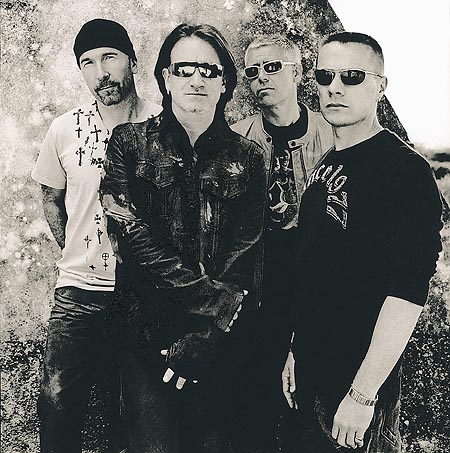 An article I wrote on the band U2 was just published by the American Management Association as the lead article in its popular Moving Ahead: Management Insights for Business Success publication. The article is entitled “Great Teams: The Extraordinary Unity of U2.” Thanks goes to Shari Lifland, the editor of Moving Ahead, who made some very clever changes from the original article that was published last month in The Economic Times in India.
Are Weak Connections Via Twitter Worthwhile?
Clive Thompson wrote a fascinating article for the weekend’s The New York Times Magazine entitled “Brave New World of Digital Intimacy.” I clearly see the benefit of weak connections online that come from LinkedIn and Facebook. I question the value of weak connections that are less substantive in nature, the type that are maintained via Twitter, especially if it crowds out time for personal reflection which I believe is necessary to thrive in life. What do you think?
Connection Culture, Hawaii Style
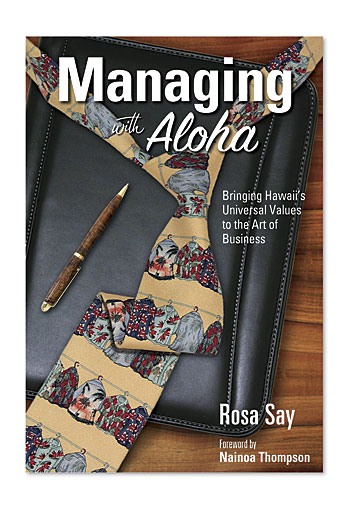 Managing Aloha by Rosa Say is an excellent book that I’m adding to my recommended reading list for managers. Rosa Say is a Hawaii-based leadership and executive coach who formerly worked as a manager at various premier luxury hotels and resorts in Hawaii. In reading about her journey and experiences as a manager, we learn the values and practices that Rosa has identified as critical to success and happiness at work and in life. They are also the values that Rosa aspires to live out and to pass on to her children.
I thoroughly enjoyed reading this book. What was especially fascinating to me were the rich descriptions of the values Rosa identifies. While readers will recognize many as being the universal values identified by positive psychology research, Rosa expresses them in Hawaiian words and in an Hawaiian context. In doing so, the values are more resonnant, i.e. they connect more with Hawaiians. This greater emotional connection is in part due to the fact that expressing universal values in native terms and stories gives Hawaiians a “sense of place” and pride that Rosa writes about in the book. After reading Managing with Aloha, I now look for ways to contextualize values for those I’m teaching and training.
I appreciated the way in which Rosa introduced new values while connecting them to those introduced earlier in the book. This building approach helps readers see the inter-connections among the values and how they play out in real life rather than viewing them as discrete concepts that are unrelated to one another.
Rosa’s values provide the optimal mix of task excellence and relationship excellence that is required to achieve sustainable superior performance. In the stories she tells, we see a manager who expects excellence, and works hard to achieve it herself while caring about the people she is responsible for leading.
Another benefit that comes from reading this book is that you learn about the practices that Rosa has developed. One in particular is called “take five.” When a manager asks an employee to “take five” it is an invitation to meet briefly together so the manager can hear what is on the employee’s mind. This simple practice gives every employee an opportunity to express his ideas and opinions and it motivates him to be continuously thinking so that he will be prepared when it is his time to “take five.” This practice increases the elements of Value and Voice that I write and speak about in my work.
In addition to Managing with Aloha, I encourage you to check out several websites that Rosa maintains. Here are links to them:www.ManagingWithAloha.com
www.SayLeadershipCoaching.com
www.sayleadershipcoaching.com/MWAcoaching
www.sayleadershipcoaching.com/TalkingStory
www.JoyfulJubilantLearning.com
Think Different: An Alternative View of Apple’s Success


Webcast: SabreTown Helps Sabre Holdings and Its Employees Thrive!
Join me in a webcast with my guest Al Comeaux, SVP of Corporate Communications for Sabre Holdings. Al will present an overview of SabreTown, the remarkable social networking platform Sabre built in-house. I saw Al’s presentation at a conference and was struck by the profound and positive impact SabreTown has had on Sabre Holdings. In Al’s presentation you will learn:
- how the SabreTown community is increasing connections among employees over geographic distances, while saving the company money and creating efficiency,
- how SabreTown has become a powerful knowledge management tool,
- what Sabre did that has resulted in an extraordinary rate of adoption by Sabre employees,
- how Sabre designed SabreTown so that it requires little oversight, and
- how SabreTown helps employees get up to speed faster.
If you work in information technology, corporate communications, employee engagement, training and development, or corporate learning functions, this is a presentation you don’t want to miss! I hope you’ll join me in this lively and enlightening webcast that shows how web 2.0 and corporate culture are combining to take organizations to the next step in their evolution. Click on “SabreTown Helps Sabre Holdings and Its Employees Thrive!” to sign up for the webcast.