

Some years ago I had the good fortune to meet New York Times columnist David Brooks for lunch. This was back in the days when he was writing for The Weekly Standard and contributing articles to The Atlantic. I admire David and his work. He’s frequently an island of reason and moderation amidst an ocean of extremist media pundits. And if you’re interested in connection, David Brooks is a writer you’ll want to follow. Check out David’s latest articles related to connection: The New York Times column entitled “Amy Chua is a Wimp” and the New Yorker article entitled “Social Animal: How the new sciences of human nature can help make sense of life.”
Category Archives: Connection Culture
Can We Humanize Organizational Cultures?
Check out this thought-provoking interview with Peter Block. During the interview he states the following:
“in the context of organization development, what we’re trying to do is humanize systems. The systems of consistency and control and predictability steal our humanity.”
Do you agree? Can organizations achieve consistency, control and predictability while still preserving our humanity? How about organizations where the cost of failure is high such as hospitals, nuclear power plants, NASA and the armed services?
Jason Pankau and I teach leaders that it’s necessary to achieve both task excellence and relationship excellence if you aspire to achieve sustainable superior performance. In the modern era, we’ve certainly focused on and made great strides forward in achieving task excellence but we have failing miserably when it comes to achieving relationship excellence. Two articles Jason and I wrote are relevant to this topic. The first article entitled “Strengthening Human Value in Organizational Cultures” appeared in the Leader to Leader Journal. The second article entitled “Encouraging Knowledge Flow” appeared in Perdido.
What do you think?
Emotional Connections Important to a Healthy Life
The emotional connections that Jason Pankau and I write, speak and teach about are in the workplace and in life outside of work. Research has shown that Emotionally Focused Therapy for marriage helps couples develop and the maintain the emotional connections that have been shown to be the most important factor predicting marriage longevity (and emotional disconnection is the top predictor of divorce). Emotional connections are important to children too. Research has shown that teenagers who feel connected to their families and/or friends are less likely to become involved in sexual activity or drinking alcohol at an early age. Two books I recommend on this topic are Safe Haven Marriage and The Five Love Languages of Teenagers. These are outstanding books that will strengthen your relationships with your spouse and children, and improve your wellbeing in life.
Extended Social Connections Affect Our Wellbeing
Check out this article entitled “Wellbeing on the Home Front.” It describes how social connections at home, at work and in the community affect our wellbeing. Gallup’s new research provides additional support for the Connection Cultures we described in Fired Up or Burned Out.
Coach Rex Ryan Connects with Jets

Check out this great article entitled “Channelling Churchill, Ryan Inspires His Team” on New York Jets’ football coach Rex Ryan The article makes several important points that support the conclusion we came to from our research on leaders who produce sustainable superior performance. Our research concluded that sustainable superior performance comes when leaders develop task excellence and relationship excellence. Rex Ryan is doing this by connecting with his players on both emotional and rational levels. He connects rationally by communicating and leading his team to implement effective strategy and tactics. This produces “task excellence.” Ryan’s passion and authenticity helps him connect on an emotional level. This helps produce “relationship excellence.” Ryan communicates simple, relevant and memorable themes with phrases such as “burn the boats” and “how dare you?” He tells memorable stories to illustrate his points.
The Jets are a decent team but not a great team, yet. They just pulled off a big playoff win by defeating the Indianapolis Colts. Given what I’m seeing, I expect the Jets are on the rise as Rex Ryan and team continue to develop a Connection Culture with Vision, Value and Voice.
Cancer Free, Seven Years Today
Seven years ago today, my wife Katie had surgery for advanced ovarian cancer. The prior year, Katie had surgery to remove breast cancer. Today, she is cancer free.
I wrote an essay entitled “Alone No Longer” about how setting my work aside to focus on being with and helping Katie and our daughters changed my perspective on life. The essay has been read by many individuals who want to know how they can help people in their lives who are battling a serious illness. The essay also challenges readers to examine their own lives to consider if they are too focused on status and achievement and insufficiently focused on relationships. I hope you’ll take time to read “Alone No Longer,” reflect on your life and share the essay with friends who might benefit from reading it.
Coming Talent Shortage Relevant to Nations, Organizations, Managers
Take a look at this fascinating article in Foreign Affairs by Nicholas Eberstadt entitled “The Demographic Future.” It has an excellent discussion of how population and labor supply around the world will change over the next 20 years as a result of the nearly 50 percent decline of fertility worldwide over the last half century. The larger point of the article is that although many nations are presently experiencing an excess supply of labor, a shortage is certain to result as baby boomers retire and the economy resumes growing. The analysis in the article points out the need for nations to improve educational opportunities, health conditions and economic environments. In addition, it supports the need for nations to create Connection Cultures that will attract and retain immigrant talent to their home markets, the need for organizations to create Connection Cultures that will attract and retain talent to their organizations, and the need for managers to create Connection Cultures that will attract and retain talent to the units they lead.
How Solitude Shapes Great Leaders
Take time to read this thoughtful speech entitled Solitude and Leadership by William Deresiewicz given to this year’s plebe class at West Point. He describes how great leaders develop the courage of their convictions, which includes moral courage. Reflection, time alone with one’s thoughts, interactions with trusted friends and reading great books, as Deresiewicz says, are part of the mix. What he didn’t adequately include is the impact of one’s experiences in life including one’s family of origin and periods of adversity and suffering that breed humility. Despite its shortcomings, it’s a fine speech and well worth taking time to read.
Many thanks to David Books of The New York Times for bringing this thoughtful speech to my attention. Brook’s recognized Deresiewicz’s speech as one of the best pieces of long journalism written in 2010.
Signals We Send in Relationships
Thanks to my friend Deborah Mills-Scofield for sending me this article from Science Daily entitled “Exploring How Partners Perceive Each Others Emotion During a Relationship Fight.” It looks at how expressions of hard, flat or soft emotion are perceived and how such perceptions affect relationships. This research suggests that a leader’s ability to express appropriate emotions at appropriate times is important to keep people feeling connected to the them (and emotional connections are essential to employee engagement and alignment).
Motivate Employees Now
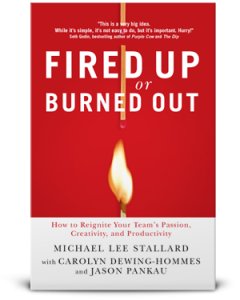 This morning appeared as a guest on my friend Jim Blasingame’s nationally-syndicated “Small Business Advocate” radio program where we talked about leadership, employee engagement and productivity. During the program, Jim and I discussed how the three core elements of a Connection Culture — Vision, Value and Voice — motivate employees to give their best efforts and align their behavior with organizational goals. One of the ideas I shared was to bring employees together to read and discuss a management book including how it applies to their business. To get them started, I offered a free download of the digital version of Fired Up or Burned Out to listeners who sign up for my email newsletter. To sign up for the newsletter and access the free book download click on this link.