Can Phil Jackson Build “the Yankees of Basketball”?

philjackson

As seen on Fox Business.

Phil Jackson, the New York Knicks’ new president of basketball operations, is nothing if not audacious.  After building two basketball dynasties as a coach of the Chicago Bulls and the Los Angeles Lakers, he accepted the challenge to achieve a three-peat, but this time in the toughest town of all, New York City.  Furthermore, he will try to build more than a great team.  In his new role, he is responsible for building a broader organization.

Will Jackson end his career in a blaze of glory or will the Knicks and New York City reduce him to smoldering ashes?  Despite the obstacles, I’m betting on the former.  And there will be a lesson for CEOs in watching Jackson in action. 
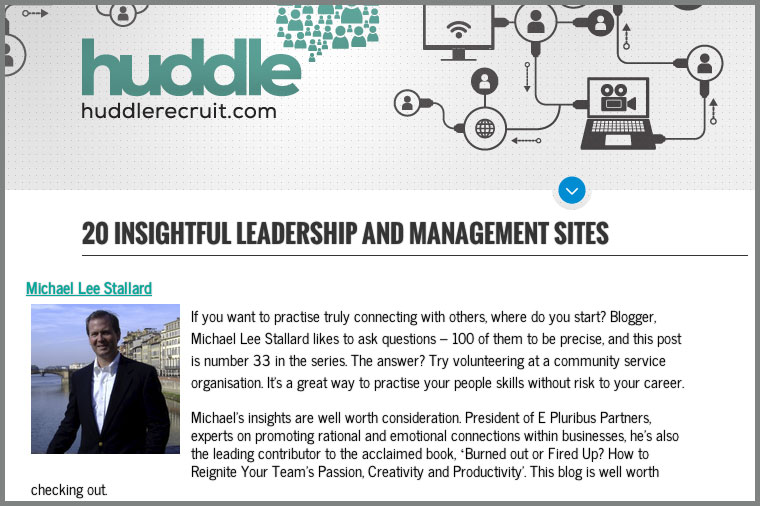
We Are Featured: 20 Insightful Leadership and Management Sites

huddle2

We are honored to have been featured on Huddle Recruit’s list of 20 insightful leadership and management sites. The list is designed to help entrepreneurs and innovators stay on top of the latest advice, and is a helpful resource for anyone hoping to refine their leadership skills. Check out the great list of blogs and prepare to be inspired.

Warren Buffett: More than an Oracle

Warren Buffett is in the news these days after publicly expressing his confidence in the future of American corporations and recently investing $8 Billion Dollars to purchase interests in GE and Goldman Sachs. With the recent stock market turmoil, many look to the world’s wealthiest man for guidance, and rightly so. Buffett is widely recognized as an exceptional judge of corporate value. “The Oracle of Omaha,” as he is known, is arguably the most successful investor in history. Corporate leaders regularly make the trek to Omaha, Nebraska, seeking his wisdom. With so much attention on Buffett’s investment acumen, it’s easy to overlook another talent: motivating people. It’s one of a host of reasons his investments tend to outperform the market.

Corporation: “to thine own self be true”

Inspired by Socrates advice to “know thyself,” Shakespeare penned the words “to thine own self be true” in Hamlet. From our research at E Pluribus Partners on employee engagement, leadership development and team building, we know that great leaders have a high degree of self awareness, i.e. they know who they are and who they are not.

Knowing oneself is also important to organizations. Why? Organizations today must differentiate themselves in ways that are relevant to customers in order to win in the crowded, noisy marketplace. You can learn how by watching a recent webcast I hosted with Larry Ackerman, one of today’s leading experts on corporate and individual identity. Larry is the founder and president of The Identity Circle. He is also the author of two excellent books I recommend entitled Identity is Destiny and The Identity Code. In his presentation, Larry explains how he helped the Global 500 company Norsk Hydro discover its identity. You can see my webcast with Larry Ackerman by clicking on employee engagement.