Seek the Unique

#6  Seek the Unique   When meeting someone for the first time, ask questions to identify something that is both unique and positive about them.  Doing this will make you more likely to remember them and what differentiates them from others.

While teaching a leadership seminar in Boston, a participant from the American Red Cross told me that Elizabeth Dole, the former president of the Red Cross, practiced this and Ms. Dole frequently brought up in conversation what was unique about a person the next time she saw him/her. (This practice reflects the Connection Culture element of Value.)

This is the sixth post in our series entitled “100 Ways to Connect.” The series highlights language, attitudes and behaviors that help you connect with others.  Although the language, attitudes and behaviors focus on application in the workplace, you will see that they also apply to your relationships at home and in the community.


Say “Hi” and “Bye”

#5 Say Hi and Bye

When you enter a room and it’s appropriate given the context and number of people present, greet people by name.  When you leave their presence, say goodbye.  Not saying hi and/or bye, runs the risk of giving someone the impression that you are indifferent to them.  (This practice reflects the Connection Culture element of Value.)

This is the fifth post in our series entitled “100 Ways to Connect.” The series highlights attitudes and behaviors that help you connect with others.  Although the attitudes and behaviors focus on application in the workplace, you will see that they also apply to your relationships at home and in the community.

Update: Howard Behar, former President of Starbucks North America and Starbucks International, and I co-authored an article entitled “Leadership Myopia” that appears in the August edition of Leadership Excellence alongside articles by well known leadership experts Gary Hamel, Marshall Goldsmith and Patrick Lencioni.    On October 10, I will give a keynote speech at the Retailing Summit held in Dallas, Texas.  The Retailing Summit is a premiere event for senior leaders in retail.  This year’s conference includes Karen Katz, President and CEO of Nieman Marcus, Maxine Clark, Founder of Build-a-Bear Workshop, Duncan Mac Naughtan, EVP, Chief Merchandising & Marketing Officer for Wal-Mart U.S. and Graham Atkinson, CMO & Chief Experience Officer of Walgreens.

Former Cab Driver Helps Liberate WWII France

After American and British troops took control of the beaches on D-Day, they got stuck in France’s hedgerow country. Sergeant Curtis Cullen, a former cab driver from Chicago, came up with an innovation that General Omar Bradley, commander of America’s First Army, credited with helping to liberate France.  Watch the video to learn about this extraordinary story of innovation and the leaders and culture that made it all possible.

Feel Lonely and Left Out at Work?

Recently, I’ve sensed more people feel lonely and left out at work.  With years of layoffs, those who remain carry greater workloads.  This crowds out time to connect with colleagues.  Managers are also stretched and have less time to connect with the people they are responsible for leading.  When I ask people at the seminars I teach which element of a Connection Culture — Vision, Value or Voice — they would like to increase in their workplace culture, it’s nearly always Voice.   One result of this is that there has been a decline of connection, community and the spirit of unity in organizations.

Life-Giving Cultures in Health Care Organizations

You can’t give what you don’t have. That’s why cultures in health care organizations need to be life-giving in order to energize health care workers who give so much of themselves to their patients. This is an important issue today.  In some health care-related fields, as many as one-third of employees leave their jobs each year. What can be done?  To learn more, read the article I wrote for the Fall 2012 Addiction and Behavioral Health Business Journal entitled, “Connection Culture: Creating a Life-Giving Environment in Health Care Organizations.”

When Mission Matters

Organizational missions are inspiring when they communicate how an organization brings truth, beauty and/or goodness to the world. For example, organizations in research or education help bring truth to the world (e.g. biotech companies, universities, schools). Organizations that produce goods or services reflecting aesthetic or artistic beauty or functional excellence bring beauty to the world (e.g. organizations that produce goods or services reflecting a high level of quality, advertising and design organizations, entertainment organizations). Finally, organizations that help improve the wellbeing of people, bring goodness into the world (e.g. healthcare, consumer products or leisure and entertainment organizations).

Citibank’s recent television commercial is a great example of an organization communicating a mission that inspires. The ad shows some of the projects that Citi helped finance including the transatlantic cable, the Marshall Plan to rebuild a post-World War II war-torn Europe, and the Space Shuttle Program. Now those are some accomplishments to be proud of and collectively they have brought greater truth, beauty and goodness into the world.

In a Crisis, Culture Matters: the Navy on 9/11

Within hours after the terrorist attacks on September 11, 2001, U.S. Navy aircraft carriers, destroyers and cruisers were in place to protect America’s shores. Naval leaders anticipated what had to be done and took action before they received orders. At the Pentagon in Washington, D.C., planning for America’s response began while fires from the attack still smoldered nearby.

The rapid response of the U.S. Navy on September 11 was in part due to the culture led by Admiral Vern Clark who served as the U.S. Chief of Naval Operations (CNO) from 2000 until his retirement in 2005.  The CNO is the principal naval adviser to the President and the Secretary of Defense on the conduct of war.  The Navy achieved some impressive gains during Clark’s tenure as CNO and the naval leaders I’ve met or spoken with have praised his leadership and positive impact.  By the time Clark retired as the second longest serving CNO in U.S. Navy history, he had led changes that would have a positive effect on the U.S. Navy for years to come.  Learn about Admiral Clark’s leadership of the U.S. Navy in an article I wrote for Leadership Excellence that you can read at this link

Is Facebook Making Us Lonely?

Check out this excellent article in The Atlantic entitled “Is Facebook Making Us Lonely?”  Some eye-popping statistics and quotes from the article include:

  • In 1950 less than 10 percent of American households contained only one person.  By 2010, nearly 27 percent had just one person.
  • A 2010 AARP survey found that 35 percent of adults older than 45 were chronically lonely as opposed to 20 percent a decade earlier.
  • Roughly 20 percent of Americans — about 60 million people — are unhappy with their lives because of loneliness.
  • “Across the Western world, physicians and nurses have begun to speak openly about an epidemic of loneliness.”

The rise in loneliness has led to an explosion in the number of paid confidants.  A 2010 Hoover Institute paper stated in 1950 the U.S. had a combined 33,000 paid confidants including clinical psychologists, social workers and therapists.  By 2010 that number reached an estimated 1,091,00 paid confidants which includes new categories such as mental health counselors, marriage and family therapists, and life coaches.

Clearly, Facebook and other assorted addictions to media are not the only contributors to the epidemic of loneliness. The geographic spread of families, increased time spent working/commuting to work, and the decline of relationships in the workplace are also responsible.  Regarding relationships in the workplace, the push for productivity has contributed to a rise of cultures that label people who take time to build relationships as slackers.   Today, having lunch alone in your office is the norm.  Unfortunately, productivity and innovation take a toll when workers burn out from a lack of human connection.  They learn to play “face time” games that make it look like they’re working, when in reality they’re not.  Creating Connection Cultures in organizations to achieve “relationship excellence” is wise.  We most recently made the case for Connection Cultures in an article entitled,”The Science of Engagement,” that appeared in the Spring edition of  Training Industry Quarterly.

In addition to the The Atlantic article on Facebook making us lonely, here are two other readings I recommend.

Sympathy is NOT Empathy

Connecting with people requires empathy i.e. you feel the emotion another individual feels.  This is different from sympathy where you recognize the emotion but don’t feel it.

In Fired Up or Burned Out, I wrote about the company Cranium and how it designs “high five moments” into its games.  High five moments are times when people connect via the shared empathy of joy (remember that we define “the force of connection” as shared identity, empathy and understanding).  When you are interacting with people you want to connect with, feeling and expressing emotion helps.  When you feel someone’s joy or pain, it connects.

In the news

Here are a few recent articles related to connection that you might enjoy:

Walter Isaacson wrote about leadership lessons from Steve Jobs’ life for Harvard Business Review.  In the article, Isaason addresses issues relevant to Connection Cultures including the elements of Vision, Value and Voice.  Jobs was brilliant when it came to Vision, terrible when it came to Value and mixed win it came to Voice.  Fortunately, there are other members of Apple’s senior leadership team whose strengths helped overcome Jobs’ weaknesses.

David Brooks just wrote a column for The New York Times entitled “The Relationship School” that touches on aspects of Connection Cultures in schools.

The Atlantic had a piece entitled “Stress Makes You Sick: Exploring the Immune System Connection.” The article explores how stress weakens the human immune system and mentions the link between stress and connection. (Remember I shared with you that recent research over a 20-year period showed people who work in cultures with supportive relationships had mortality rates that were 2.4 times lower than people who worked in cultures with weak relational support. This supports the longstanding view that lifestyles with little relational support produce chronic stress will kill you.)

While teaching seminars on leadership and Connection Cultures at the Darden Graduate School of Business, Professor Marian Moore introduced me to the work of her colleague Jonathan Haidt, a social psychology professor at the University of Virginia.  Haidt just wrote The Righteous Mind.  Here’s a well-written review of the book entitled “Why Won’t They Listen?”  The book review clearly shows it addresses issues related to the Connection Culture elements of Value and Voice.  I’ve ordered a copy but not read it yet.

Finally, I recently spoke with Jim Blasingame about the competitive advantage of culture on his nationally syndicated radio program entitled “Small Business Advocate” that you can hear at this link.  Also, I wrote an article on the  “Science of Engagement” for Training Industry Quarterly.

Many Ways to Connect

wheels-Mulally-Focus-Electric-CES-blog480


This last week I was in Boston for several meetings and to teach a seminar for the Institute for Management Studies (IMS).  I always teach that there are hundreds of ways to connect with others and the challenge facing leaders is to get to know the people they lead and identify ways to connect with them given who they are and the context of their work together.

Following are a few of the ways I learned that people and organizations are connecting.

  • At Bose Corporation, new employees learn “The Essence and Values of Bose,” including that “we treat others with respect.”  At Bose, these words are more than window dressing.  All new employees take a course on respect that help them bring this value to life in Bose culture.
  • At Amica Insurance, serving customers is an all-consuming passion.  Amica is a perennial winner of customer service awards.  Inside the company, when an employee is identified as having served a customer well, his or her team is recognized too.  This motivates the team to support one another’s efforts to serve customers.
  • Elizabeth Dole, when she was president of the Red Cross, took the time to learn something significant about each person she would meet so that she could affirm each individual a personal way.  In subsequent meetings, Ms. Dole was very good at remembering and mentioned the significant fact when she saw the individual.
  • David Gill, a professor at Gordon Conwell College, told me that we connect with the Divine when we “help people fulfill their dreams or overcome their nightmares.”  (We also connect with others when our organization’s mission accomplishes these ends.)

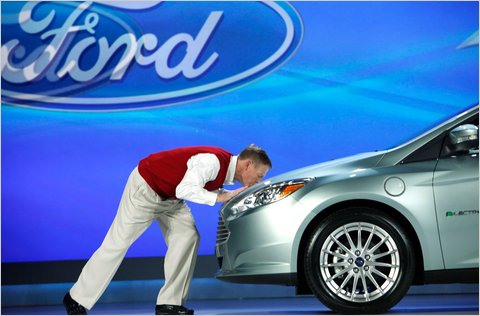
The importance of creating Connection Culture also came to my attention this week as I was doing research on Alan Mulally, Ford’s CEO.  Ford just announced its third full year of profit.  Frances Hesselbien, a friend and leader whom I much admire, has praised Mulally so I decided it’s about time that I take a closer look at his leadership of Ford.  In this splendid interview he did with The New York Times, Mulally recounts how he learned the importance of giving people autonomy, being inclusive, keeping people in the loop and connecting them to their organization’s “Inspiring Identity.”

In the coming weeks I’ll be speaking and teaching in Houston, Amsterdam, Brussels, London and Edinburgh.  As I travel, I’ll post new things I learn about connection.