Neutralize “Killer Stress” to Boost the Bottom Line

Who experiences greater levels of stress: management or employees? Managers seem to think they do, but hard research data makes it clear: Employees experience greater stress, and that affects the company’s bottom line.

It doesn’t have to be that way: Effective leaders can create an organizational culture that reduces “killer stress” and encourages “challenge stress,” which produces gains in productivity and performance.

Despite its reputation, all stress is not bad. What we call “challenge stress,” actually stimulates people to perform at their best.

“Killer stress,” is the kind that comes from feeling like you don’t have control over your work. Killer stress is unhealthy and in many individuals triggers fight, flight, freeze or stalking behavior — not what good leaders want to find in their organizations.

Here are three actions you can take to reduce killer stress, increase challenge stress and boost your company’s bottom line. 

Your Work Culture: Live-Giving or Killing You?

Are you working in a “culture of connection” where you feel a sense of connection to your supervisor, your colleagues, your day-to-day job tasks, and your organization’s mission, values and reputation?  A connection culture is life-giving as compared to a culture of indifference or culture of dominance that drain the life out of you.   To learn more, check out the video interview I did with Michelle Pokorny of Maritz Motivation following the keynote speech I gave at the Recognition Professionals International Annual Conference in New Orleans.

Connection Cultures Help Students Thrive

Greenwich High School (Greenwich, CT) was recognized in a New York Times article as a school in an affluent community that’s successfully integrating students from low income families. What the article misses is that a key contributor to Greenwich High School’s success is that it its Connection Culture.

The school’s headmaster, Christopher Winters, regularly talks and writes about the importance of connecting students, teachers, administrators and parents. He walks the talk, too. Chris greets students when they arrive in the morning and he easily moves about the student center connecting with students.  He encourages camaraderie among teachers and administrators and encourages parental involvement.

Leader, Beware of Failing to Give People a Voice

John Sexton, the president of New York University, is been aggressively expanding NYU at home and abroad.  Now the faculty of NYU’s largest school, Arts and Sciences, have scheduled a no-confidence vote on Sexton.  An article in yesterday’s New York Times entitled “A Test of Leadership at NYU,” described the no-confidence vote as coming about because dissident faculty felt Sexton was acting like a maverick CEO.  How did this happen?  It appears that Sexton’s mistake was failing to give faculty a voice in major decision-making and failing to address their legitimate concerns such as increased teaching loads that require travel abroad and the impact of the expansion on student-teacher ratios. “Voice” is one of the three elements in a Connection Culture (the others are Vision and Value).  When a leader fails to give people a voice in decisions that affect them, he or she runs the risk that some people will organize and seek to have the leader replaced.  This article describes that scenario.  Note in the article that one astute observer comments: “had more faculty been involved in the process…few if any professors [would be actively opposing Sexton].”

Sympathy is NOT Empathy

Connecting with people requires empathy i.e. you feel the emotion another individual feels.  This is different from sympathy where you recognize the emotion but don’t feel it.

In Fired Up or Burned Out, I wrote about the company Cranium and how it designs “high five moments” into its games.  High five moments are times when people connect via the shared empathy of joy (remember that we define “the force of connection” as shared identity, empathy and understanding).  When you are interacting with people you want to connect with, feeling and expressing emotion helps.  When you feel someone’s joy or pain, it connects.

In the news

Here are a few recent articles related to connection that you might enjoy:

Walter Isaacson wrote about leadership lessons from Steve Jobs’ life for Harvard Business Review.  In the article, Isaason addresses issues relevant to Connection Cultures including the elements of Vision, Value and Voice.  Jobs was brilliant when it came to Vision, terrible when it came to Value and mixed win it came to Voice.  Fortunately, there are other members of Apple’s senior leadership team whose strengths helped overcome Jobs’ weaknesses.

David Brooks just wrote a column for The New York Times entitled “The Relationship School” that touches on aspects of Connection Cultures in schools.

The Atlantic had a piece entitled “Stress Makes You Sick: Exploring the Immune System Connection.” The article explores how stress weakens the human immune system and mentions the link between stress and connection. (Remember I shared with you that recent research over a 20-year period showed people who work in cultures with supportive relationships had mortality rates that were 2.4 times lower than people who worked in cultures with weak relational support. This supports the longstanding view that lifestyles with little relational support produce chronic stress will kill you.)

While teaching seminars on leadership and Connection Cultures at the Darden Graduate School of Business, Professor Marian Moore introduced me to the work of her colleague Jonathan Haidt, a social psychology professor at the University of Virginia.  Haidt just wrote The Righteous Mind.  Here’s a well-written review of the book entitled “Why Won’t They Listen?”  The book review clearly shows it addresses issues related to the Connection Culture elements of Value and Voice.  I’ve ordered a copy but not read it yet.

Finally, I recently spoke with Jim Blasingame about the competitive advantage of culture on his nationally syndicated radio program entitled “Small Business Advocate” that you can hear at this link.  Also, I wrote an article on the  “Science of Engagement” for Training Industry Quarterly.

Many Ways to Connect

wheels-Mulally-Focus-Electric-CES-blog480


This last week I was in Boston for several meetings and to teach a seminar for the Institute for Management Studies (IMS).  I always teach that there are hundreds of ways to connect with others and the challenge facing leaders is to get to know the people they lead and identify ways to connect with them given who they are and the context of their work together.

Following are a few of the ways I learned that people and organizations are connecting.

  • At Bose Corporation, new employees learn “The Essence and Values of Bose,” including that “we treat others with respect.”  At Bose, these words are more than window dressing.  All new employees take a course on respect that help them bring this value to life in Bose culture.
  • At Amica Insurance, serving customers is an all-consuming passion.  Amica is a perennial winner of customer service awards.  Inside the company, when an employee is identified as having served a customer well, his or her team is recognized too.  This motivates the team to support one another’s efforts to serve customers.
  • Elizabeth Dole, when she was president of the Red Cross, took the time to learn something significant about each person she would meet so that she could affirm each individual a personal way.  In subsequent meetings, Ms. Dole was very good at remembering and mentioned the significant fact when she saw the individual.
  • David Gill, a professor at Gordon Conwell College, told me that we connect with the Divine when we “help people fulfill their dreams or overcome their nightmares.”  (We also connect with others when our organization’s mission accomplishes these ends.)

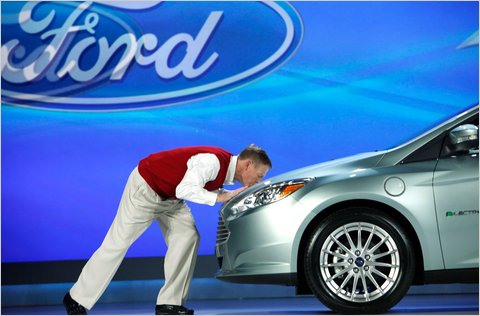
The importance of creating Connection Culture also came to my attention this week as I was doing research on Alan Mulally, Ford’s CEO.  Ford just announced its third full year of profit.  Frances Hesselbien, a friend and leader whom I much admire, has praised Mulally so I decided it’s about time that I take a closer look at his leadership of Ford.  In this splendid interview he did with The New York Times, Mulally recounts how he learned the importance of giving people autonomy, being inclusive, keeping people in the loop and connecting them to their organization’s “Inspiring Identity.”

In the coming weeks I’ll be speaking and teaching in Houston, Amsterdam, Brussels, London and Edinburgh.  As I travel, I’ll post new things I learn about connection.

Great Leaders: TCU’s Chancellor, Victor Boschini

TCU is on a roll.  It has been recognized by U.S. News as one a top 100 colleges in America.   Its athletics’ teams are generally among the top teams in Division I college sports.   More recently the Chronicle of Higher Education named TCU as one of the “43 best colleges to work for.” I could go on.

This is no accident. TCU has benefitted from having a string of great leaders over recent decades.  These leaders developed a vision for the school that inspired the TCU community.  They raised money to fund a sizable endowment that gives the school financial flexibility to weather the ups and downs of the economy.  They improved campus infrastructure.  They invested in identifying and attracting the best “teacher-scholars” who love teaching and connecting with students and also share a passion to advance the pursuit of truth through research and scholarship.

The current leader of TCU, its chancellor, Victor Boschini, is an impressive leader.  He’s brimming with energy and optimism while being grounded in reality.  He combines a passion for excellence in tasks and in relationships (Boschini refers to fundraising as “friend-raising.”) He’s curious, always seeking people’s opinions and tapping their  knowledge.  He has surrounded himself with a team that has the energy and intelligence I can only compare to the White House staff in Aaron Sorkin’s West Wing.

At present, Boschini’s focus is to strengthen TCU’s culture of unity, community and connection.  This is one reason I’m thrilled as a parent that my daughter Sarah is a junior at TCU, and beginning next Fall, my youngest daughter, Elizabeth, will be a freshman there.   Sarah is co-captain of TCU’s cheerleaders. She describes TCU as “a small school with big spirit.”  Like many students at TCU, she’s involved in the local community.  Sarah is the cheerleading coach of Nolan Catholic High School where she coaches and mentors girls to develop their competence as student-athletes and their character as human beings.

Culture and leadership matter.  Most academic cultures are indifferent to students as human beings.  Not TCU. That’s why I’m writing an article about TCU and spending a healthy sum to send my daughters there.   My hope is that more colleges will become Connection Cultures, especially during this time when research shows college freshman are experiencing record levels of stress according to recent research by UCLA.

To learn more about Victor Boschini, check out this great article entitled “Far from Normal” written when he was appointed chancellor and this inspiring convocation speech he gave earlier this year on TCU’s Connection Culture.

Another leader to keep your eyes on is Dr. Ronald DePinho, president of the University of Texas’ M.D. Anderson Cancer Center. Dr. DePinho has declared that M.D. Anderson, the world’s largest cancer center, is “in a moonshot moment” in the war on cancer. Take a look a at this inspiring article about him entitled, “Leader in Cancer Fight, and Son of an Illegal Immigrant.” My prediction: an highly-motivated leader who knows how to connect with people + the competence and resources at M.D. Anderson = very big things in the years to come.  (Full discosure: Both TCU and M.D. Anderson are clients of my leadership training and consulting firm, E Pluribus Partners.)

Finally, Ruth Simmons, president of Brown University, is yet another leader who looks promising based on what I’m reading. Check out this great interview she did with The New York Times entitledI Was Impossible, but Then I Saw How to Lead.

When a Psychopath Inhabits the C-Suite

This post is a continuance of my prior post on evil in organizational cultures.

The “dark triad” — psychopaths, narcissists and machiavellians — represents a small part of the population. What unties this group of destructive personalities is that they lack empathy for other human beings and care only about themselves. Some end up in correctional institutions while others end up in leadership positions where they create dog-eat-dog cultures or cultures that are indifferent to human beings (this is opposed to Servant Leaders who create “Connection Cultures”).

For some interesting thoughts on psychopaths in the C-suite, see this post by Larry Kahaner of the McGowan Fund and the link in his post to an article entitled “The Corporate Psychopaths Theory of the Global Financial Crisis” that appeared in the Journal of Business Ethics.  The book and movie entitled The Corporation make the argument that organizations that care only about profit have effectively become psychopathic.

The way to keep members of the dark triad out of positions of leadership and out of organizations is to educate everyone so that they understand what a healthy culture is, how it’s based on character strengths and virtues, and how organizations develop people with both character and competence.  One project we are working on with Scotiabank is creating a monthly piece for leaders entitled Leading with Character. Each month’s piece highlights a particular character strength, explains how it’s relevant to the organization and how to strengthen one’s leadership in ways that reflect the character strength.  If you are interested in learning more, please email me at mstallard@epluribuspartners.com or call me at 203-422-6511.