The Leadership Style of Warren Buffett

Over the weekend I read Warren Buffett’s letter to shareholders of Berkshire Hathaway.  I admire Buffett.  I’ve met him, followed him closely over the years and I own Berkshire stock.  I’ve also written about Buffett in The Economic Times and spoke about his leadership style in leadership training workshops I conduct and in this brief training video I recorded for Athenaonline.com (click on the link to see the video).   

In his letter to shareholders, Buffett displays some of the attributes I’ve described as being part of his leadership style, namely he loves to praise and give credit to his managers while being humble (or critical) about his own performance. Here are just a few excerpts that provide more evidence that Buffett is as great a leader as he is an investor:


Webcasts: High Performance, Virtuous Organizations and Organizational Storytelling

Recently, I hosted a series of webcasts that will help individuals who want to promote virtuous organizational cultures and/or who are interested in organizational storytelling. In the first webcast, Professor Kim Cameron of the University of Michigan talks about Positive Organizational Scholarship and case for virtuous organizational cultures. In a second, Rick Garlick of Maritz Research presents compelling research that virtuous organizational cultures have a economic advantage. In a third webcast, John Timmerman, Corporate VP of Operations at Ritz-Carlton, talks about the Ritz-Carlton’s culture and its practice called the “Daily Line Up” that promotes virtues. In the last webcast, organizational storytelling expert Steve Denning talks about how to tell stories that motivate change, including change in values. I hope you will check out some or all of these webcasts and share your ideas and opinions about how to promote the virtuous organizational cultures we need.

Teaching Connection at GE


Today I taught about Connection Cultures and employee engagement to leaders at GE’s famed Crotonville Leadership Training Center. In the coming weeks I’ll be working with GE to add material from 
Fired Up or Burned Out to one of GE’s leadership courses.  The Connection Culture will help GE attain its desire to be inclusive.  And I’m fired up about helping this great organization become even better. 

GE is a company I’ve always admired.  Previously I’ve written about Jeff Immelt, GE’s CEO, and how he has made inclusiveness one of GE’s values.  More recently, I wrote in a post entitled “Warren Buffett: More Than an Oracle,” that Buffett made a multibillion dollar investment in GE.  Although the current economic conditions are challenging, like Buffett, I believe GE’s future is bright.

Joining Marshall Goldsmith, others as expert on Success Television

Last week I joined Marshall Goldsmith and others as one of Success Television’s experts on leadership and employee engagement. Former CNN executive Helen Whelan, Success Television’s founder and CEO, is developing an excellent platform to provide corporate training via online, dvds and videos. Success Television’s website is currently featuring an article I wrote about Truth, Beauty and Goodness in Leadership. You can learn more about it by clicking on Success Television.

Webcast: John Timmerman, Corp. VP Operations, Ritz-Carlton

John Timmerman, Corporate Vice President of Operations at the Ritz-Carlton Hotel Company, L.L.C. (click here for his bio) was my guest on a recent webcast on Brighttalk.com’s Leadership and Employee Engagement Channel.  You can see the webcast by clicking on employee engagement.

During the webcast John identifies a variety of Ritz-Carlton practices that hep make it a Connection Culture including:

Presentation to Wharton and Harvard Business School Clubs of D.C.

Last week I spoke at a breakfast meeting of Wharton and Harvard Business School Clubs of D.C.  It was such an engaging group of individuals that included entrepreneurs, leaders of government agencies, and leaders from the social sector.  I would like to thank them for their enthusiastic response to my presentation.  

During the presentation I spoke about the leadership style of or Retired Admiral Vern Clark, the former Chief of Naval Operations (CNO) who served as CNO from 2000-2005.  Retired Rear Admiral Rose Levitre, who presently works for LMI (an intelligence consulting organization) and Rear Admiral Frank Thorp, the current Chief of Information for the Navy, stood up before the group and shared their experiences working for Admiral Clark.  Thank you Rose and Frank for inspiring us with your stories.  

Finally, I would like to thank the Wharton Alumni Club of D.C.’s president, Alan Schlaifer, for doing a first class job of organizing this event and Anthony Priest, chairman of the Harvard Business School Club of D.C., for promoting it.

Weathering the Storm

Facilitator and blogger Terry Seamon just posted a piece I wrote entitled “Weathering the Storm.” Terry has invited a number of thinkers to share their ideas on employee engagement in a series on his blog entitled “Engaging Voices.” This series will include posts from David Zinger, Tim Wright, Judy Bardwick, Phil Gerbyshak, and Judy McLeish.

Challenger Disaster Documentary a Tribute to Truth Tellers


In Fired Up or Burned Out, I wrote about the lack of Knowledge Flow (or Voice) at NASA and how it contributed to the Challenger Space Shuttle disaster.  National Geographic produced an excellent documentary about the Challenger disaster that’s available on Hulu.com.  You can access it at
Challenger: The Untold Story.  

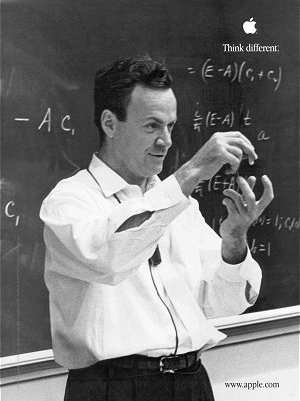
In most organizations there are truth tellers who have the courage to speak truth to power.  In this case, Morton Thiokol engineer Roger Boisjoly and The Rogers Commission’s Richard Feynman emerge as the courageous truth tellers.  Feynman appears in another chapter of Fired Up or Burned Out as the young supervising engineer of the Manhattan Project who asks Robert Oppenheimer to tell the supporting engineers the purpose of the project (which results in a tenfold increase in their productivity). Feynman also appeared in Apple’s “Think Different” advertising campaign (above).

Lessons I Learned from Stephen Hopson’s Adversity University

There is a lot of talk these days about focusing people on their strengths.  Certainly there’s some wisdom in that but it’s not wise to focus on apparent strengths alone.

Recently, I met an extraordinary man named Stephen Hopson. His life story made me reconsider the wisdom of focusing on apparent strengths. 

Stephen is deaf and has been since birth.  If Stephen had focused on his apparent strengths, what would he have become? Probably not a financial executive on Wall Street, a motivational speaker or an airplane pilot.

Hopson became all of those.