“Interpersonal Connectedness” One Factor in Metric to Replace GDP

There is a movement to replace GDP as a statistical measure of national success and well-being.  In “The Rise and Fall of GDP,” that appeared in The New York Times Magazine, Jon Gertner describes this effort.  Gertner writes about the U.S. Government Accountability Office (GAO) developing a “key national indicators” system that will be available online. (Last year I spoke at the GAO’s headquarters in Washington, D.C. about The Connection Culture: A New Source of Competitive Advantage.) The article goes on to say that “interpersonal connectedness” is one of the components being considered.

Including connection as a component in a measure of national success would be wise.  What’s measured is what gets done.  David Brooks, also of The New York Times, effectively supports my view.  He argued in “The Limits of Policy,” that it would be wise for government leaders to “try to use policy to strengthen relationships.”
Relationship Excellence: Chick-fil-A’s Competitive Edge

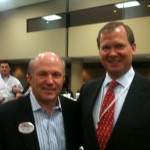
IMG_0924I just met and heard Chick-fil-A’s President Dan Cathy speak to a group at the Chick-fil-A Leadercast about values, faith, serving others and the competitive advantage of relationships.  It was an inspiring message and he is genuine and clearly passionate about the organization, its people, customers and what it represents.  Dan told the audience that he recently committed to his father, Chick-fil-A founder S. Truett Cathy, to keep the company private which will help preserve the values of this great organization.

Observing Dan speak, it’s clear that he connects with the employees of Chick-fil-A.  He spends more than half of his time on the road visiting stores and connecting with employees and customers.  He tells stories that move him and in so doing move the hearts of others.  He often uses objects that help people remember his points.  A large pepper grinder represents adding pepper to the customer’s experience by going the second mile to be friendly.  Chick-fil-A has won numerous awards for its exceptionally high level of customer service.

Sometimes when I hear corporate leaders talk I wonder if they walk the talk.  I’ve done some due diligence and feel highly confident that Chick-fil-A is the real deal.  Even my own mother who lives in Bristol, Virginia sings the praises of the local Chick-fil-A for their good people and positive influence on the local community.

In the coming weeks I’ll be interviewing Dan Cathy to learn more about his journey as a leader and his work at Chick-fil-A so stay tuned.

Leaders Shape Stories

Mark Sanborn just said people should slow down, reflect and be shapers of stories.  How true! It made me think of a scene in the movie Apollo 13 when Mission Director Gene Kranz changed the story of the Apollo 13 mission failure from being about a potential disaster to being one of NASA’s greatest moments by bringing the astronauts safely home despite the odds against them.  For those who don’t know, NASA performed heroically and saved the three astronauts lives.

Last week I spoke to a leader at NASA’s Johnson Space Center who told me that Gene Kranz’s famous line “failure is not an option” that he stated in the movie still influences NASA’s culture today.  On June 17, Jason Pankau and I will be speaking to leaders at the NASA Johnson Space Center where Gene Kranz uttered those famous words that reshaped NASA’s story.  We feel a sense of awe and humilty to have an opportunity to speak at NASA.  We hope to inspire NASA’s leaders about how important it is to create a Connection Culture so that they will thrive, individually and collectively.

Winning Workplaces’ Article on Connection

Winning Workplaces just featured an article that Jason Pankau and I wrote in its April newsletter and on its website.  The article is entitled “To Boost Productivity and Innovation, Fire Up the People You Lead.”  Check out the article and the Winning Workplaces website, it has great ideas, many written by one of our favorite bloggers Mark Harbeke.  Mark is Winning Workplaces’ Director of Content Development.

Sandra Bullock: Wishing Her Well

David Brooks asks the question in his New York Times column entitled, The Sandra Bullock Trade,” if you were in Sandra Bullock’s shoes and could somehow choose between winning an Oscar for best actress or having a strong, supportive marriage, which would you select?  He goes on to describe why you should select the strong, supportive marriage and then describes what I refer to as the force of connection, including how it affects so much in our lives from happiness to the productivity of nations.

Thanks to an introduction from David Bradley, owner of The Atlantic, David and met for lunch in Washington D.C. some years ago.   We discussed my ideas on the force of connection and my concern that the decline of connection in market democracies was having a detrimental effect on well-being and economic productivity.  A few years later I wrote about it in The Connection Culture: A New Source of Competitive Advantage that was published by changethis.com.

My heart goes out to Sandra Bullock. I’ve always liked her as an actress and she seems like a terrific person. In an earlier post , I heaped praise on Bullock’s tour-de-force performance in The Blind Side.  Watching her acceptance speech for best actress at the Academy Awards, then, I was surprised to see her remarks and demeanor seemed bittersweet.  Of course, at that time, I was not aware that her husband has been, as David says, “an adulterous jerk.”   In hindsight, it would appear that she was struggling, as any of us would, to make it through a difficult season in her life.  My hope is that Ms. Bullock has a group of close loving family members and friends who can help her through this.  That’s the most important benefit of connection in my opinion.  It helps us get through the inevitable difficult seasons in life, a topic I wrote about from personal experience in Alone No Longer.

Happier People Connect Daily

Here’s a link to a New York Times article entitled “Talk Deeply, Be Happy.” The study cited is additional evidence that people need to connect during the workday in order to flourish.  It is especially relevant today when workers do more work online.  I like Dr. Edward Hallowell’s advice that human beings need face-to-face human moments of connection on average at least every four hours to perform at the top of their game.

When Truth is Victim of “Nice”

Take a look at this article about Ursula Burns, the new CEO of Xerox, and her efforts to alter Xerox’s culture.  Anne Mulachy, the former CEO did a remarkable job pulling the Xerox family together to save the company when it was on the verge of bankruptcy.  Mulcahy is a tough act to follow but I’m pulling for Ms. Burns to take Xerox to the next level.  One way to look at  Ms. Burns challenge is that she needs to frame Xerox’s success as being rooted in achieving both task excellence and relationship excellence.  When a culture sacrifices truth to being nice (or more accurately to avoiding conflict) a company’s performance eventually suffer.  Ms. Burns is performing a delicate dance.  If she comes off too strong, people wil ear to spaek he truth.  If she does nothing, it seems that the desire to avoid constructive conflict may eventually sabotage the companies performance.

If I were advising Ms. Burns, I would say “make it clear to your Xerox colleagues that we must be intentional about achieving BOTH task excellence AND relationship excellence in order to thrive.  Sacrifice either and we will risk managerial failure for reasons I’ve written about in Fired Up or Burned Out.

High Fives, Fist Bumps: Touch and Performance are Correlated

IFired Up or Burned Out I wrote about “high five moments” that are celebrated at Cranium, the games company.  It turns out that new research reported in a New York Times article by Benedict Carey entitled “Evidence That Little Touches Do Mean So Much” shows there is a correlation between touch and performance.  Reading the article immediately made me think of the twin Jensen brothers who dominate men’s doubles in tennis.  They must give each other a hundred fist bumps a set!

Like the Jensen brother in tennis, Craniun is a force to be reckoned with in games.  Here’s what I wrote about them:

Day 19: High-Five Moments

In 1998, with $100,000 of their own money, Richard Tait and Whit Alexander, two former Microsoft employees, decided to create a new board game.1 Tait came up with the idea when he and his wife were playing games at the home of their friends. The couple easily won Pictionary and were trounced at Scrabble. Pondering how he felt as the winner of one game and loser of another, Tait thought it would be ideal to play a game that involved different skills so that everyone had a chance to shine. That type of game would be more fun, and it would bring people together rather than alienate them in a winner-take-all battle. Tait persuaded Alexander to join him, and together they created the game Cranium.

Cranium became the fastest-selling independent board game in history, selling more than either Pictionary or Trivial Pursuit had in its first year. The company (also named Cranium) went on to shatter industry records by creating games that won the Toy Industry Association’s Toy of the Year game award four out of the last five years. It has sold more than 15 million games in 10 languages and 30 countries. In 2005, while the toy industry’s unit sales were down 6 percent, Cranium’s sales were up 50 percent.

Human Value Boosts Employee Engagement

Amy Wrzesniewski, Associate Professor of Organizational Behavior Yale School of Management, recently sent me a paper she co-authored with Jane Dutton (University of Michigan) and Gelaye Debebe (George Washington University) entitled “Caring in Constrained Contexts.”  Reading it made me realize that for workers in low status positions the indifference and incivility they experience is in part why 90 percent of employees today are either disengaged or not aligning with organizational goals.  Reading the comments of workers provides a technicolor view of their day-today experiences. Here are a few excerpts:

  • “The doctors have a tendency to look at us like we’re not even there, like, you know, we’ll be working in the hallways, and you know, no recognition of what you are doing whatsoever.”
  • “A typical day with the nurses down here would be I come in at about 4:30. I set my cart up in my area. … they do a lot of staring and gawking. I don’t know the purpose of this. It’s a very uncomfortable feeling for me.”
  • “I was called as a favor to my supervisor to come up …and clean a room because the patient’s family was complaining that the room was filthy. It was supposed to be cleaned by the day shift and evidently the day shift has skipped over that particular room…And you have these people shouting, ‘This room is filthy,’ and this, that, and the other, and ‘I want this room cleaned now.’”
  • Doctors will do things like, you know, they’ll do an exam, take off their gloves and drop them on the floor. You know, just things like that…they don’t even think, you know, they expect housekeeping to do everything…I think there’s a difference between housekeeping and maid service and they get confused”
  • “Some of them [the doctors] feel like they’re next to God. There’s a lot of doctors who feel that way too…Just in their tone and their body language. Every now and then some might, they don’t want to say it, but you know they just feel it. Say, like this. For instance I am cleaning their room or waxing. A doctor will walk right through it. Even if it is not an emergency. You can tell them. Everyone else will go around. You know, I’m saying, he will walk right through here. Now, do you think that’s kind of a sense? Just because he’s a doctor. Nurses will go around housekeepers. So that’s why you get this feeling. Who he just thinks he is….”

Relational Disconnectors Sabotage Themselves and Their Organizations

Here’s an interview of George Cloutier at American Management Services in The New York Times entitled “Fire Your Relatives. Scare Your Employees. And Stop Whining.” This guy is Howell Raines all over again. One of my favorite case studies of poor leadership is Ken Auletta’s magnificent article about Raines leadership as the executive editor of The New York Times entitled “The Howell Doctrine.”

Leaders like Cloutier always end up destroying their organizations like Raines did (he was eventually fired over the Jayson Blair plagiarism scandal).  They may be successful at achieving “task excellence” for a time but eventually the failure to achieve “relationship excellence” sabotages task excellence.  As the legendary UCLA basketball coach John Wooden said, “ability may get you to the top but it takes character to keep you there.”