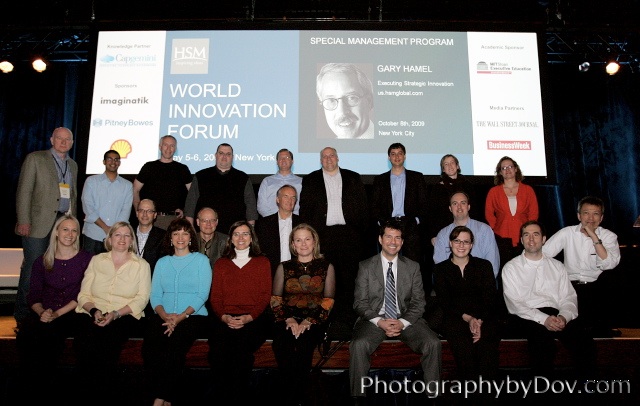
HSM invited me to the World Innovation Forum next week at the Nokia theater in New York City where I will be joining a group of leading bloggers. In addition to yours truly (www.twitter.com/michaelstallard), Twitter accounts and blogs for the bloggers are as follows:
Category Archives: Uncategorized
Darden: A Legacy of Community and Connection

This week I taught a half-day workshop on Connection Cultures, employee engagement, leadership and teams to the graduating seniors of the MBA for Executives program at the University of Virginia’s Darden Graduate School of Business. This is the second year I’ve taught at Darden. After speaking last year, I wrote about my first impression of Darden in a blog post entitled “The Connected Class.”
New Webcasts: Servant Leaders, Lonely Leaders and Networking Leaders
In my experience as a leader, a board member and an advisor to leaders, I’ve learned that all great leaders are “servant leaders,” a term first used by Robert Greenleaf in his influential essay “The Servant as Leader.” Recently, I hosted several webcasts on the leadership and employee engagement channel at Brighttalk.com that have a link to the servant leadership theme.
Howard Behar, the inspiring and wise former president of Starbucks International, spoke with me about his experiences as a leader and his outstanding book entitled It’s Not About the Coffee. I loved this book.
The Leadership Style of Warren Buffett
Over the weekend I read Warren Buffett’s letter to shareholders of Berkshire Hathaway. I admire Buffett. I’ve met him, followed him closely over the years and I own Berkshire stock. I’ve also written about Buffett in The Economic Times and spoke about his leadership style in leadership training workshops I conduct and in this brief training video I recorded for Athenaonline.com (click on the link to see the video).
In his letter to shareholders, Buffett displays some of the attributes I’ve described as being part of his leadership style, namely he loves to praise and give credit to his managers while being humble (or critical) about his own performance. Here are just a few excerpts that provide more evidence that Buffett is as great a leader as he is an investor:
Webcasts: High Performance, Virtuous Organizations and Organizational Storytelling
Recently, I hosted a series of webcasts that will help individuals who want to promote virtuous organizational cultures and/or who are interested in organizational storytelling. In the first webcast, Professor Kim Cameron of the University of Michigan talks about Positive Organizational Scholarship and case for virtuous organizational cultures. In a second, Rick Garlick of Maritz Research presents compelling research that virtuous organizational cultures have a economic advantage. In a third webcast, John Timmerman, Corporate VP of Operations at Ritz-Carlton, talks about the Ritz-Carlton’s culture and its practice called the “Daily Line Up” that promotes virtues. In the last webcast, organizational storytelling expert Steve Denning talks about how to tell stories that motivate change, including change in values. I hope you will check out some or all of these webcasts and share your ideas and opinions about how to promote the virtuous organizational cultures we need.
Lessons I Learned from Stephen Hopson’s Adversity University
There is a lot of talk these days about focusing people on their strengths. Certainly there’s some wisdom in that but it’s not wise to focus on apparent strengths alone.
Recently, I met an extraordinary man named Stephen Hopson. His life story made me reconsider the wisdom of focusing on apparent strengths.
Stephen is deaf and has been since birth. If Stephen had focused on his apparent strengths, what would he have become? Probably not a financial executive on Wall Street, a motivational speaker or an airplane pilot.
Hopson became all of those.
Truth, Beauty and Goodness Increase Employee Engagement
Here is the draft of an article I’m working on. What do you think about it? If you have any comments or suggestions, please email me at mstallard@epluribuspartners.
Values of Great Leaders Connect with Employees
By Michael Lee Stallard
When people feel emotionally connected, they put more effort in their work. Research bears this out. A 2004 Corporate Leadership Council study of 50,000 employees worldwide concluded that emotional factors were four times as important as rational factors when it came to employee effort.
Great leaders connect on an emotional level with the people they are responsible for leading. When employees follow their leader’s example, they become more connected with one another, boosting trust, cooperation and esprit de corps throughout the organization. What I have discovered as a leader and as an advisor to leaders over the years is that the emotional connections leaders develop with people are ultimately grounded in the leader’s own values. The values that foster connection among people come in clusters that I refer to as Truth Values, Beauty Values and Goodness Values.
Webcast with Prof. Kim Cameron, University of Michigan
On Monday, January 26 at 11:00 AM Eastern, Professor Kim Cameron of the University of Michigan’s Center for Positive Organizational Scholarship (POS) will be my guest on the Leadership and Employee Engagement webcasts I host for Brighttalk.com. On the webcast, Professor Cameron will tell us about the work and select findings of the Center for POS, including the link between virtuous behavior and organizational performance. You can sign up for the free webcast by clicking on employee engagement.
Speaking at Wharton and Harvard Business School Clubs in D.C.
I’ll be speaking about Connection Cultures at a joint meeting of the Wharton and Harvard Business School Clubs of Washington, D.C. The meeting will be held at 7:30 AM on February 5 in Tysons Corner, Virginia. For details click here.
How to energize your organization
I just discovered a fascinating article that appeared in the Sloan Management Review about how individuals increase energy in organizations. Several of the practices are germane to employee engagement and Connection Culture Theory. Here’s a copy of the article what-creates-energy-in-organizations
Note: The free download of this article was available on co-author Professor Wayne Baker’s website at the University of Michigan.