

 An article I wrote on the band U2 was just published by the American Management Association as the lead article in its popular Moving Ahead: Management Insights for Business Success publication. The article is entitled “Great Teams: The Extraordinary Unity of U2.” Thanks goes to Shari Lifland, the editor of Moving Ahead, who made some very clever changes from the original article that was published last month in The Economic Times in India.
Category Archives: Knowledge Flow
Are Weak Connections Via Twitter Worthwhile?
Clive Thompson wrote a fascinating article for the weekend’s The New York Times Magazine entitled “Brave New World of Digital Intimacy.” I clearly see the benefit of weak connections online that come from LinkedIn and Facebook. I question the value of weak connections that are less substantive in nature, the type that are maintained via Twitter, especially if it crowds out time for personal reflection which I believe is necessary to thrive in life. What do you think?
Connection Culture, Hawaii Style
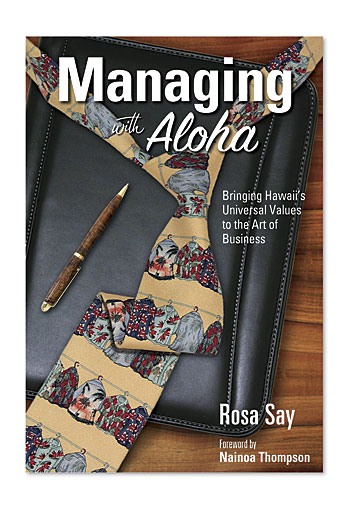 Managing Aloha by Rosa Say is an excellent book that I’m adding to my recommended reading list for managers. Rosa Say is a Hawaii-based leadership and executive coach who formerly worked as a manager at various premier luxury hotels and resorts in Hawaii. In reading about her journey and experiences as a manager, we learn the values and practices that Rosa has identified as critical to success and happiness at work and in life. They are also the values that Rosa aspires to live out and to pass on to her children.
I thoroughly enjoyed reading this book. What was especially fascinating to me were the rich descriptions of the values Rosa identifies. While readers will recognize many as being the universal values identified by positive psychology research, Rosa expresses them in Hawaiian words and in an Hawaiian context. In doing so, the values are more resonnant, i.e. they connect more with Hawaiians. This greater emotional connection is in part due to the fact that expressing universal values in native terms and stories gives Hawaiians a “sense of place” and pride that Rosa writes about in the book. After reading Managing with Aloha, I now look for ways to contextualize values for those I’m teaching and training.
I appreciated the way in which Rosa introduced new values while connecting them to those introduced earlier in the book. This building approach helps readers see the inter-connections among the values and how they play out in real life rather than viewing them as discrete concepts that are unrelated to one another.
Rosa’s values provide the optimal mix of task excellence and relationship excellence that is required to achieve sustainable superior performance. In the stories she tells, we see a manager who expects excellence, and works hard to achieve it herself while caring about the people she is responsible for leading.
Another benefit that comes from reading this book is that you learn about the practices that Rosa has developed. One in particular is called “take five.” When a manager asks an employee to “take five” it is an invitation to meet briefly together so the manager can hear what is on the employee’s mind. This simple practice gives every employee an opportunity to express his ideas and opinions and it motivates him to be continuously thinking so that he will be prepared when it is his time to “take five.” This practice increases the elements of Value and Voice that I write and speak about in my work.
In addition to Managing with Aloha, I encourage you to check out several websites that Rosa maintains. Here are links to them:www.ManagingWithAloha.com
www.SayLeadershipCoaching.com
www.sayleadershipcoaching.com/MWAcoaching
www.sayleadershipcoaching.com/TalkingStory
www.JoyfulJubilantLearning.com
Webcast: SabreTown Helps Sabre Holdings and Its Employees Thrive!
Join me in a webcast with my guest Al Comeaux, SVP of Corporate Communications for Sabre Holdings. Al will present an overview of SabreTown, the remarkable social networking platform Sabre built in-house. I saw Al’s presentation at a conference and was struck by the profound and positive impact SabreTown has had on Sabre Holdings. In Al’s presentation you will learn:
- how the SabreTown community is increasing connections among employees over geographic distances, while saving the company money and creating efficiency,
- how SabreTown has become a powerful knowledge management tool,
- what Sabre did that has resulted in an extraordinary rate of adoption by Sabre employees,
- how Sabre designed SabreTown so that it requires little oversight, and
- how SabreTown helps employees get up to speed faster.
If you work in information technology, corporate communications, employee engagement, training and development, or corporate learning functions, this is a presentation you don’t want to miss! I hope you’ll join me in this lively and enlightening webcast that shows how web 2.0 and corporate culture are combining to take organizations to the next step in their evolution. Click on “SabreTown Helps Sabre Holdings and Its Employees Thrive!” to sign up for the webcast.
U2: The “Band” as Family
Earlier this year I posted about the unity among the members of the band U2 and how it contributed to the band’s success. Comments from several individuals made me dig much deeper into the band’s story (thank you Astid, David Zinger, Lee Smith and Rachel for enlightening me). What I discovered was an extraordinary journey the band made to evolve into the force it is today.
The article I wrote about it was published today in The Economic Times (in India) and it will be published later this year in two of the American Management Association’s publications (Moving Ahead and the AMA’s Catalog). Here’s the link to The Economic Times’ article.
Let me know what you think.
Interview with Jim Blasingame, The Small Business Advocate
Reducing employee anxiety
What can managers do to reduce the anxiety workers feel these days? Anita Bruzzese, award-winning journalist and workplace columnist for Gannett News Service, recently interviewed me about this topic for her nationally syndicated column. The article, entitled “In gloomy times, good management becomes essential,” has appeared in Gannett papers across the country.
From Process-centric to People-centric
Another theme that emerged from Communitelligence’s Employee Engagement conference in Chicago last week is what I would describe as “Moving from Process-centric to People-centric.” It seems that every organization has a robust set of process-oriented programs in place such as Six Sigma and Balanced Scorecard. These programs have helped organizations but people sense something’s still missing.
The next steps in the evolution of organizations will be focused on people and their values rather than additional process improvements. Organizations had lost their way in some respects by focusing so much on processes. By turning their attention to their core values, organizations were finding their way again, re-discovering their identities, who they are and what’s important to them.
Here are my observations from various presentations:
Communitelligence’s Employee Engagement Conference: Social Networking Tools Inside Organizations
Chief Learning Officer Magazine Online: Employee Engagement Removes Knowledge Traps
In the current edition of Chief Learning Officer Magazine Online, Associate Editor Lindsay Edwards Wickman interviews me about how employee engagement and Connection Cultures remove knowledge traps in organizations. The interview is entitled “Connection Cultures Keep Workers Engaged.”