Achieving Greatness Requires Coaching

Did you notice at the Olympics that all the world class athletes had coaches?  No one becomes great without coaching.  We all have blind spots we cant see that are sabotaging our performance.  This is true of leaders, too. Coaches and mentors help leaders see their blind spots. They also provide advice and encouragement to help leaders overcome their blind spots and strengthen their strengths.

Are you stuck in your career or want to accelerate your growth?  If so, get a coach.

Update

Check out the interview I did on Connection Cultures with Ago Cluytens of Coaching Masters in Switzerland.  You might also enjoy this article I wrote for the August edition of Leadership Excellence entitled “Great Leaders Connect.”

NYTimes: Why Coach K “Coaches Like a Girl”

Recently I was delighted to read a great USA Today article about Coach K of Duke leading the U.S. Men’s Basketball Team in the Olympics.  Coach K has won four NCAA college basketball titles as the head coach of Duke, a gold medal as an assistant coach of the 1992 Dream Team in Barcelona and a gold medal as head coach of the U.S. mens team in the 1998 olympics in Beijing.  He’s a servant leader who creates the “Connection Culture” where his players feel connected to him and to one another, a phenomenon we wrote about in Fired Up or Burned Out.  Coach K cares about task excellence and relationship excellence.  He cares about people and results.

To learn more about Coach K’s leadership style and the surprising story of how he evolved as a leader check out this fascinating New York Times Magazine  article entitled “Follow Me.”   In it you’ll learn why this extraordinary leader, a guy’s guy from an all boys Catholic high school, West Point and the U.S. Army, coaches, as the author Mike Sokolove says, “like a girl.”

Courage, Connection and the Flow of Ideas

“Little of consequence is ever done alone.”

– David McCullough

Last week my wife and I went to see the historian David McCullough speak about his new book The Greater Journey: Americans in Paris.  I’ve seen David McCullough speak twice before and always found his talks to be thoughtful and inspiring.

On this occasion, McCullough spoke on the courage of Americans who went to France between 1830 and 1900 because they were “in love with learning and advancing their abilities.” They made the difficult trip across the Atlantic that lasted anywhere from one to three months.  They remained there despite language differences and outbreaks of disease such as cholera.  Upon their return, they applied knowledge acquired in France to improve America.  Greater competence in their chosen fields was not all they gained.  Their character had changed as well.  Exposure to new people, new ideas, exquisite art and architecture, broadened their perspective, lifted their spirits and inspired them to make a difference.

The stories McCullough told were marvelous.  His enthusiasm was contagious as he recounted the tales of Harriett Beecher Stowe, Oliver Wendell Holmes, Emma Willard and others.  James Fenimore Cooper, while writing in Paris, visited the Louvre every afternoon to speak words of encouragement that would help his friend, Samuel F.B. Morse, persevere in painting the masterpiece Gallery of the Louvre.  It was in France that Morse learned something that gave him the idea for the telegraph.  Charles Sumner, while studying at the Sorbonne, came to know black students who were his equal in their aspirations and intelligence.  He returned to America to become an influential voice for abolition despite threats against his life.  The flow of ideas and knowledge, reflected in these personal accounts, is something I’ve written about in Fired Up or Burned Out and in the article “Encouraging Knowledge Flow” that appeared in Perdido.

This summer I’ll be reading The Greater Journey and another of McCullough’s books, The Great Bridge.  If you’ve not already picked up books for summer reading, I encourage you to check out these titles.  I’ve also thoroughly enjoyed and highly recommend Brave Companions, John Adams and Mornings on Horseback, also by David McCullough.

Update

In early May I spoke at the American Society for Training and Development (ASTD) International Conference and Exposition in Denver on the topic “Do Leaders Need to Make Employees Happy?”.

Is Facebook Making Us Lonely?

Check out this excellent article in The Atlantic entitled “Is Facebook Making Us Lonely?”  Some eye-popping statistics and quotes from the article include:

  • In 1950 less than 10 percent of American households contained only one person.  By 2010, nearly 27 percent had just one person.
  • A 2010 AARP survey found that 35 percent of adults older than 45 were chronically lonely as opposed to 20 percent a decade earlier.
  • Roughly 20 percent of Americans — about 60 million people — are unhappy with their lives because of loneliness.
  • “Across the Western world, physicians and nurses have begun to speak openly about an epidemic of loneliness.”

The rise in loneliness has led to an explosion in the number of paid confidants.  A 2010 Hoover Institute paper stated in 1950 the U.S. had a combined 33,000 paid confidants including clinical psychologists, social workers and therapists.  By 2010 that number reached an estimated 1,091,00 paid confidants which includes new categories such as mental health counselors, marriage and family therapists, and life coaches.

Clearly, Facebook and other assorted addictions to media are not the only contributors to the epidemic of loneliness. The geographic spread of families, increased time spent working/commuting to work, and the decline of relationships in the workplace are also responsible.  Regarding relationships in the workplace, the push for productivity has contributed to a rise of cultures that label people who take time to build relationships as slackers.   Today, having lunch alone in your office is the norm.  Unfortunately, productivity and innovation take a toll when workers burn out from a lack of human connection.  They learn to play “face time” games that make it look like they’re working, when in reality they’re not.  Creating Connection Cultures in organizations to achieve “relationship excellence” is wise.  We most recently made the case for Connection Cultures in an article entitled,”The Science of Engagement,” that appeared in the Spring edition of  Training Industry Quarterly.

In addition to the The Atlantic article on Facebook making us lonely, here are two other readings I recommend.

Sympathy is NOT Empathy

Connecting with people requires empathy i.e. you feel the emotion another individual feels.  This is different from sympathy where you recognize the emotion but don’t feel it.

In Fired Up or Burned Out, I wrote about the company Cranium and how it designs “high five moments” into its games.  High five moments are times when people connect via the shared empathy of joy (remember that we define “the force of connection” as shared identity, empathy and understanding).  When you are interacting with people you want to connect with, feeling and expressing emotion helps.  When you feel someone’s joy or pain, it connects.

In the news

Here are a few recent articles related to connection that you might enjoy:

Walter Isaacson wrote about leadership lessons from Steve Jobs’ life for Harvard Business Review.  In the article, Isaason addresses issues relevant to Connection Cultures including the elements of Vision, Value and Voice.  Jobs was brilliant when it came to Vision, terrible when it came to Value and mixed win it came to Voice.  Fortunately, there are other members of Apple’s senior leadership team whose strengths helped overcome Jobs’ weaknesses.

David Brooks just wrote a column for The New York Times entitled “The Relationship School” that touches on aspects of Connection Cultures in schools.

The Atlantic had a piece entitled “Stress Makes You Sick: Exploring the Immune System Connection.” The article explores how stress weakens the human immune system and mentions the link between stress and connection. (Remember I shared with you that recent research over a 20-year period showed people who work in cultures with supportive relationships had mortality rates that were 2.4 times lower than people who worked in cultures with weak relational support. This supports the longstanding view that lifestyles with little relational support produce chronic stress will kill you.)

While teaching seminars on leadership and Connection Cultures at the Darden Graduate School of Business, Professor Marian Moore introduced me to the work of her colleague Jonathan Haidt, a social psychology professor at the University of Virginia.  Haidt just wrote The Righteous Mind.  Here’s a well-written review of the book entitled “Why Won’t They Listen?”  The book review clearly shows it addresses issues related to the Connection Culture elements of Value and Voice.  I’ve ordered a copy but not read it yet.

Finally, I recently spoke with Jim Blasingame about the competitive advantage of culture on his nationally syndicated radio program entitled “Small Business Advocate” that you can hear at this link.  Also, I wrote an article on the  “Science of Engagement” for Training Industry Quarterly.

Articles, Media on Leadership, the Science of Connection, and Taking a Creative Risk

Last week I met Frances Hesselbein, head of the Frances Hesselbein Institute, over a delightfully long lunch at the Waldorf Astoria.  Peter Drucker once called Mrs. Hesselbein America’s best leader.  I’ve written about her remarkable leadership of the Girl Scouts of the USA.

At one point in our lunch I mentioned a quote from Psalm 78:72 about King David’s leadership of Israel.  The New Living Translation of the Bible states it this way: “he cared for Israel with a true heart and led them with skillful hands.”  It’s a variation of the “Task Excellence + Relationship Excellence” model we teach at organizations.  After hearing the Bible verse, Mrs. Hesselbein leaned over toward me, looking me directly in the eyes and said “and he cared for them first.”  I will never ever forget those words coming from a leader who lived them out.

New Media on Connection

Tomorrow I fly back to the U.S. after a 10-day trip to Amsterdam, Brussels, London and Edinburgh where I taught seminars for the Institute for Management Studies, spoke at ITV, saw several friends and spent a couple days on vacation with my wife, Katie.

While here, I learned about several new items of media coverage related to connection. Several items came from my friends Sean Witty and Jay Morris. Here are the items below.

Dr. Suzanne Zeedyk’s research on the importance of connection to babies and their ability to connect

Mental Heath Foundation of the UK report on rising loneliness and declining connection in the UK

UNICEF summary report on meeting children’s need for connection in the UK, Sweden and Spain

Article in Entrepreneur magazine “Forget Networking. How to be a Connector

Center for Creative Leadership article on introverts who connect well with colleagues

Dr. Stephen Jones on the need to connect with others to keep your mind and memory sharp

Many Ways to Connect

wheels-Mulally-Focus-Electric-CES-blog480


This last week I was in Boston for several meetings and to teach a seminar for the Institute for Management Studies (IMS).  I always teach that there are hundreds of ways to connect with others and the challenge facing leaders is to get to know the people they lead and identify ways to connect with them given who they are and the context of their work together.

Following are a few of the ways I learned that people and organizations are connecting.

  • At Bose Corporation, new employees learn “The Essence and Values of Bose,” including that “we treat others with respect.”  At Bose, these words are more than window dressing.  All new employees take a course on respect that help them bring this value to life in Bose culture.
  • At Amica Insurance, serving customers is an all-consuming passion.  Amica is a perennial winner of customer service awards.  Inside the company, when an employee is identified as having served a customer well, his or her team is recognized too.  This motivates the team to support one another’s efforts to serve customers.
  • Elizabeth Dole, when she was president of the Red Cross, took the time to learn something significant about each person she would meet so that she could affirm each individual a personal way.  In subsequent meetings, Ms. Dole was very good at remembering and mentioned the significant fact when she saw the individual.
  • David Gill, a professor at Gordon Conwell College, told me that we connect with the Divine when we “help people fulfill their dreams or overcome their nightmares.”  (We also connect with others when our organization’s mission accomplishes these ends.)

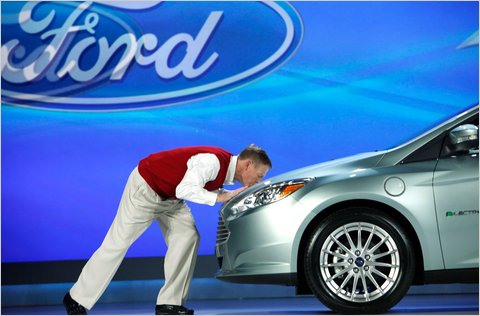
The importance of creating Connection Culture also came to my attention this week as I was doing research on Alan Mulally, Ford’s CEO.  Ford just announced its third full year of profit.  Frances Hesselbien, a friend and leader whom I much admire, has praised Mulally so I decided it’s about time that I take a closer look at his leadership of Ford.  In this splendid interview he did with The New York Times, Mulally recounts how he learned the importance of giving people autonomy, being inclusive, keeping people in the loop and connecting them to their organization’s “Inspiring Identity.”

In the coming weeks I’ll be speaking and teaching in Houston, Amsterdam, Brussels, London and Edinburgh.  As I travel, I’ll post new things I learn about connection.

Malcolm Gladwell, Atul Gawande on Connection

Several writers at The New Yorker understand how important the force of human connection is to help people thrive.  I’ve previously written about Ken Auletta’s masterpiece “The Howell Doctrine,” and, of course, there’s Jim Surowiecki’s The Wisdom of Crowds.  Two other writers at The New Yorker have made significant contributions on this topic.

In Atul Gawande’s The Checklist Manifesto, we learn that disconnection (the failure to communicate and connect) is the primary cause of aircraft accidents and a major contributor to medical errors.  Gawande, a surgeon, prescribes checklists to help improve performance as the work we do becomes increasingly complex.  Here’s one example.  Doctors at Johns Hopkins Hospital learned that surgical teams performed better when, prior to surgery, each member of the team introduced him or herself and shared any foreseeable concerns.  When surgical teams did this, lower status members were more likely to speak up if they saw mistakes being made.  This became a step on Gawande’s checklist he and his team developed for the World Health Organization.

In Malcolm Gladwell’s most recent book, Outliers: The Story of Success, connection is a theme throughout.  In the introduction, we learn that several research studies found residents of the town of Roseto, Pennsylvania were healthier and lived longer solely because they were a more relationally connected community.  In the next chapter, we learn that 10,000 hours of intentional practice is required with coaching (i.e. connection) to achieve expert level performance.  Although Gladwell doesn’t explicitly make this point, the support of family and friends is necessary to persevere through the inevitable difficulties of  practicing for 10,000 hours, which is 10 years of practicing for 20 hours a week.

In a chapter on geniuses, Gladwell concludes they are often not very successful because they fail to connect with other human beings and it renders them less effective at getting things done.  Similar to Gawande’s book, we learn that the key to airline safety is to reduce human error by making sure pilots, co-pilots and air traffic controllers are connected in both a rational and emotional sense.  Gladwell describes how the crash of a Columbian Airlines flight a few years ago because it ran out of fuel was attributable to a failure of communication between the co-pilot, pilot and air traffic controller at JFK Airport in New York.  The problem was that the plane’s co-pilot used “mitigating speech” to be respectful to those he perceived as having great status and authority.  When he needed to communicate the urgency of the situation he should have been screaming like a New York cab driver to make his point clear.

Finally, we learn from Gladwell about the success of the KIPP charter schools in low income urban neighborhoods.  Eighty percent of KIPP students go on to attend college.  KIPP students learn a protocal called “SSLANT” which stands for smile, sit up, listen, ask questions, nod when being spoken to, and track with our eyes.”  All of these behaviors help kids connect with others.  Brilliant, isn’t it.  KIPP teaches its students academic competence and relationship competence.  It was so inspiring to read how KIPP was giving these kids hope for a bright future, I wanted to stand up and cheer.

I very highly recommend both of these books.  They are utterly fascinating and well written, so much so that I couldn’t put them down.