

The year was 1958. Ed Mitchell, a 54-year old marketing and advertising executive, got off the commuter train from New York City and announced he was leaving the awful work culture he had put up with for years. Ed realized that being nice to people and caring about them were in his DNA and the work environments on Madison Avenue that he had experienced were indifferent to those values or viewed them as a weakness. Those toxic environments were literally giving him ulcers.
Ed decided to open a men’s clothing store in his hometown of Westport, Connecticut. This way he could create the environment that he wanted to work in. Ed began by selling a selection of three suits all hung on a pipe left over from the previous tenant, a plumber. Norma, his wife, made coffee for customers. The Mitchells’ friends showed up to support them. Ed loved being around people and getting to know them. He loved helping community organizations too. And the Mitchells’ store grew and grew.
Ed and Norma’s sons, Bill and Jack, eventually joined the business, as have members of the next generation of Mitchells. Eventually, they acquired two other stores that shared their philosophy: Richards in Greenwich, Connecticut and Marshs in Long Island. Mitchells/Richards/Marshs has been wildly successful. In 2002, they were named Menswear Retailer of the Year. Celebrities and corporate chiefs flock to their stores. The three stores are likely pulling in around $100 million a year in revenue.
What are the keys to their success? When you observe their business, a few things stand out. They value excellence in the products they sell and the services they provide. A business that attracts and retains the kind of demanding customers that Mitchells/Richards/Marshs has doesn’t succeed unless it meets its customers’ high expectations. What really differentiates Mitchells/Richards/Marshs is hugs. The “hug” is a metaphor for connecting with clients and associates and showing them you care. A hug is everything from knowing a customer’s pet’s name to going the extra mile to get a customer’s suit delivered on time for a special event. In service businesses, hugs are a source of competitive advantage. The Mitchells community (family, associates, customers and suppliers) hug each other a lot. Imagine a culture that lives by the Golden Rule and you’ll get a sense for what it feels like to be a part of this hugging community.
Now the hugging philosophy has gone global. And why not? It’s inspiring. It’s simple. It works. Jack Mitchell, chairman and CEO of Mitchells/Richards/Marshs, has written Hug Your Customers (available in several languages) and Hug Your People. I highly recommend both books. They will give you an up-close look at a thriving example of the Connection Culture I’ve written about that increases employee and customer engagement.
Ed and Norma Mitchell are no longer alive but their dream lives on and so does their example of how to treat employees like family and customers like friends. They started something great. You can find the inspiring story of how it all began on Jack Mitchell’s website under videos (it’s entitled “The Ed Mitchell Story”). To the casual observer, it may look like these unassuming merchants are mere purveyors of exceptional clothing and jewelry. In reality, it’s so much more. They’re philosophers in Armani and Zegna, spreading their beliefs one hug at a time.
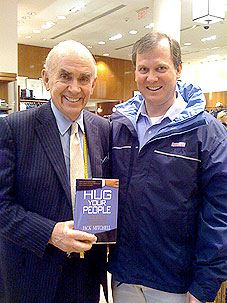
Picture: Jack Mitchell (on the left) with me at his book signing held at the Richards’ store in my hometown of Greenwich, Connecticut.


