

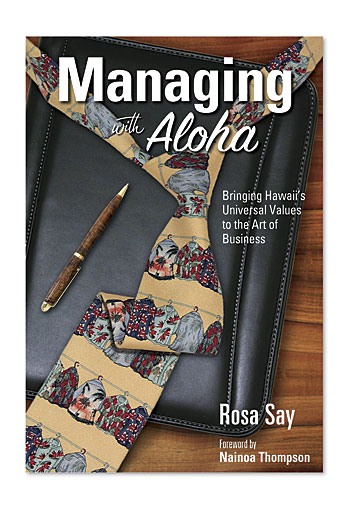
 Managing Aloha by Rosa Say is an excellent book that I’m adding to my recommended reading list for managers. Rosa Say is a Hawaii-based leadership and executive coach who formerly worked as a manager at various premier luxury hotels and resorts in Hawaii. In reading about her journey and experiences as a manager, we learn the values and practices that Rosa has identified as critical to success and happiness at work and in life. They are also the values that Rosa aspires to live out and to pass on to her children.
I thoroughly enjoyed reading this book. What was especially fascinating to me were the rich descriptions of the values Rosa identifies. While readers will recognize many as being the universal values identified by positive psychology research, Rosa expresses them in Hawaiian words and in an Hawaiian context. In doing so, the values are more resonnant, i.e. they connect more with Hawaiians. This greater emotional connection is in part due to the fact that expressing universal values in native terms and stories gives Hawaiians a “sense of place” and pride that Rosa writes about in the book. After reading Managing with Aloha, I now look for ways to contextualize values for those I’m teaching and training.
I appreciated the way in which Rosa introduced new values while connecting them to those introduced earlier in the book. This building approach helps readers see the inter-connections among the values and how they play out in real life rather than viewing them as discrete concepts that are unrelated to one another.
Rosa’s values provide the optimal mix of task excellence and relationship excellence that is required to achieve sustainable superior performance. In the stories she tells, we see a manager who expects excellence, and works hard to achieve it herself while caring about the people she is responsible for leading.
Another benefit that comes from reading this book is that you learn about the practices that Rosa has developed. One in particular is called “take five.” When a manager asks an employee to “take five” it is an invitation to meet briefly together so the manager can hear what is on the employee’s mind. This simple practice gives every employee an opportunity to express his ideas and opinions and it motivates him to be continuously thinking so that he will be prepared when it is his time to “take five.” This practice increases the elements of Value and Voice that I write and speak about in my work.
In addition to Managing with Aloha, I encourage you to check out several websites that Rosa maintains. Here are links to them:www.ManagingWithAloha.com
www.SayLeadershipCoaching.com
www.sayleadershipcoaching.com/MWAcoaching
www.sayleadershipcoaching.com/TalkingStory
www.JoyfulJubilantLearning.com
Category Archives: Intentional Connectors
Webcast: SabreTown Helps Sabre Holdings and Its Employees Thrive!
Join me in a webcast with my guest Al Comeaux, SVP of Corporate Communications for Sabre Holdings. Al will present an overview of SabreTown, the remarkable social networking platform Sabre built in-house. I saw Al’s presentation at a conference and was struck by the profound and positive impact SabreTown has had on Sabre Holdings. In Al’s presentation you will learn:
- how the SabreTown community is increasing connections among employees over geographic distances, while saving the company money and creating efficiency,
- how SabreTown has become a powerful knowledge management tool,
- what Sabre did that has resulted in an extraordinary rate of adoption by Sabre employees,
- how Sabre designed SabreTown so that it requires little oversight, and
- how SabreTown helps employees get up to speed faster.
If you work in information technology, corporate communications, employee engagement, training and development, or corporate learning functions, this is a presentation you don’t want to miss! I hope you’ll join me in this lively and enlightening webcast that shows how web 2.0 and corporate culture are combining to take organizations to the next step in their evolution. Click on “SabreTown Helps Sabre Holdings and Its Employees Thrive!” to sign up for the webcast.
U2: The “Band” as Family
Earlier this year I posted about the unity among the members of the band U2 and how it contributed to the band’s success. Comments from several individuals made me dig much deeper into the band’s story (thank you Astid, David Zinger, Lee Smith and Rachel for enlightening me). What I discovered was an extraordinary journey the band made to evolve into the force it is today.
The article I wrote about it was published today in The Economic Times (in India) and it will be published later this year in two of the American Management Association’s publications (Moving Ahead and the AMA’s Catalog). Here’s the link to The Economic Times’ article.
Let me know what you think.
Reducing employee anxiety
What can managers do to reduce the anxiety workers feel these days? Anita Bruzzese, award-winning journalist and workplace columnist for Gannett News Service, recently interviewed me about this topic for her nationally syndicated column. The article, entitled “In gloomy times, good management becomes essential,” has appeared in Gannett papers across the country.
Building Connections in a Disconnected Iraq
Last Thursday my wife and I attended the premiere of the new documentary Full Battle Rattle produced and directed by Tony Gerber and Jesse Moss. The documentary is about the U.S. Army’s billion dollar simulated Iraq in California’s Mojave Desert, complete with hundreds of exiles playing civilians and insurgents, terrorist suspects, grieving mothers, and innocent shopkeepers. It’s an extraordinary work that gives the viewer a very real sense of the challenges faced by an occupying force in a foreign land. A.O. Scott just reviewed the film for The New York Times. Here’s a clip about the movie from CNN.
Staying Connected With Your Family
My blog is primarily about Connection Cultures in the workplace and how they increase employee engagement. Connection is even more important at home. I’ve had several friends who were so swept up in their careers that they ignored and lost connection with their spouses. Their lives drifted apart and their marriages soon ended in divorce.
Maureen Dowd at The New York Times wrote a gem of an article entitled “An Ideal Husband” that infers the importance of relational connection in marriage. There’s a lot of wisdom in this article. I’ll be reading it soon to my two teenage daughters.
Wisdom in Starting on a Positive Note
It’s wise to begin your day on a positive note by saying “good morning” to your colleagues at work. Failing to recognize them is to communicate indifference. It’s also wise to begin every meeting with a positive comment. Research has shown that beginning a meeting with a positive comment makes group participants better listeners and makes the group more constructive. These benefits of starting your day and meetings off on a positive note are consistent with the findings of Professor Barbara Frederickson’s research on positive emotions.
I learned the foregoing from my friend Alex Kjerulf. Check out his Chief Happiness Officer blog and his book entitled Happy Hour is 9 to 5: Learn How to Love Your Job, Love Your Life and Kick Butt at Work.
Our Responsibility to Connect to the Disconnected Among Us
 Years ago when I attended a large church in Wheaton, Illinois, I remember the Asgedom family who came from a refugee camp in Sudan. They were ever present members of our church community. Mawi Asgedom was a young boy at that time. I recently learned that Mawi went on to graduate cum laude from Harvard in 1999 and was voted by his fellow students to be one of the Harvard’s four commencement speakers.
Standing before an audience of 30,000 Mawi gave a remarkable speech entitled “Of Snakes, Butterfies and Small Acts of Kindness.”
Forgiveness as a Bridge to Unity
 Nelson Mandela recently celebrated his 90th birthday. I’m grateful for this man and the wisdom of his example. When he entered Robben Island Prison he was known for confronting his enemies. When he was released 27 years later, Mandela stunned South Africans with his magnanimous behavior toward former adversaries.
Is Employee Engagement a Competitive Advantage?
Check out a wonderful column in today’s The New York Times written by one of my favorite journalists, Joe Nocera. The column is entitled, “The Sinatra of Southwest Feels the Love.” In it Nocera contrasts the sober atmosphere at American Airlines annual meeting in Dallas this last Wednesday morning to the lovefest at Southwest Airlines annual meeting that commenced a couple hours later across town. The article focuses on Southwest’s co-founder Herb Kelleher and his belief that treating your employees well provides a competitive edge. Nocera shares his observations about Kelleher and explores other possible reasons for Southwest’s success. Like everything Nocera writes, it’s an enjoyable read with thought-provoking observations and insight.