


Recently it was my privilege to be the guest of host Peter Clayton on Total Picture Radio. Peter is a well-respected thinker as well as an outstanding and insightful interviewer. In the interview we discussed how Connection Cultures increase employee engagement. You can access my interview with Peter by clicking here.
Category Archives: Employee Engagement
The ABC’s of Employee Engagement
Over at David Zinger’s blog you’ll find a fun and thoughtful list of ideas related to employee engagement from some top thinkers and consultants in the business. Although I don’t know all of the participants I have great respect for the participants I know including David Zinger, Robert Morris, Terrence Seamon, Steve Roesler and Tim Wright. I’m certain the others are top rate too. The free e-book is available at this link.
Lifehack Live Interview
Recently, I was interviewed by Dustin Wax of the popular Lifehack Live podcast on Blogtalkradio.com about Fired Up or Burned Out and how Connection Cultures increase employee engagement. To hear the interview click here. Lifehack.org is the premier personal development site on the web, with daily content on productivity, organization, communication, technology, and more. Lifehack live features interviews with leading personal development experts, roundtable chats on topics related to productivity, and an assortment of tips, tricks and hacks to help you make the most out of your life.
Stephen Paletta, The Biggest Giver
 Tonight, the judges for Oprah’s new hit show “The Big Give” selected Stephen Paletta as the biggest giver. My family and I just returned home from watching the Big Give with Steve’s family and friends at a local restaurant. Everyone attending the gathering was thrilled that Steve won because he is a big giver, in more ways than you might expect.
Cranky Middle Manager Interview
 I recently recorded an interview with Wayne Turmel, host of the “Cranky Middle Manager Show” on The Podcast Network. Wayne is an interviewer extraordinaire. His valuable insights and sense of humor always enliven and enlighten listeners (and guests) alike. Wayne and I had a great chat about Connection Cultures and how they increase employee engagement. To listen to the interview, click here. Also, be sure to check out the other 139 interviews Wayne has recorded since the Cranky Middle Manager show’s inception.
The Mitchells’ Mission: Conquer the World One Hug at a Time
The year was 1958. Ed Mitchell, a 54-year old marketing and advertising executive, got off the commuter train from New York City and announced he was leaving the awful work culture he had put up with for years. Ed realized that being nice to people and caring about them were in his DNA and the work environments on Madison Avenue that he had experienced were indifferent to those values or viewed them as a weakness. Those toxic environments were literally giving him ulcers.
Ed decided to open a men’s clothing store in his hometown of Westport, Connecticut. This way he could create the environment that he wanted to work in. Ed began by selling a selection of three suits all hung on a pipe left over from the previous tenant, a plumber. Norma, his wife, made coffee for customers. The Mitchells’ friends showed up to support them. Ed loved being around people and getting to know them. He loved helping community organizations too. And the Mitchells’ store grew and grew.
Ed and Norma’s sons, Bill and Jack, eventually joined the business, as have members of the next generation of Mitchells. Eventually, they acquired two other stores that shared their philosophy: Richards in Greenwich, Connecticut and Marshs in Long Island. Mitchells/Richards/Marshs has been wildly successful. In 2002, they were named Menswear Retailer of the Year. Celebrities and corporate chiefs flock to their stores. The three stores are likely pulling in around $100 million a year in revenue.
What are the keys to their success? When you observe their business, a few things stand out. They value excellence in the products they sell and the services they provide. A business that attracts and retains the kind of demanding customers that Mitchells/Richards/Marshs has doesn’t succeed unless it meets its customers’ high expectations. What really differentiates Mitchells/Richards/Marshs is hugs. The “hug” is a metaphor for connecting with clients and associates and showing them you care. A hug is everything from knowing a customer’s pet’s name to going the extra mile to get a customer’s suit delivered on time for a special event. In service businesses, hugs are a source of competitive advantage. The Mitchells community (family, associates, customers and suppliers) hug each other a lot. Imagine a culture that lives by the Golden Rule and you’ll get a sense for what it feels like to be a part of this hugging community.
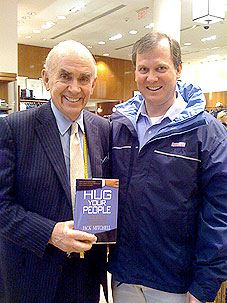
Now the hugging philosophy has gone global. And why not? It’s inspiring. It’s simple. It works. Jack Mitchell, chairman and CEO of Mitchells/Richards/Marshs, has written Hug Your Customers (available in several languages) and Hug Your People. I highly recommend both books. They will give you an up-close look at a thriving example of the Connection Culture I’ve written about that increases employee and customer engagement.
Ed and Norma Mitchell are no longer alive but their dream lives on and so does their example of how to treat employees like family and customers like friends. They started something great. You can find the inspiring story of how it all began on Jack Mitchell’s website under videos (it’s entitled “The Ed Mitchell Story”). To the casual observer, it may look like these unassuming merchants are mere purveyors of exceptional clothing and jewelry. In reality, it’s so much more. They’re philosophers in Armani and Zegna, spreading their beliefs one hug at a time.
Picture: Jack Mitchell (on the left) with me at his book signing held at the Richards’ store in my hometown of Greenwich, Connecticut.
Misunderstood: Steve Jobs and Apple
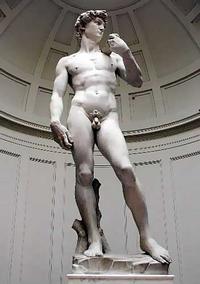 Apple is on a roll. And so is its co-founder Steve Jobs. Why?
In a world of muted, bland corporate identities and product designs, Apple dares to take a stand. Its corporate visual identity, store design and product designs are inspiring. They move people on an emotional level when most products utterly fail to inspire. Who can forget the Think Different ads featuring iconic individuals such as Gandhi, Einstein and Picasso, the animated ads featuring U2 performing their hit song “Vertigo,” or the stunning design of the iPhone? When critics of the iPhone complained that Apple sacrificed battery functionality for design, I thought to myself, “what did they expect?” Steve Jobs has an off the charts passion for aesthetic beauty and excellence. Understanding this is key to decoding what Jobs and Apple are all about. It also helps explain why they’ve been extraordinarily successful.
Let’s begin by making it clear what Steve Jobs is not.
The Connected Class

Last week it was my honor to speak about Connection Cultures to the first graduating class of students in the MBA Program for Executives at the University of Virginia’s Darden Business School. It was thrilling to see how they picked up on the importance of connection at work and in life. As I spent more time with them, I began to see why connection resonated with the class of 2008.
Share your thoughts with journalist William J. Holstein on his BNet Blog
William J. Holstein, the well-respected business journalist who writes for The New York Times, The Wall Street Journal, Business Week and other publications, described my new ebook on connection this way: “For those of us who write about business, every once in a while, a book or an article comes along that seems so simple on some levels yet communicates great wisdom. “The Connection Culture: A New Source of Competitive Advantage” is one such work.”
On his blog, Holstein invites readers of The Connection Culture to share their thoughts. Would you consider sharing your reaction by posting a comment on Holstein’s BNet blog entitled “The Corner Office?”
WCBS-AM New York City interview on the “Lonely Leader”
Earlier this week I spoke with Pat Farnack, WCBS New York City news radio’s daytime host, about how Eliot Spitzer appears to fit the profile of the lonely leader. Since the interview, several other political leaders around the world have confessed to extramarital sexual encounters including Spitzer’s successor. Listen to this interview to find out what is often the root cause of this behavior and how it affects employee engagement when it comes to leaders. Here is a link to the lonely leader interview.