Upcoming Leadership Events

Below are links to several leadership events that Jason Pankau and I will be speaking at or participating in.

On January 27, I’ll join Dean Homer Erekson of the Neeley School of Business at TCU where we will discuss leadership and employee engagement as part of the Tandy Leadership Speakers Series.

On February 10-11, I’ll be in London participating in the HTB Leadership Conference.

On March 4-6, I’ll be in at the Homestead resort in Virginia where my colleague Jason Pankau will speak at the New Canaan Society Annual Retreat.

On March 7-9, I’ll be speaking about leadership, employee engagement, productivity and innovation at the National Human Capital Summit in Atlanta.  I hope you’ll check it out and consider attending.

On March 10-11, Jason Pankau and I will be speaking about Connection Cultures, leadership, employee engagement, productivity and innovation at the Learning for Life Conference in Reno, Nevada.

Coming Talent Shortage Relevant to Nations, Organizations, Managers

Take a look at this fascinating article in Foreign Affairs by Nicholas Eberstadt entitled “The Demographic Future.” It has an excellent discussion of how population and labor supply around the world will change over the next 20 years as a result of the nearly 50 percent decline of fertility worldwide over the last half century. The larger point of the article is that although many nations are presently experiencing an excess supply of labor, a shortage is certain to result as baby boomers retire and the economy resumes growing. The analysis in the article points out the need for nations to improve educational opportunities, health conditions and economic environments.  In addition, it supports the need for nations to create Connection Cultures that will attract and retain immigrant talent to their home markets, the need for organizations to create Connection Cultures that will attract and retain talent to their organizations, and the need for managers to create Connection Cultures that will attract and retain talent to the units they lead.

How Solitude Shapes Great Leaders

Take time to read this thoughtful speech entitled Solitude and Leadership by William Deresiewicz given to this year’s plebe class at West Point. He describes how great leaders develop the courage of their convictions, which includes moral courage. Reflection, time alone with one’s thoughts, interactions with trusted friends and reading great books, as Deresiewicz says, are part of the mix.  What he didn’t adequately include is the impact of one’s experiences in life including one’s family of origin and periods of adversity and suffering that breed humility.  Despite its shortcomings, it’s a fine speech and well worth taking time to read.

Many thanks to David Books of The New York Times for bringing this thoughtful speech to my attention.  Brook’s recognized Deresiewicz’s speech as one of the best pieces of long journalism written in 2010.

Motivate Employees Now

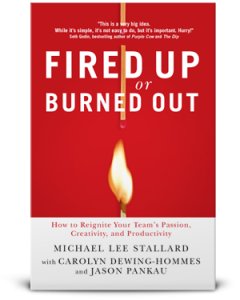
Fired_Up_or_Burned_Out_Book_CoverThis morning appeared as a guest on my friend Jim Blasingame’s nationally-syndicated “Small Business Advocate” radio program where we talked about leadership, employee engagement and productivity.  During the program, Jim and I discussed how the three core elements of a Connection Culture — Vision, Value and Voice — motivate employees to give their best efforts and align their behavior with organizational goals.  One of the ideas I shared was to bring employees together to read and discuss a management book including how it applies to their business.  To get them started,  I offered a free download of the digital version of Fired Up or Burned Out to listeners who sign up for my email newsletter.  To sign up for the newsletter and access the free book download click on this link.

Shine the Light on Others

u2_wallpaper_rattle_humBono, megastar of the rock band U2, frequently shines the light on his fellow band members.  In the photo above, Bono is shining a spotlight on The Edge, U2’s legendary lead guitar player. Bono does this in a metaphorical sense too.  Bono has stated that he’s a lousy guitar and keyboards player, and that his gifted fellow band members bring to life the melodies he hears in his head. He’s also said that being around his fellow band members makes him a better human being. Furthermore, Bono has said that when one of one of his fellow band members is in need it takes precedence over the band’s music.

Are you shining the light of recognition and belonging on your family members, your friends and your colleagues at work?  Here are some actions to consider:

  • When you see someone doing something that’s admirable, be sure to let them know that you recognize it.
  • Tell your family members and friends how much and why you appreciate them.
  • When you are in a group discussion, praise others for their good ideas and opinions.
  • Send a hand-written personal note of appreciation to a family member, friend or colleague at work.
  • When a family member, friend or colleague at work is sick, send them a get well gift.
  • When a family member, friend or colleague at work has something to celebrate congratulate them.


Connection Cultures on Gary Hamel’s MIX

Recently I was delighted to see two great case studies written by good friends of mine appeared on Gary Hamel’s MIX.  Both case studies reflect elements of the Connection Culture that I wrote about in Fired Up or Burned Out.  The first case study written by Deborah Mills-Scofield is entitled “The 160-year old Startup.” The second case study written by Drew Williams is entitled “Restoring Faith in the Institution: How Mission Shaped Communities Revitalized St. Andrews.”  I encourage you to check them out!

Pixar’s Competitive Advantage? A Connection Culture

IMG_0504

At the Technical Academy Awards ceremonies held in Hollywood, the Associated Press reported that it wasn’t the host, actress Jessica Biel, who attracted the most attention. Instead, it was an understated, bespectacled, computer engineer named Ed Catmull. When Catmull’s name was announced to receive an Oscar for his lifetime of work in computer animation, the crowd went wild, whistling and whooping. And rightly so. The impact Catmull and his collaborators have had on Hollywood may last for decades to come.

Ed Catmull is the president of Pixar and Disney Animation Studios. He has rejected the traditional Hollywood star system and its often toxic work environment and replaced it with an environment that emphasizes community and long-term relationships. Catmull described it this way in a Harvard Business Review article he wrote: “[Pixar has] an environment that nurtures trusting and respectful relationships and unleashes everyone’s creativity…the result is a vibrant community where talented people are loyal to one another and their collective work, everyone feels that they are part of something extraordinary, and their passion and accomplishments make the community a magnet for talented people…”

What is it about Pixar’s environment that attracts talented employees and helps them produce outstanding movies such as the blockbuster hits Toy Story, Finding Nemo, The Incredibles, Ratatouille, and WALL-E that have made Pixar the envy of Hollywood?

Employee Engagement Webinar Today

ntmn


Jason Pankau and I will present a webinar today on employee engagement and alignment.   The webinar is for the New Talent Management Network. It will be held from Noon until 1:00 PM Eastern.  Additional details and sign up information are at 
this link. Webinar participants can access the free download of the digital copy of our book Fired Up or Burned Out by signing up for our newsletter at this link.

Chief Happiness Officer at TED

Watch my friend Alexander Kjerulk, the Chief Happiness Officer, speaking at TED Copenhagen about happiness at work. You’ll love it. Alex is fun and thoughtful. He provides a global perspective on happiness at work. Not to mention that you’ll learn about

The happiest bus driver Alex ever met.
The strange Danish word arbejdsglæde, and why the rest of the world needs to learn it.
What makes us happy in life and at work.
Why Denmark isn’t really the happiest country.
What you can do to be happy at work.

Overcoming Leadership Myopia

Howard Behar and Michael Lee Stallard

American leaders need to wake up and smell the coffee. Research from two well-respected organizations makes it clear that we have a big collective blind spot that’s dragging down productivity, innovation and economic performance. Earlier this year, a Conference Board research report showed that job satisfaction is at the lowest level since the organization began measuring it more than 20 years ago. The report went on to show this has been a long-term downward trend rather than a temporary decline due to the Great Recession.

Another well-respected organization, the Corporate Executive Board, came out with a research report last year that showed 90 percent of employees are either not aligned with organizational goals or not engaged and giving their best efforts. It’s nearly impossible to pull out of difficult economic seasons when nine out of ten employees are just showing up for the paycheck. We need everyone to pull together in the same direction to lift us out of this slump. What can be done?