

Mike Kanazawa has written a terrific new manifesto for changethis.com entitled People Don’t Hate Change, They Hate How You’re Trying to Change Them. In it he explains why change programs fail to gain traction. Mike is the CEO of Dissero Partners. He is also the co-author with Robert Miles of the excellent book entitled Big Ideas to Big Results. Mike understands the importance of focus, of connecting with people and being inclusive by keeping people informed and giving them a voice in the change process. After you check out Mike’s free, downloadable manifesto, I’m sure you’ll want to go deeper by reading his book.
Category Archives: Book Reviews
Great books to read as a team
Book Review: Manage the Media
Award-winning, veteran journalist William J. Holstein has written a little gem of a book filled with wise advice for CEOs about how to manage today’s media. Manage the Media is one of Harvard Business Press’s new “Memo to the CEO” series. It’s a quick read and to the point which should be perfect for time-starved executives. I highly recommend it for CEOs, board members, members of senior management and anyone interested in media coverage of organizations.
A poignant journey to heal and reconnect
 In honor of Mother’s Day tomorrow, I am taking a break from writing about connection at work to focus on connection in families. Each of us experience times in life when we feel disconnected from family members. The lack of relational intimacy with the people we love can be especially painful. It often contributes to unhealthy behaviors as a means to cope with the pain. In the stories of individuals who break their addiction, you will nearly always find one person or a group of people who helped heal the wounds of the addicted with love and encouragement.
Lost & Found is the poignant story of Kathryn Slattery, a contributing editor of Guideposts magazine and author of several books. In the book, Kitty describes her disconnection with her mother and father, the onset of bulimia, how her husband Tom’s love and encouragement helped her overcome bulimia, and finally how Kitty reconnected with her parents.
I enjoyed this book.
The Mitchells’ Mission: Conquer the World One Hug at a Time
The year was 1958. Ed Mitchell, a 54-year old marketing and advertising executive, got off the commuter train from New York City and announced he was leaving the awful work culture he had put up with for years. Ed realized that being nice to people and caring about them were in his DNA and the work environments on Madison Avenue that he had experienced were indifferent to those values or viewed them as a weakness. Those toxic environments were literally giving him ulcers.
Ed decided to open a men’s clothing store in his hometown of Westport, Connecticut. This way he could create the environment that he wanted to work in. Ed began by selling a selection of three suits all hung on a pipe left over from the previous tenant, a plumber. Norma, his wife, made coffee for customers. The Mitchells’ friends showed up to support them. Ed loved being around people and getting to know them. He loved helping community organizations too. And the Mitchells’ store grew and grew.
Ed and Norma’s sons, Bill and Jack, eventually joined the business, as have members of the next generation of Mitchells. Eventually, they acquired two other stores that shared their philosophy: Richards in Greenwich, Connecticut and Marshs in Long Island. Mitchells/Richards/Marshs has been wildly successful. In 2002, they were named Menswear Retailer of the Year. Celebrities and corporate chiefs flock to their stores. The three stores are likely pulling in around $100 million a year in revenue.
What are the keys to their success? When you observe their business, a few things stand out. They value excellence in the products they sell and the services they provide. A business that attracts and retains the kind of demanding customers that Mitchells/Richards/Marshs has doesn’t succeed unless it meets its customers’ high expectations. What really differentiates Mitchells/Richards/Marshs is hugs. The “hug” is a metaphor for connecting with clients and associates and showing them you care. A hug is everything from knowing a customer’s pet’s name to going the extra mile to get a customer’s suit delivered on time for a special event. In service businesses, hugs are a source of competitive advantage. The Mitchells community (family, associates, customers and suppliers) hug each other a lot. Imagine a culture that lives by the Golden Rule and you’ll get a sense for what it feels like to be a part of this hugging community.
Now the hugging philosophy has gone global. And why not? It’s inspiring. It’s simple. It works. Jack Mitchell, chairman and CEO of Mitchells/Richards/Marshs, has written Hug Your Customers (available in several languages) and Hug Your People. I highly recommend both books. They will give you an up-close look at a thriving example of the Connection Culture I’ve written about that increases employee and customer engagement.
Ed and Norma Mitchell are no longer alive but their dream lives on and so does their example of how to treat employees like family and customers like friends. They started something great. You can find the inspiring story of how it all began on Jack Mitchell’s website under videos (it’s entitled “The Ed Mitchell Story”). To the casual observer, it may look like these unassuming merchants are mere purveyors of exceptional clothing and jewelry. In reality, it’s so much more. They’re philosophers in Armani and Zegna, spreading their beliefs one hug at a time.
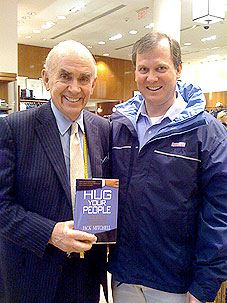
Picture: Jack Mitchell (on the left) with me at his book signing held at the Richards’ store in my hometown of Greenwich, Connecticut.
Free EBook at Changethis.com
 Changethis.com has posted my new downloadable, free EBook entitled The Connection Culture: A New Source of Competitive Advantage. For all of those individuals you know who don’t have time to read Fired Up or Burned Out or who want to investigate further before purchasing a copy, this is a perfect introduction to the ideas of E Pluribus Partners including why we need to create Connection Cultures. Help us spread the word by forwarding a copy to everyone you know who needs to read it.
CausePlanet.org features Fired Up or Burned Out in March
 CausePlanet.org selected Fired Up or Burned Out as its featured book summary for March. CausePlanet.org is an organization that provides nonprofit executives and their board members from the business sector a one-stop source for news, articles, and recommended published works. The book summary includes nonprofit applications and interpretations. Nonprofit executives will get fast information about how the book is applicable to the nonprofit world and why they should buy it, as well as an author interview. After readers have screened the summary for its relevance in their respective professional stations, they can click on a link to purchase it.
Book Review: Happy Hour Is 9 to 5, by Alexander Kjerulf, the Chief Happiness Officer
 Did you know the Danish language has a specific word for “happiness at work?” The word is “arbejdsglaede.” Don’t ask me to pronounce it.
Thanks to Alexander Kjerulf, a Dane who is also known as the Chief Happiness Officer, I now know of this wonderful yet difficult to pronounce word. And thanks to Alex’s book, entitled Happy Hour is 9 to 5: Learn How to Love Your Job, Create a Great Business and Kick Butt at Work, I’ve learned even more about happiness at work.
Alex’s writing has a fun, conversational style, just like you would expect from the Chief Happiness Officer. Don’t mistake this for fluff, however. He covers a lot interesting material in a thoughtful, smart way. I especially liked the research he presented on the effect of starting meetings out on a positive note, his thoughts on the cult of overwork, how to tell a bad boss to improve and his frank advice in a section entitled “should I stay or should I go?” There is a very good chapter about what managers can do to help make people happy at work. This is a pragmatic book filled with ideas and suggestions.
You can purchase Alex’s book, purchase and download it in a pdf format, or read it for free. All three options are available at his Chief Happiness Officer blog (www.positivesharing.com). In addition to Alex’s book, his blog has a lot of interesting material too. Be sure to check it out. You’ll be happy you did.
Book Review: Big Ideas to Big Results by Michael Kanazawa and Robert H. Miles
 Leaders of organizations would be wise to follow the advice of Michael Kanazawa and Robert H. Miles in their excellent new book entitled Big Ideas to Big Results. The book lays out their ACT process for organizations that want to implement three to four major initiatives each year.
The authors developed the process to combat corporate ADD and employee disengagement when it comes to executing organizational initiatives. Based on my more than 25 years experience in business as well as my expertise in employee engagement, I completely agree that these are major problems in organizations today and the solution the authors propose will go a long way toward solving them. The ACT process is also entirely consistent with the employee engagement research we have conducted at E Pluribus Partners. The process helps meet universal human needs for respect, recognition, belonging, autonomy, personal growth and meaning. When these needs are met, people thrive, individually and collectively.
Strong leaders will recognize many of the best practice steps that are a part of ACT. What makes this book valuable is the way the authors integrate the best practices into a step-by-step process and add ideas of their own. I especially liked their descriptions of annual high employee engagement cascades with tablework and quarterly mini-cascades. It’s worth buying the book just to learn more about these practices alone.
Big Ideas to Big Results will be popular with corporate leaders. It’s a quick and easy read with a process that is practical to implement and will help move organizations from identifying big ideas to producing big results. Congratulations to Kanazawa and Miles for developing an important new contribution to process innovation and describing it in an accessible way.
Book Review: Remarkable Leadership by Kevin Eikenberry
 Kevin Eikenberry and I met in December 2007 at 800-CEO-READ’s Pow Wow for business authors. His new book entitled Remarkable Leadership is impressive for the breadth and depth of material it covers. I’m not surprised. Kevin is an energetic individual who combines a passion for leadership with a bright mind and extensive experience. Reading Kevin’s book is like working with a great leadership teacher and leadership coach combined in one individual. The teacher in Kevin explains leadership concepts in understandable ways and the coach makes practical suggestions about how to implement the concepts.
The book is also user-friendly. It is well-organized into a logically-sequenced presentation of concepts and practices. Kevin’s positive attitude and conversational writing style make this book easy to read.
Let me mention several other reasons why Remarkable Leadership is a standout among leadership books. I liked that Kevin shares gems he discovered in other leadership books. It says a lot about Kevin that he has the humility and curiosity to read extensively about leadership and that he has the confidence and integrity to share with us what he learned from others while conspicuously noting his sources in the text. He gives credit where credit is due (like a remarkable leader should). Kevin emphasizes that becoming a remarkable leader is a journey rather than something that can be easily and quickly accomplished. He also encourages reflection, including the use of a Learning Journal. Throughout the book Kevin also points the reader to additional downloadable content available at RLBonus.com.
In summary, if you aspire to be a remarkable leader, you would be wise to purchase this book, read and reflect on its advice, and then put it into practice. If you purchase it soon, Kevin is including access to additional resources that you can find out about by clicking here.