

Many thanks to Michael Hyatt for featuring my guest post entitled “John Wooden and the Power of Virtue in Leadership” on his blog. Michael’s blog was recently recognized and the #1 leadership blog. Not bad considering his day job is CEO of America’s 7th largest trade book publishing company, Thomas Nelson.
Tag Archives: teamwork
Research: Employee Engagement = Connections

This month Jason Pankau and I will be speaking to leaders at NASA’s Johnson Space Center, Johnson & Johnson, the Internal Revenue Service and to church leaders at LifeSpring Network’s Conference on Connection Culture & Discipleship.
In recent presentations, we’ve emphasized the importance of research from The Conference Board that concluded after studying 30 definitions of employee engagement used by consulting firms, the best definition is as follows:
“Employee engagement is a heightened emotional and intellectual connection that an employee has for his/her job, organization, manager, or coworkers that, in turn, influences him/her to apply additional discretionary effort to his/her work.”
This definition is consistent with our research at E Pluribus Partners where we frequently heard respondents use the terms “connect” or “feel connected” to describe the emotions they experience in relation to their organization’s identity, the people they work with and their day-to-day work.
In our book Fired Up or Burned Out and in The Connection Culture Manifesto, we identify and describe the “force of connection” as
“a bond based on shared identity, empathy and understanding that moves self-centered individuals toward group-centered membership.”
After defining connection, we identify the “Connection Culture” as an environment producing emotional and rational connections that, as The Conference Board’s definition says, “influences [people] to apply discretionary effort to [their] work.”
The Connection Culture meets universal human needs for respect, recognition, belonging, autonomy, personal growth and meaning. When these needs are met, people thrive individually and collectively. The Connection Culture is ultimately grounded in character strengths and virtues. Learn more by reading the manifesto or go even deeper by reading our book. For the latest developments and examples about how to boost connection, stay tuned to blog posts here and consider following my tweets on www.twitter.com/michaelstallard.
John Wooden: What the Obituaries Missed
John Robert Wooden, the legendary basketball coach, died yesterday. He was 99 years old. This morning I read Wooden’s obituaries in The New York Times and the Associated Press and felt they missed important aspects of his story that reflect the essence of the man and his legacy.
I profiled Wooden as a role model who we can all learn from in my book Fired Up or Burned Out. Wooden’s favorite saying was “a life not lived for others is a life not lived.” He said his heroes were his father Joshua Wooden, Abraham Lincoln and Mother Theresa, each of whom lived a life of service to others. In John Wooden’s honor, I’m posting the following excerpts from my book:
Connection and the Legend
So often in life, good things bloom from the seeds of hardship. The personal character of a young teenager who went on to become a great leader was immeasurably shaped during the Depression when his family lost their farm in Indiana. His father’s reaction to the loss was unusual. He wasn’t bitter about it. Instead, his dad focused on the future and told his children that everything would be all right. And it was.
During those impressionable years in this leader’s life, he learned that, like the Depression, some things in life are not in our control. His father taught him that he should always strive to do his best at anything he chose to do and not worry about the outcome. He would later spread that philosophy to countless other.
Another perspective he gained during those formative years was to value people. By watching his mom and dad and hearing the stories of faith they taught him, he learned the joy that came from making people and relationships his focus in life.
The young boy grew up to be an outstanding high school and college basketball player in a state that was rabid about the game. After college he married Nell, the love of his life and the only woman he had ever dated. He taught high school English and coached basketball until 1943 when he enlisted to serve in the Navy during World War II. When he returned from the war to the high school in South Bend, Indiana, where he previously taught, he was offered his old job. Other returning GIs were not, however, and so he refused the offer because he felt it was wrong for the school to deny veterans the jobs they had left to serve their country. Instead, he accepted an offer to become athletic director and head basketball coach at Indiana State Teachers College.
A Caring Coach
For the 1946-47 season Indiana State received a post-season invitation to the National Association of Intercollegiate Basketball (NAIB) national play-offs. After the coach learned that a young African-American, second-string guard on his team, Clarence Walker, would not be allowed to participate in the tournament because of the color of his skin, he declined the offer.
Sustainable Organizations: The Ideas of Martin Seligman
In an earlier post, I wrote that the ideas of thought-leader Dov Seidman, CEO of LRN and author of How, are likely to have a profound effect on organizations in the years to come. In this second post on thought leaders affecting the evolution of organizations, I highlight the work of Martin Seligman.
Seligman, a psychology professor at the University of Pennsylvania, founded the positive psychology movement when he became president of the American Psychological Association. There isn’t adequate space in this post to provide an overview of positive psychology, so for those who are interested in learning more, I highly recommend reading an article co-authored by Seligman entitled “Positive Psychology: An Introduction” and a New York Times’ Magazine article entitled “Happiness 101” that describes how the positive psychology movement is growing.
Positive psychology has identified 24 character strengths that it believes — and a growing body of research shows — affect human flourishing. These character strengths are universal. Religious thinkers and moral philosophers throughout the ages have advocated them. Political, social and economic cultures that have been sustained for long periods of time have these values and systems that don’t (i.e. coercive utopian systems such as communism and fascism), fail because the values they promote work against human flourishing.
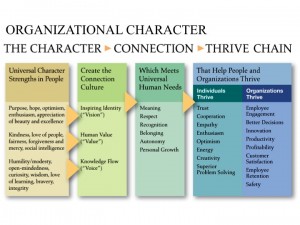
Our research at E Pluribus Partners identified a “Character > Connection > Thrive Chain” (see below) that posits organizations and individuals thrive because they are comprised of people who embrace and behave in ways that reflect the character strengths and in doing so create “Connection Cultures” which meet universal human needs such as meaning, respect, recognition, belonging, autonomy and personal growth. Learn more about positive psychology and the Character >Connection>Thrive Chain on pages 116-130 of the free digital book download of Fired Up or Burned Out.
Recent research from The Conference Board and the Corporate Executive Board make it clear that employee engagement is at dismal levels but eventually leaders will discover that embracing and behaving in ways that reflect the 24 character strengths creates Connection Cultures and develops the corporate character strengths necessary to produce sustainable organizations.
(To enlarge the diagram below, click on it once until it appears then click on it a second time for an enlarged version.)
Leaders of the New Century
On June 23, I’ll be filming a few video segments for the Leader to Leader Institute’s “Leaders of the New Century” project that includes Allan Mulally of Ford, Sir Richard Branson and Tony Hseih of Zappos. Next week the Summer edition of the Leader to Leader Journal comes out. It includes an article that Jason Pankau and I wrote entitled “To Boost Productivity and Innovation, Connect with the Core.” The article is about how great leaders don’t just focus on star performers, they are intentional about connecting with employees at large. Examples in the article include Ret. U.S. Chief of Navy Operations Admiral Vern Clark and Bono, the lead singer for the rock band U2.
What Are “Sustainable Values”?
In my last post, I wrote about “sustainable values,” i.e. the beliefs and behaviors that produce an inspiring identity, human value and knowledge flow in groups that help people thrive individually and collectively. In other words, when a group embraces and behaves in ways that are consistent with sustainable values, it leads to sustainable superior performance.
In our work, we recommend that leaders of organizations promote the universal character values celebrated by religious thinkers and moral philosophers throughout history. Cultures that have these values exhibit superior strategic alignment, employee engagement, productivity, innovation and overall performance. Researchers that are part of the American Psychological Association’s positive psychology research effort identified these values as helping people flourish and a body of large body research is developing in support of that view. Here’s a list of the values and their definitions:
Tom Friedman, Dov Seidman: Need For “Sustainable Values”
Check out Tom Friedman’s column in today’s New York Times at this link. Friedman cites Dov Siedman’s belief that in an interconnected world we need “sustainable values” more than ever. I couldn’t agree more. In past posts I’ve written about Dov, his book entitled How and LRN, the company he founded to promote principled leadership.
In our work at E Pluribus Partners, we promote universal character values and virtue as essential for people to thrive, individually and collectively. Our “Character > Connection > Thrive Model” (see below) lays out the rationale. In a nutshell, individuals who believe and behave in ways that are consistent with Universal Character Values (also known as character strengths), create “Connection Cultures” that meet universal human needs to thrive. You can learn more about Connection Cultures, Universal Character Strengths and Virtues by reading this free manifesto published by changethis.com entitled The Connection Culture: A New Source of Competitive Advantage.

What Steve Jobs, Ed Catmull and A.G. Lafley have in common
Jobs, Catmull and Lafley connect with employees of their respective organizations, although they do so in distinctly unique ways. This is the topic of a webinar Jason Pankau and I will be doing for Communitelligence. You can learn more about it at this link. This topic is relevant today because Corporate Executive Board research shows that 90 percent of employees are either not engaged and giving their best efforts or they are not aligned with their organization’s goals. Research by both The Conference Board and the Corporate Executive Board shows that the solution to this problem to develop the emotional and rational connections that employee have with their organization’s mission and values, supervisor, colleagues and day-to-day work tasks. In the webinar, Michael and Jason show how great leaders do this.
Leaders Shape Stories
Mark Sanborn just said people should slow down, reflect and be shapers of stories. How true! It made me think of a scene in the movie Apollo 13 when Mission Director Gene Kranz changed the story of the Apollo 13 mission failure from being about a potential disaster to being one of NASA’s greatest moments by bringing the astronauts safely home despite the odds against them. For those who don’t know, NASA performed heroically and saved the three astronauts lives.
Last week I spoke to a leader at NASA’s Johnson Space Center who told me that Gene Kranz’s famous line “failure is not an option” that he stated in the movie still influences NASA’s culture today. On June 17, Jason Pankau and I will be speaking to leaders at the NASA Johnson Space Center where Gene Kranz uttered those famous words that reshaped NASA’s story. We feel a sense of awe and humilty to have an opportunity to speak at NASA. We hope to inspire NASA’s leaders about how important it is to create a Connection Culture so that they will thrive, individually and collectively.
Winning Workplaces’ Article on Connection
Winning Workplaces just featured an article that Jason Pankau and I wrote in its April newsletter and on its website. The article is entitled “To Boost Productivity and Innovation, Fire Up the People You Lead.” Check out the article and the Winning Workplaces website, it has great ideas, many written by one of our favorite bloggers Mark Harbeke. Mark is Winning Workplaces’ Director of Content Development.