
Closing Your Company’s “Leadership Gap”

The Office Cast, Photo Courtesy of NBC

The Office Cast, Photo Courtesy of NBC

Historically, leaders have relied on their internal networks and intuition to assess employee engagement and strategic alignment.  Tom Peters and Robert Waterman called it “management by wandering around” or “MBWA” in their classic book In Search of Excellence.

Just as intuition once tricked us into believing that the world was flat and the sun rotated around the earth, it is a flaw of human nature that most leaders are mistaken in their assessment of the engagement and alignment of people they lead. They don’t recognize employee engagement and alignment problems until they feel the pain from underperformance or face reality in the form of poor results from an employee engagement survey.
The Collective Wisdom of Relationship-Centered Networks

When individuals feel like valued members of a group, it boosts a host of positive outcomes including superior decision-making, employee engagement, employee motivation, strategic alignment, organizational learning, cooperation, productivity, innovation and overall performance. This applies to groups of all sizes including classrooms and schools, families, business and government organizations, hospitals, sports teams and the social sector.  Strong relationships are key for any group to achieve the benefits enumerated above.

In an earlier post, I wrote about the University of Chicago research on relational trust that I learned about from my friend Parker Palmer.  For those of you who are interested in relational trust and the wisdom of crowds, I encourage you to check out this fascinating interview my friend Robert Morris, the freelance writer, did with Alan Briskin, co-author of The Power of Collective Wisdom. In the interview, Briskin and Morris discuss relationship centered networks that tap into collective wisdom.

For those of you who read Robert Morris’ book review and interview, you will see why I believe he is among the very best at what he does.  In addition to being a well-organized, clear writer, Morris is a Renaissance man who always sprinkles his writings and interviews with thoughtful insights drawn from remarkably diverse fields of knowledge.  Check out his book reviews and interviews at this link and you’ll see what what I mean.

How Paul O’Neill Fired Up Alcoa’s Culture

This week I taught a workshop for the Institute for Management Studies on strategic alignment and employee engagement.  The workshop was held in Pittsburgh and leaders from many the area’s top organizations were in attendance.  The workshop was hosted by IMS chair Mark Spear.  Mark has great tremendous breadth and depth of experience in organizational development.  One of his previous employers was Alcoa.  Over dinner the night before the workshop, Mark praised Paul O’Neill’s leadership of Alcoa during what many current and former employees of the company refer to as the “golden age of Alcoa.”  One observation Mark shared was that O’Neill regularly met with groups of employees to answer any questions they had and to ask them questions.He was approachable, humble, open-minded and inquisitive.   This is an example of what I refer to as a leader who conducts “Knowledge Flow Sessions” that have increase strategic alignment, employee engagement, productivity and innovation.  The story was so compelling I asked Mark to share it with attendees when I presented the section on “Knowledge Flow.”  If you are interested in Paul O’Neill’s leadership style and legacy, take a look at this article that appeared in Business Week.

Human Value Boosts Employee Engagement

Amy Wrzesniewski, Associate Professor of Organizational Behavior Yale School of Management, recently sent me a paper she co-authored with Jane Dutton (University of Michigan) and Gelaye Debebe (George Washington University) entitled “Caring in Constrained Contexts.”  Reading it made me realize that for workers in low status positions the indifference and incivility they experience is in part why 90 percent of employees today are either disengaged or not aligning with organizational goals.  Reading the comments of workers provides a technicolor view of their day-today experiences. Here are a few excerpts:

  • “The doctors have a tendency to look at us like we’re not even there, like, you know, we’ll be working in the hallways, and you know, no recognition of what you are doing whatsoever.”
  • “A typical day with the nurses down here would be I come in at about 4:30. I set my cart up in my area. … they do a lot of staring and gawking. I don’t know the purpose of this. It’s a very uncomfortable feeling for me.”
  • “I was called as a favor to my supervisor to come up …and clean a room because the patient’s family was complaining that the room was filthy. It was supposed to be cleaned by the day shift and evidently the day shift has skipped over that particular room…And you have these people shouting, ‘This room is filthy,’ and this, that, and the other, and ‘I want this room cleaned now.’”
  • Doctors will do things like, you know, they’ll do an exam, take off their gloves and drop them on the floor. You know, just things like that…they don’t even think, you know, they expect housekeeping to do everything…I think there’s a difference between housekeeping and maid service and they get confused”
  • “Some of them [the doctors] feel like they’re next to God. There’s a lot of doctors who feel that way too…Just in their tone and their body language. Every now and then some might, they don’t want to say it, but you know they just feel it. Say, like this. For instance I am cleaning their room or waxing. A doctor will walk right through it. Even if it is not an emergency. You can tell them. Everyone else will go around. You know, I’m saying, he will walk right through here. Now, do you think that’s kind of a sense? Just because he’s a doctor. Nurses will go around housekeepers. So that’s why you get this feeling. Who he just thinks he is….”

Your Corporation: Corpus or Corpse?

The root word of corporation is “corpus,” a Latin word meaning body. Does your corporation act like a healthy body where members support one another and recognize that harm to one is damaging to all. If not, perhaps your corporation is diseased with members harming one another through incivility or indifference. If so, your corporation is on its way to becoming a corpse (and its culture may be killing individual members, too).

Most corporations today are diseased. Corporate Executive Board research shows that 90 percent of employees today are either not engaged and giving their best efforts or they are not aligned with organizational goals. In this article that appeared this week in Hearst Newspapers entitled “Extinguising Employee Burnout” I spoke with reporter Scott Gargan about leadership, employee engagement, productivity and how to combat the growing problem of employee burnout that is literally draining the life out of individuals and organizations.

Strengthen Employee Brand, Employee Engagement, Employee Retention and Strategic Alignment

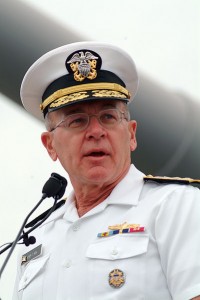
401px-CNO-Vern-Clark-2005


When organizational cultures value people, they achieve higher rates of employee engagement and retention.  They also benefit from stronger employer brand (as the word spreads that they value people) and tighter strategic alignment (when employees who feel valued want to advance the organization’s interests).  I just wrote a post about this topic for the Human Capital Institute’s blog. In the post, I tell the story of how Admiral Vern Clark, Chief of Naval Operations (CNO) for the U.S. Navy, increased the element of Human Value in the Navy’s culture and the effect it had on first term reenlistment rates. You can read more about it
at this link or below.

Strategic Alignment and Engagement

Motivating employees to align their behavior with the organization’s strategy (strategic alignment) and give their best efforts (employee engagement) is one of the challenges of senior leadership. Typically, leaders and stars feel connected to the organization but research shows that 75 percent or more of the employees do not. Because they don’t feel connected, over time they gradually stop caring, they stop aligning their behavior with organizational goals, they stop giving their best efforts and they stop fully communicating. One serious consequence of the break-down in communications is that decision makers don’t get the information they need to make optimal decisions. These conditions lead to underperformance at both individual and corporate levels.

Free Download for GAO

Today I’m speaking at the U.S. Government Accountability Office (GAO) in Washington, DC.  The GAO is known as “the investigative arm of Congress” and “the congressional watchdog.” It supports the U.S. Congress in meeting its constitutional responsibilities and helps improve the performance and accountability of the federal government for the benefit of the American people.  (Note: The free download was open for two days which has now expired.)