
In Addition to Competence, College Building Character and Connection

A trusted friend and former colleague of mine at Morgan Stanley recently praised Andy Chan’s work at Wake Forest University to help students understand and develop character, then discover their passion and a career path to match it. Here’s a great article about Chan’s work from the Chronicle of Higher Education entitled “Finished College. Now What?

Chan’s work fits well with our mission to develop strength of character and connection in organizations (you can learn why we believe character strengths are so important for individual, organizational and societal health in the Connection Culture Manifesto that was published by changethis.com). I’ll be learning more and writing future blog posts about Andy Chan and Wake Forest’s work so stay tuned.

Brain Research: To Improve Learning, Use Whole Body

We learn best when we think, feel and do.  That’s the message of Dr. Adele Diamond, a cognitive developmental neuroscientist who currently teaches at the University of British Columbia in Canada.  We might refer to this as “whole body learning.”  According to Dr. Diamond, the executive function of the brain — the prefrontal cortex — works best when we go beyond the rational mind by also involving emotions and physical behaviors.  That makes sense since the more we involve other parts of the brain, the more neural connections we make that reinforce learning.

The implications are wide-ranging.  It reminds me of Howard Gardner’s theory of multiple intelligences and Robert Sternberg’s identification of different thinking styles. The more we incorporate different approaches to learning that speak to diverse individuals who are wired to learn differently, the greater the probability they will in fact learn.

Are you using more than analytic, rational methods of learning?   Do you use stories to move people emotionally?  Do you employ exercises that require people to behave in ways that will help them learn?

For those who want to go deeper, there a fascinating hour-long interview of Dr. Adele Diamond by Krista Tippett of American Public Radio’s “Speaking of Faith” program that you can hear at this link.

Friedman, Seidman on Character & Connection

Here is an outstanding session from the Aspen Institute’s Ideas Festival where Dov Seidman and Tom Friedman discuss the importance of individual and corporate character in a connected world. I was fortunate to attend the first Aspen Institute Ideas Festival some years back where it seemed all the speakers touched on the issue of connection. In a future blog post, I plan to share some of my thoughts related to connection that I recorded in my personal journal following that event.

Adams Family Character

IMG_0964This weekend, my wife Katie and I went for a rare getaway to Boston, about a three hour drive from our home in Connecticut.   Our primary interest was to see the home of the Adams family, not of the television sitcom fame, however. We were interested in seeing the other Adams family, John and Abigail Adams, and their son John Quincy Adams.  Katie and I much admire the Adams’s for their character, their faith and the positive impact they had America.

As it turned out, Sunday was the birthday of John Quincy Adams.  When we visited the tombs of the Adams’s we saw a wreath on John Quincy Adam’s tomb sent from President Obama.

The highlight of the trip for me was seeing the Mendi Bible that was given by the Mendi men to John Quincy Adams in thanks for representing them in their successful case to win their freedom, a case that went all the way to the U.S. Supreme Court.  The Mendi Bible is kept in a safe except on the weekend of John Quincy Adams’s birthday when it is on display in the Adams’s library adjacent to their home in Quincy, Massachusetts.

The tour guide let me read a copy of the letter the Mendi Men presented to John Quincy Adams at the time they gave him the Bible. The letter expressed their gratitude to President Adams, how much the Bible meant to them during their time in prison and how they continue reading it now that they are free. President Adams wrote back to the Mendi that “it was from that book that I learnt to espouse your cause when you were in trouble.”

The story of the Mendi men was captured in Stephen Spielberg’s highly acclaimed movie “Amistad,” which I encourage you to see.   In 2007, Deval Patrick, Massachusett’s first African-American governor, was sworn in using the Mendi Bible (you can read about it in this Boston Globe article.)
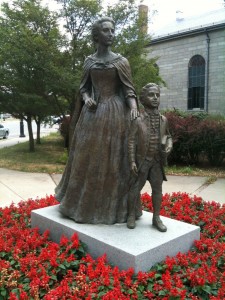
IMG_0968Near the church where the Adams’s are entombed, there is a statue of young John Quincy at around nine years old holding the hand of his mother Abigail.  She was a remarkable woman of faith, wisdom and courage.  Knowing the stories of John and Abigail Adams it should come as no surprise that their son went on to become America’s sixth president and later a defender of liberty and justice in the case of the Mendi’s.  As historian David McCullough wrote,

“While there are indeed great, often unfathomable forces in history before which even the most exceptional of individuals seem insignificant, the wonder is how often events turn upon a single personality, or the quality we call character.”

The Adams’ family was a tremendous example of strength of character in action.  I was encouraged learning more about them.

Learning about and celebrating the stories of individuals who have good character is one way we can be encouraged to live up to their example. By developing habits that reflect strength of character in our lives and teaching the stories of role models such as the Adams’s to our children we help them develop good character too.

Best Practice Institute Employee Engagement Webinar

On July 14, 2010 at 12:00 pm EDT, Michael and Jason Pankau will join the Best Practice Institute to present a 45 minute webinar on creating a work environment to maximize employee engagement and strategic alignment.   Following the webinar there will be a 15 minute period for Q&A.

During the session, Michael and Jason will cover:

  • Six universal human needs to thrive at work
  • Three core elements of a culture that motivates employees to give their all
  • Best practices of leaders who energize the people they lead
  • Why task and relationship excellence are necessary to achieve sustainable superior performance.

You can register for the webinar at this link.

LeaderLab Podcast Interview

Jason Pankau and I were recently guests on LeaderLab’s podcast interviews available online or at iTunes. LeaderLab’s podcasts are hosted by David Burkus. David’s past guests on LeaderLab’s podcasts have included Marshall Goldsmith, Daniel Pink and Steve Farber. Check it out.

Who Has Your Back?

William SewardOne reason so many leaders fail is that they become isolated.  We all need good friends who “have our back,” as my friend and business colleague Jason Pankau likes to say.  Good friends tell us the truth, they are willing to speak up if they believe we are wrong, and they support and encourage us through the inevitable difficult seasons we all experience in life.

A couple summers ago, I shot the above photograph of the William Seward statue in New York City’s Madison Square Park knowing that one day I would write about him. Seward was a onetime political rival of Abraham Lincoln’s who became a member of Lincoln’s cabinet and one of Lincoln’s best friends.  Doris Kearns-Goodwin wrote about their friendship in her wonderful book Team of Rivals. Frequently, Lincoln went to Steward’s residence in Washington D.C. where the two men talked for hours. Seward’s friendship was a lifeline for Lincoln during his struggles with depression, challenging periods he faced during the Civil War, his wife’s mental illness and the grief he felt following the death of his son.

Ask yourself if you have a few good friends who have your back at work and in life outside of work.  If you do, why not reach out to them and let them know how much you appreciate their friendship.  If you don’t have close friends, take out pen and paper then write down the names of individuals who have the potential to become good friends. Consider the following questions when selecting potential good friends:  Is he trustworthy?; Does he share your interests and values?; Does he live near you so that you can meet on a regular basis? Now that you have a few names, prioritize them then reach out to see if they are willing to meet you over a meal or coffee.  If the meeting goes well, ask if he would consider meeting on a regular basis. In my next post, I’ll write about the types of interactions that will make your meeting time with good friends worthwhile for each of you.

NASA JSCI’m dedicating this post to one of my best friends, Jason Pankau.  Here is a picture of us when we spoke recently at NASA’s Johnson Space Center in Houston, Texas (Jason is on the right side of the picture). We are standing in front of the Mission Control center for the International Space Station.

The Need to Respect Legitimate Authority and One’s Colleagues

With the recent firing of General McChrystal as commander of American forces in Afghanistan over his insubordination, I thought it would be an ideal time to reproduce here what I wrote in Fired Up or Burned Out about one of the greatest military leaders in history, America’s Army Chief of Staff, General George C. Marshall.

Marshall created a culture that stands in stark contrast to the culture created by General McChrystal as reported in a Rolling Stone magazine article entitled “The Runaway General.” Defenders of McChrystal argue he was speaking truth to power.  General Marshall was known for speaking truth to power but, unlike McChrystal, he recognized the need to respect legitimate authority and to always be respectful in dealing with the people he interacted with whether they were fellow soldiers, diplomats or representatives of foreign governments.

Because Marshall possessed humility of character, he knew that he was not always right and had to defer to the decisions of his superior in the chain-of-command then put extra effort into executing such decisions. As a result, Marshall had the complete confidence of the leaders he reported to such as General John “Blackjack” Pershing and President Franklin Deleno Roosevelt.

Marshall should be one of the role models all leaders strive to emulate. The title of the chapter I wrote about General Marshall was  “Soldier of Peace.”  You can read it below.

Obama’s Good Call: Replacing Disrespectful Leader with One Known for Competence and Character

We teach leaders to hold “Knowledge Flow Sessions” to hear the opinions and ideas of others; doing so will help leaders make optimal decisions. We also teach leaders that disrespectful behavior is intolerable because it reduces “Human Value” in a culture, and leaders and/or individual contributors who exhibit disrespectful behavior need to be removed from the organization if they fail to change.

President Obama’s recent action to replace General Stanley McChrystal is an excellent example.   Here is an article about President Obama’s decision-making process and here is the Rolling Stone magazine article entitled “The Runaway General” that brings General McChrystal’s character into question.  Replacing McChrystal with General David Patraeus was also wise. Whereas McChrystal’s leadership style brought compliance out of fear, General Patraeus by all accounts appears to have the competence and character necessary to inspire the best efforts and aligned behavior of the soldiers he now leads.

If you are a leader or aspire to be one, ask yourself if you have developed the competence and character necessary to inspire others to follow you? In terms of character, you should reflect on whether or not your behavior reflects the following character strengths:

  • Persistence
  • Perspective/Wisdom
  • Purpose
  • Work Ethic
  • Hope/Optimism
  • Citizenship
  • Love of Learning
  • Bravery/Courage
  • Integrity
  • Prudence
  • Curiosity
  • Open Mindedness
  • Kindness
  • Love of People
  • Fairness
  • Self-Control
  • Forgiveness/Mercy
  • Gratitude
  • Humor
  • Humility/Modesty
  • Appreciation of Beauty and Excellence.

Which of these character strengths are most important to your success?  Which character strengths need more focus?  Now take action by finding a mentor or coach you respect and who will help you develop these character strengths.

For more on Knowledge Flow and Human Value see articles we published entitled “Encouraging Knowledge Flow” and “Strengthening Human Value in Organizational Cultures.”