Developing Connections When People are Geographically Remote

At the heart of building community is developing a bond of connection among the members of a group. In other words, when the members of a group feel positive emotions related to being understood, respected, appreciated, and included by their group’s leaders and fellow members, it forms a bond that strengthens cooperation and commitment among group members.

Emotions are important to organizational effectiveness. Research by the Corporate Executive Board has shown that emotional factors are four times as effective as rational factors when it comes to the amount of effort employees put in their work. Emotional factors include how an employee feels about his organization’s identity and the people he works with whereas rational factors include what an employee thinks about his compensation.

Typically, an organization’s managers and stars feel emotionally connected while three-quarters of all employees do not. What happens to those who don’t feel connected? They stop caring. They stop giving their best efforts. They stop fully communicating and, as a result, decision-makers don’t get the information they need to make optimal decisions. This disconnection results in a gradual spiraling down of performance that may eventually threaten an organization’s survival.

Connection is grounded in human needs. I’ve found that two of these needs, recognition and belonging, can be partially met through participation in online communities. The need for recognition is in our DNA. It’s almost as if we have a “recognition battery” that needs to be charged regularly but the curious aspect of this battery is that its plug-in is located at a spot on our back that we can’t quite reach. As such, we rely on the people around us to charge our recognition battery. If it’s charged, we are energized; if not, we become drained and lose energy.

In addition to recognition, we have a need to feel that we belong to a group — to be in a place where “everyone knows your name,” as the popular theme song of the old comedy television show Cheers stated. Positive interactions on a regular basis with members of a group bring about this feeling of belonging.

There are a number of online capabilities that organizations can put place to help meet the needs for recognition and belonging, and bring about feelings of connection.

Online Personal Profiles that allow people to express their personal identities through posting photographs, hobbies and interests outside of work provide recognition. When co-workers inevitably comment on these personal expressions of identity, it provides recognition and a sense of belonging that makes people feel more connected. Giving employees a place to express who they really are helps them avoid feelings of isolation that occur when they begin to feel like cogs in a machine. Also related to personal identity are affinity groups such as book clubs and alumni groups. These groups can be encouraged and supported with online intranet websites and social media that increase connection among people with shared interests outside of work.

Social Media can be used to inform employees and invite them into conversations about corporate issues. Leaders who mine the resulting body of content for good ideas, implement them, and give credit where credit is due will discover that this helps employees feel more connected. This practice will also improve decision-making and innovation as decision makers gain access to new information and participants to identify new business opportunities, process improvements and product possibilities.

Podcasts and Webcasts are helpful tools to facilitate connection by reaching employees who have visual and auditory learning styles. They can also be used to increase awareness of thought leaders and experts in an organization. For example, Polly Pearson, former Vice President of Employment Brand and Strategy Engagement at EMC, interviewed thought leaders and experts on an internal webcast entitled “Culture Talk.” Polly helped several EMC employees to become internal bloggers and eventually to blog externally. As a result, EMC developed more than 40 bloggers.

These are but a few of the online means that can be utilized to foster connection among the members of an organization. By helping everyone to feel connected, organizations will increase the employee engagement, strategic alignment, productivity, innovation and overall performance.

Happiness at Work Podcast

alter logoJason Pankau and I were guests on a podcast for clients of The Alter Group, one of America’s leading real estate development firms.  The podcast host was Tom Silva, Vice President of the Alter Group. Our topic was happiness at work, leadership, employee engagement and employee motivation. You can check it out at this link or download it on iTunes.

Coming Talent Shortage Relevant to Nations, Organizations, Managers

Take a look at this fascinating article in Foreign Affairs by Nicholas Eberstadt entitled “The Demographic Future.” It has an excellent discussion of how population and labor supply around the world will change over the next 20 years as a result of the nearly 50 percent decline of fertility worldwide over the last half century. The larger point of the article is that although many nations are presently experiencing an excess supply of labor, a shortage is certain to result as baby boomers retire and the economy resumes growing. The analysis in the article points out the need for nations to improve educational opportunities, health conditions and economic environments.  In addition, it supports the need for nations to create Connection Cultures that will attract and retain immigrant talent to their home markets, the need for organizations to create Connection Cultures that will attract and retain talent to their organizations, and the need for managers to create Connection Cultures that will attract and retain talent to the units they lead.

Motivate Employees Now

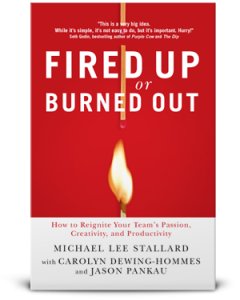
Fired_Up_or_Burned_Out_Book_CoverThis morning appeared as a guest on my friend Jim Blasingame’s nationally-syndicated “Small Business Advocate” radio program where we talked about leadership, employee engagement and productivity.  During the program, Jim and I discussed how the three core elements of a Connection Culture — Vision, Value and Voice — motivate employees to give their best efforts and align their behavior with organizational goals.  One of the ideas I shared was to bring employees together to read and discuss a management book including how it applies to their business.  To get them started,  I offered a free download of the digital version of Fired Up or Burned Out to listeners who sign up for my email newsletter.  To sign up for the newsletter and access the free book download click on this link.

The Pride Paradox

Michael Lee Stallard and Jason Pankau

In a recent post, I (Michael) wrote about a leader who imparted his values to the people he was responsible for leading at work and to his children.  In this post, we’ll address the “pride paradox” that relates to values.

Imparting one’s values to others and judging them based on their values has the potential to create a culture of self-righteousness and legalism. Mark Twain alluded to this when he described some people as “good in the worst sense of the word.”

Don’t get us wrong, great leaders impart their values to others and judge others by their values.  Herein lies the paradox.  Some leaders who do this fail to develop what is arguably the most important character value: humility.

Best Practice Institute Employee Engagement Webinar

On July 14, 2010 at 12:00 pm EDT, Michael and Jason Pankau will join the Best Practice Institute to present a 45 minute webinar on creating a work environment to maximize employee engagement and strategic alignment.   Following the webinar there will be a 15 minute period for Q&A.

During the session, Michael and Jason will cover:

  • Six universal human needs to thrive at work
  • Three core elements of a culture that motivates employees to give their all
  • Best practices of leaders who energize the people they lead
  • Why task and relationship excellence are necessary to achieve sustainable superior performance.

You can register for the webinar at this link.

The Need to Respect Legitimate Authority and One’s Colleagues

With the recent firing of General McChrystal as commander of American forces in Afghanistan over his insubordination, I thought it would be an ideal time to reproduce here what I wrote in Fired Up or Burned Out about one of the greatest military leaders in history, America’s Army Chief of Staff, General George C. Marshall.

Marshall created a culture that stands in stark contrast to the culture created by General McChrystal as reported in a Rolling Stone magazine article entitled “The Runaway General.” Defenders of McChrystal argue he was speaking truth to power.  General Marshall was known for speaking truth to power but, unlike McChrystal, he recognized the need to respect legitimate authority and to always be respectful in dealing with the people he interacted with whether they were fellow soldiers, diplomats or representatives of foreign governments.

Because Marshall possessed humility of character, he knew that he was not always right and had to defer to the decisions of his superior in the chain-of-command then put extra effort into executing such decisions. As a result, Marshall had the complete confidence of the leaders he reported to such as General John “Blackjack” Pershing and President Franklin Deleno Roosevelt.

Marshall should be one of the role models all leaders strive to emulate. The title of the chapter I wrote about General Marshall was  “Soldier of Peace.”  You can read it below.

Has Jim Goodnight Cracked the Code of Corporate Culture?

Today, The Economic Times in India published an article I wrote about Jim Goodnight and SAS Institute.  The article is based on an interview I conducted with Goodnight at Giant Impact’s Leadercast conference in Atlanta.  You can read my article at The Economic Times‘ website or below.    

Tom Friedman, Dov Seidman: Need For “Sustainable Values”

Check out Tom Friedman’s column in today’s New York Times at this link. Friedman cites Dov Siedman’s belief that in an interconnected world we need “sustainable values” more than ever. I couldn’t agree more.  In past posts I’ve written about Dov, his book entitled How and LRN, the company he founded to promote principled leadership.  

In our work at E Pluribus Partners, we promote universal character values and virtue as essential for people to thrive, individually and collectively.  Our “Character > Connection > Thrive Model” (see below) lays out the rationale.  In a nutshell, individuals who believe and behave in ways that are consistent with Universal Character Values (also known as character strengths), create “Connection Cultures” that meet universal human needs to thrive.   You can learn more about Connection Cultures, Universal Character Strengths and Virtues by reading this free manifesto published by changethis.com entitled The Connection Culture: A New Source of Competitive Advantage.

Slide1

What would Jack Bauer do?

24wallpaperIn the current season of the show “24,” the President of the United States is about to uncharacteristically agree to cover up a murder for the sake of a peace treaty. When Jack Bauer, the show’s hero, confronts the president, she admits she doesn’t like to do this but in this particular instance the end justifies the means. Bauer disagrees and is now working against the American government to expose the murder.

It’s a thrilling story and I have to admit I’m hooked on this season of 24. It’s interesting to note that Jack Bauer in pursuit of justice is not averse to torturing suspected enemies to get information that will help him prevent harm to others or protect America. His justification, like the president’s, is that the end justifies the means.

The story in this season’s 24 also happens to be relevant to a series of presentations, articles and a book I’m working on about character values and how they impact the performance of individuals and organizations, including employee engagement, strategic alignment, productivity and innovation. In June, Jason Pankau and I will be speaking about this at NASA’s Johnson Space Center where during the Apollo 13 mission Gene Krantz uttered the line “failure is not an option” that was made famous in Ron Howard’s spectacular movie Apollo 13. Was Krantz right? Are there indeed times when anything and everything is acceptable to achieve success? If not, when is failure acceptable?