Developing Connections When People are Geographically Remote

At the heart of building community is developing a bond of connection among the members of a group. In other words, when the members of a group feel positive emotions related to being understood, respected, appreciated, and included by their group’s leaders and fellow members, it forms a bond that strengthens cooperation and commitment among group members.

Emotions are important to organizational effectiveness. Research by the Corporate Executive Board has shown that emotional factors are four times as effective as rational factors when it comes to the amount of effort employees put in their work. Emotional factors include how an employee feels about his organization’s identity and the people he works with whereas rational factors include what an employee thinks about his compensation.

Typically, an organization’s managers and stars feel emotionally connected while three-quarters of all employees do not. What happens to those who don’t feel connected? They stop caring. They stop giving their best efforts. They stop fully communicating and, as a result, decision-makers don’t get the information they need to make optimal decisions. This disconnection results in a gradual spiraling down of performance that may eventually threaten an organization’s survival.

Connection is grounded in human needs. I’ve found that two of these needs, recognition and belonging, can be partially met through participation in online communities. The need for recognition is in our DNA. It’s almost as if we have a “recognition battery” that needs to be charged regularly but the curious aspect of this battery is that its plug-in is located at a spot on our back that we can’t quite reach. As such, we rely on the people around us to charge our recognition battery. If it’s charged, we are energized; if not, we become drained and lose energy.

In addition to recognition, we have a need to feel that we belong to a group — to be in a place where “everyone knows your name,” as the popular theme song of the old comedy television show Cheers stated. Positive interactions on a regular basis with members of a group bring about this feeling of belonging.

There are a number of online capabilities that organizations can put place to help meet the needs for recognition and belonging, and bring about feelings of connection.

Online Personal Profiles that allow people to express their personal identities through posting photographs, hobbies and interests outside of work provide recognition. When co-workers inevitably comment on these personal expressions of identity, it provides recognition and a sense of belonging that makes people feel more connected. Giving employees a place to express who they really are helps them avoid feelings of isolation that occur when they begin to feel like cogs in a machine. Also related to personal identity are affinity groups such as book clubs and alumni groups. These groups can be encouraged and supported with online intranet websites and social media that increase connection among people with shared interests outside of work.

Social Media can be used to inform employees and invite them into conversations about corporate issues. Leaders who mine the resulting body of content for good ideas, implement them, and give credit where credit is due will discover that this helps employees feel more connected. This practice will also improve decision-making and innovation as decision makers gain access to new information and participants to identify new business opportunities, process improvements and product possibilities.

Podcasts and Webcasts are helpful tools to facilitate connection by reaching employees who have visual and auditory learning styles. They can also be used to increase awareness of thought leaders and experts in an organization. For example, Polly Pearson, former Vice President of Employment Brand and Strategy Engagement at EMC, interviewed thought leaders and experts on an internal webcast entitled “Culture Talk.” Polly helped several EMC employees to become internal bloggers and eventually to blog externally. As a result, EMC developed more than 40 bloggers.

These are but a few of the online means that can be utilized to foster connection among the members of an organization. By helping everyone to feel connected, organizations will increase the employee engagement, strategic alignment, productivity, innovation and overall performance.

Happiness at Work Podcast

alter logoJason Pankau and I were guests on a podcast for clients of The Alter Group, one of America’s leading real estate development firms.  The podcast host was Tom Silva, Vice President of the Alter Group. Our topic was happiness at work, leadership, employee engagement and employee motivation. You can check it out at this link or download it on iTunes.

Can We Humanize Organizational Cultures?

Check out this thought-provoking interview with Peter Block. During the interview he states the following:

“in the context of organization development, what we’re trying to do is humanize systems.  The systems of consistency and control and predictability steal our humanity.”

Do you agree?  Can organizations achieve consistency, control and predictability while still preserving our humanity? How about  organizations where the cost of failure is high such as hospitals, nuclear power plants, NASA and the armed services?

Jason Pankau and I teach leaders that it’s necessary to achieve both task excellence and relationship excellence if you aspire to achieve sustainable superior performance.  In the modern era, we’ve certainly focused on and made great strides forward in achieving task excellence but we have failing miserably when it comes to achieving relationship excellence.  Two articles Jason and I wrote are relevant to this topic.  The first article entitled “Strengthening Human Value in Organizational Cultures” appeared in the Leader to Leader Journal.  The second article entitled “Encouraging Knowledge Flow” appeared in Perdido.

What do you think?

How Solitude Shapes Great Leaders

Take time to read this thoughtful speech entitled Solitude and Leadership by William Deresiewicz given to this year’s plebe class at West Point. He describes how great leaders develop the courage of their convictions, which includes moral courage. Reflection, time alone with one’s thoughts, interactions with trusted friends and reading great books, as Deresiewicz says, are part of the mix.  What he didn’t adequately include is the impact of one’s experiences in life including one’s family of origin and periods of adversity and suffering that breed humility.  Despite its shortcomings, it’s a fine speech and well worth taking time to read.

Many thanks to David Books of The New York Times for bringing this thoughtful speech to my attention.  Brook’s recognized Deresiewicz’s speech as one of the best pieces of long journalism written in 2010.

Are You A Life Giver or Life Drainer?


Many thanks to my friend
Jeffrey Fry for sending me this wonderful video.  It’s encouraged me to be bolder in affirming my family members, friends and the people I meet day-to-day.

Validation, affirmation, recognition or whatever else you call it is relevant in the workplace and to life outside of work.  When I speak or teach about Connection Cultures I tell people that the need for recognition reminds me of a battery that every human being has and the plug-in to recharge the recognition battery is midway up our back and between our shoulder blades, a place we can’t reach so that we need to rely on the people around us to recharge our recognition battery. If it stays charged, we are more energized in life.  If it goes uncharged, we are drained of life.

Another point to remember is that recognition need to be genuine.   As my friend and co-author Jason Pankau says, give people sugar not saccharine (the fake stuff).

So here’s the question I’d like you to consider: are you charging or neglecting to charge the recognition batteries of the people in your life?

Signals We Send in Relationships

Thanks to my friend Deborah Mills-Scofield for sending me this article from Science Daily entitled “Exploring How Partners Perceive Each Others Emotion During a Relationship Fight.”  It looks at how expressions of hard, flat or soft emotion are perceived and how such perceptions affect relationships.  This research suggests that a leader’s ability to express appropriate emotions at appropriate times is important to keep people feeling connected to the them (and emotional connections are essential to employee engagement and alignment).

Motivate Employees Now

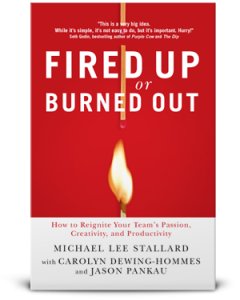
Fired_Up_or_Burned_Out_Book_CoverThis morning appeared as a guest on my friend Jim Blasingame’s nationally-syndicated “Small Business Advocate” radio program where we talked about leadership, employee engagement and productivity.  During the program, Jim and I discussed how the three core elements of a Connection Culture — Vision, Value and Voice — motivate employees to give their best efforts and align their behavior with organizational goals.  One of the ideas I shared was to bring employees together to read and discuss a management book including how it applies to their business.  To get them started,  I offered a free download of the digital version of Fired Up or Burned Out to listeners who sign up for my email newsletter.  To sign up for the newsletter and access the free book download click on this link.

Shine the Light on Others

u2_wallpaper_rattle_humBono, megastar of the rock band U2, frequently shines the light on his fellow band members.  In the photo above, Bono is shining a spotlight on The Edge, U2’s legendary lead guitar player. Bono does this in a metaphorical sense too.  Bono has stated that he’s a lousy guitar and keyboards player, and that his gifted fellow band members bring to life the melodies he hears in his head. He’s also said that being around his fellow band members makes him a better human being. Furthermore, Bono has said that when one of one of his fellow band members is in need it takes precedence over the band’s music.

Are you shining the light of recognition and belonging on your family members, your friends and your colleagues at work?  Here are some actions to consider:

  • When you see someone doing something that’s admirable, be sure to let them know that you recognize it.
  • Tell your family members and friends how much and why you appreciate them.
  • When you are in a group discussion, praise others for their good ideas and opinions.
  • Send a hand-written personal note of appreciation to a family member, friend or colleague at work.
  • When a family member, friend or colleague at work is sick, send them a get well gift.
  • When a family member, friend or colleague at work has something to celebrate congratulate them.


Connection Cultures on Gary Hamel’s MIX

Recently I was delighted to see two great case studies written by good friends of mine appeared on Gary Hamel’s MIX.  Both case studies reflect elements of the Connection Culture that I wrote about in Fired Up or Burned Out.  The first case study written by Deborah Mills-Scofield is entitled “The 160-year old Startup.” The second case study written by Drew Williams is entitled “Restoring Faith in the Institution: How Mission Shaped Communities Revitalized St. Andrews.”  I encourage you to check them out!