The Collective Wisdom of Relationship-Centered Networks

When individuals feel like valued members of a group, it boosts a host of positive outcomes including superior decision-making, employee engagement, employee motivation, strategic alignment, organizational learning, cooperation, productivity, innovation and overall performance. This applies to groups of all sizes including classrooms and schools, families, business and government organizations, hospitals, sports teams and the social sector.  Strong relationships are key for any group to achieve the benefits enumerated above.

In an earlier post, I wrote about the University of Chicago research on relational trust that I learned about from my friend Parker Palmer.  For those of you who are interested in relational trust and the wisdom of crowds, I encourage you to check out this fascinating interview my friend Robert Morris, the freelance writer, did with Alan Briskin, co-author of The Power of Collective Wisdom. In the interview, Briskin and Morris discuss relationship centered networks that tap into collective wisdom.

For those of you who read Robert Morris’ book review and interview, you will see why I believe he is among the very best at what he does.  In addition to being a well-organized, clear writer, Morris is a Renaissance man who always sprinkles his writings and interviews with thoughtful insights drawn from remarkably diverse fields of knowledge.  Check out his book reviews and interviews at this link and you’ll see what what I mean.

Burnout Results From Living in Conflict with Values

The New York Times recently had an article on rising burnout among clergy entitled “Taking a Break from the Lord’s Work.”  The article was followed by a thoughtful op-ed entitled “Congregations Gone Wild.”

Effective leadership, employee engagement and employee motivation are closely linked to the alignment of behavior with personal values. In the case of clergy, putting a muzzle on pastors so they are unable to preach in a way that is consistent with their values is a sure path to burnout.

This is a very important issue that everyone should spend time thinking about. Set aside time this month to list your values.  Ask yourself, “what do I believe in and what’s important to me in the way I live my life?”  Then compare what you wrote down with how you presently live.   During the Depression, a young financial analyst working in London did this exercise. Years later reflecting on it he wrote that “people, I realized, is what I value and I had no desire to be the richest man in the cemetery.” That young man, Peter Drucker, left his well-paying job and went on to become the father of management consulting. In “How Peter Drucker Changed My Life” I wrote about how Drucker’s writings affected my own career decisions.

What if you discover there are differences in your values and how you are presently living?  My advice is to invite 2-3 people you trust and respect to meet with you, discuss your analysis and thoughts about how you might take action to close the values gaps.  You may find all that is necessary is to speak with your supervisor about making changes to your present job or something more may be required such as moving to a different job or business unit in your organization, or, in the the most extreme instances, changing careers altogether.  Whatever the case, ignoring the present stressful state is never wise because if affects your mental and physical heath, your relationships and your job performance. Having conversations with people you trust will help reduce the stress you feel and also help clarify your thinking so that you can develop a clear plan to move forward to a better state of work and a better life.

Who Has Your Back?

William SewardOne reason so many leaders fail is that they become isolated.  We all need good friends who “have our back,” as my friend and business colleague Jason Pankau likes to say.  Good friends tell us the truth, they are willing to speak up if they believe we are wrong, and they support and encourage us through the inevitable difficult seasons we all experience in life.

A couple summers ago, I shot the above photograph of the William Seward statue in New York City’s Madison Square Park knowing that one day I would write about him. Seward was a onetime political rival of Abraham Lincoln’s who became a member of Lincoln’s cabinet and one of Lincoln’s best friends.  Doris Kearns-Goodwin wrote about their friendship in her wonderful book Team of Rivals. Frequently, Lincoln went to Steward’s residence in Washington D.C. where the two men talked for hours. Seward’s friendship was a lifeline for Lincoln during his struggles with depression, challenging periods he faced during the Civil War, his wife’s mental illness and the grief he felt following the death of his son.

Ask yourself if you have a few good friends who have your back at work and in life outside of work.  If you do, why not reach out to them and let them know how much you appreciate their friendship.  If you don’t have close friends, take out pen and paper then write down the names of individuals who have the potential to become good friends. Consider the following questions when selecting potential good friends:  Is he trustworthy?; Does he share your interests and values?; Does he live near you so that you can meet on a regular basis? Now that you have a few names, prioritize them then reach out to see if they are willing to meet you over a meal or coffee.  If the meeting goes well, ask if he would consider meeting on a regular basis. In my next post, I’ll write about the types of interactions that will make your meeting time with good friends worthwhile for each of you.

NASA JSCI’m dedicating this post to one of my best friends, Jason Pankau.  Here is a picture of us when we spoke recently at NASA’s Johnson Space Center in Houston, Texas (Jason is on the right side of the picture). We are standing in front of the Mission Control center for the International Space Station.

The Need to Respect Legitimate Authority and One’s Colleagues

With the recent firing of General McChrystal as commander of American forces in Afghanistan over his insubordination, I thought it would be an ideal time to reproduce here what I wrote in Fired Up or Burned Out about one of the greatest military leaders in history, America’s Army Chief of Staff, General George C. Marshall.

Marshall created a culture that stands in stark contrast to the culture created by General McChrystal as reported in a Rolling Stone magazine article entitled “The Runaway General.” Defenders of McChrystal argue he was speaking truth to power.  General Marshall was known for speaking truth to power but, unlike McChrystal, he recognized the need to respect legitimate authority and to always be respectful in dealing with the people he interacted with whether they were fellow soldiers, diplomats or representatives of foreign governments.

Because Marshall possessed humility of character, he knew that he was not always right and had to defer to the decisions of his superior in the chain-of-command then put extra effort into executing such decisions. As a result, Marshall had the complete confidence of the leaders he reported to such as General John “Blackjack” Pershing and President Franklin Deleno Roosevelt.

Marshall should be one of the role models all leaders strive to emulate. The title of the chapter I wrote about General Marshall was  “Soldier of Peace.”  You can read it below.

Has Jim Goodnight Cracked the Code of Corporate Culture?

Today, The Economic Times in India published an article I wrote about Jim Goodnight and SAS Institute.  The article is based on an interview I conducted with Goodnight at Giant Impact’s Leadercast conference in Atlanta.  You can read my article at The Economic Times‘ website or below.    

Creative Conversations: Boosting Creativity in Meetings

How do you boost creativity in meetings?  The key here is to tap the “corporate mind.”

The root work of “corporation” is the Latin word “corpus.”  It means “body.”  The definition of “corporation” is “a body of people acting as a single entity and authorized as such under the law.”  To maximize creativity requires getting a group of people together who in a sense represent the corporate body then helping them feel safe so that they will share their ideas and opinions.

Because individuals have diverse thinking styles, experiences and temperaments, they will naturally have different perspectives and come up with different ideas that contribute to constructing a creative new solution, product, process or new business opportunity.  As such, it is ideal to have a group that is large enough to generate diverse ideas but not so large that it becomes unwieldy.  Eight to ten individuals should be sufficient for most issues.  With issues that are more complex, and/or require broader support and implementation, you may want to have broad participation (an issue I will write about in a later post).

Here are few ways to structure a meeting and create a safe environment so that creativity will be maximized:

The Role of Business in the Pursuit of Happiness

Delivering Happiness is the rare book that gives us an inside look at one individual’s journey to find happiness and as a leader in business. Tony Hsieh, the CEO of Zappos, has written a thoughtful account of what he has learned from experiences in life, in business and from his studies of the fast growing field of positive psychology.

I highly recommend this book to leaders and others who want to see what an engaging work environment — or “Connection Culture” as I’ve described it in my writings — looks like. Not only will you learn about Hsieh’s thinking, you’ll see how he puts ideas into action.

John Wooden and the Power of Virtue in Leadership

Many thanks to Michael Hyatt for featuring my guest post entitled “John Wooden and the Power of Virtue in Leadership” on his blog. Michael’s blog was recently recognized and the #1 leadership blog. Not bad considering his day job is CEO of America’s 7th largest trade book publishing company, Thomas Nelson.

Sustainable Organizations: The Ideas of Martin Seligman

In an earlier post, I wrote that the ideas of thought-leader Dov Seidman, CEO of LRN and author of How, are likely to have a profound effect on organizations in the years to come. In this second post on thought leaders affecting the evolution of organizations, I highlight the work of Martin Seligman.

Seligman, a psychology professor at the University of Pennsylvania, founded the positive psychology movement when he became president of the American Psychological Association.  There isn’t adequate space in this post to provide an overview of positive psychology, so for those who are interested in learning more, I highly recommend reading an article co-authored by Seligman entitled “Positive Psychology: An Introduction” and a New York Times’ Magazine article entitled “Happiness 101” that describes how the positive psychology movement is growing.

Positive psychology has identified 24 character strengths that it believes — and a growing body of research shows — affect human flourishing. These character strengths are universal. Religious thinkers and moral philosophers throughout the ages have advocated them. Political, social and economic cultures that have been sustained for long periods of time have these values and systems that don’t (i.e. coercive utopian systems such as communism and fascism), fail because the  values they promote work against human flourishing.

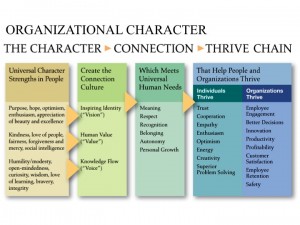
Our research at E Pluribus Partners identified a “Character > Connection > Thrive Chain” (see below)  that posits organizations and individuals thrive because they are comprised of people who embrace and behave in ways that reflect the character strengths and in doing so create “Connection Cultures” which meet universal human needs such as meaning, respect, recognition, belonging, autonomy and personal growth. Learn more about positive psychology and the Character >Connection>Thrive Chain on pages 116-130 of the free digital book download of Fired Up or Burned Out.

Recent research from The Conference Board and the Corporate Executive Board make it clear that employee engagement is at dismal levels but eventually leaders will discover that embracing and behaving in ways that reflect the 24 character strengths creates Connection Cultures and develops the corporate character strengths necessary to produce sustainable organizations.

(To enlarge the diagram below, click on it once until it appears then click on it a second time for an enlarged version.)

Slide1