Goldman Sachs’ Inspiring Identity At Risk

A few hours ago, Goldman Sachs acknowledged in an SEC filing that mounting criticism in the press is a risk to the firm.  Goldman should be concerned.  A firm’s reputation affects employer brand, employee engagement and employee retention.  In the past Goldman employees were proud to say they worked for the firm.  Not so today following a long string of articles where Goldman has been referred to as a blood-sucking leech in the economy that cares only about its bottom line.  I cringe when I read such reports because I have several good friends who work or have worked at Goldman and without exception I trust and respect each one.  That said, having worked on Wall Street for most of my career, I know that people get caught up in thinking what they do is a game the score of which is determined by  how much money they make relative to others.  This mindset encourages imprudent risk-taking and behavior that may meet the letter of the law, but not the spirit. (Note: the gamesman profile was first described by Michael Maccoby in his book The Gamesman.)

I advise leaders that they must clearly communicate a set of virtuous values and keep them in front of employees.  The most effective leaders do this by celebrating the stories of individuals who exhibit the right values and getting rid of employees who don’t.  Absent a clear focus on virtuous values, an organization’s members will eventually stray into ethically questionable behavior that can destroy the firm.  And with organizations such as Goldman that are interconnected to many companies and countries via derivative contracts,  they can take the economy down with them.  That’s one reason I agree with Paul Volker and others who support effective regulation of financial services organizations.
A Test of Google’s Character

I hope Google is considering what I presented at it’s Mountain View, California headquarters last summer as it decides how to respond to the Chinese government’s apparent hacking of Google’s servers to access information on Chinese human rights protestors. If evidence becomes clear that the Chinese government is responsible for the attack, Google’s response will have an significant effect on the firm’s reputation, consumer brand, employer brand and employee engagement. This is a test of Google’s corporate character and whether or not it will live up to its aspiration “don’t be evil” and its belief in supporting a free marketplace of ideas. Human rights abuses and censorship in China are no secret. To be indifferent to China’s actions in this instance, however, is to provide silent assent. What company or leader would want such a legacy?

The Chinese Government-Google showdown reminds me of a line from Elie Wiesel’s profound speech entitled “The Perils of Indifference.” In it, Wiesel states:

“Why did some of America’s largest corporations continue to do business with Hitler’s Germany until 1942? It has been suggested, and it was documented, that the Wehrmacht could not have conducted its invasion of France without oil obtained from American sources. How is one to explain their indifference?”

It would be wise for Google’s leaders to read Wiesel’s speech and consider how history will eventually record their decision. Some decisions reflect inflection points for a firm and for history itself. As historian David McCullough reminds us in the preface to his book Brave Companions,

“…while there are indeed great, often unfathomable forces in history before which even the most exceptional of individuals seem insignificant, the wonder is how often events turn upon a single personality, or the quality we call character.”

This can be said for corporate character too.

Note: Above is a video of a presentation I gave on leadership, employee engagement, productivity and innovation at Google’s corporate headquarters, the Googleplex, last summer. On this rare occasion, I presented alone. Normally I present with my colleague Jason Pankau because better together.  As Jason says, “Mike’s the serious one, I’m the fun one.”

Groundbreaking Identity Survey Report

Have you ever witnessed an employee whose personal identity is closely connected to the identity of his or her organization?  I’ve written about Nick the doorman at Memorial Sloan Kettering Cancer Center (MSKCC) in New York City and how fired up he is greeting cancer patients and their families.  Nick actually begins making eye contact  with patients when they are within eyesight walking toward MSKCC’s entrance (in Midtown Manhattan where no one makes eye contact).  One reason why Nick is so fired up is that he is a cancer survivor who attributes his survival to the care he received at MSKCC.

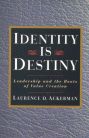
One of the leading thinkers on identity is Larry Ackerman, founder of The Identity Circle.  He wrote an excllent book entitled Identity is Destiny that effected the way I think about corporate identity and its impact on performance. Larry has come out with a new report entitled The Identity Effect.  The report is based on a survey of 2,000 individuals across five industries.  I wrote in the Connection Culture Manifesto and Fired Up or Burned Out, an organization’s identity has an impact on employee engagement and organizational performance if it inspires employees.  Larry’s research supports that view and sheds some additional insights on the power of identity. I encourage you to read it.

Corporation: “to thine own self be true”

Inspired by Socrates advice to “know thyself,” Shakespeare penned the words “to thine own self be true” in Hamlet. From our research at E Pluribus Partners on employee engagement, leadership development and team building, we know that great leaders have a high degree of self awareness, i.e. they know who they are and who they are not.

Knowing oneself is also important to organizations. Why? Organizations today must differentiate themselves in ways that are relevant to customers in order to win in the crowded, noisy marketplace. You can learn how by watching a recent webcast I hosted with Larry Ackerman, one of today’s leading experts on corporate and individual identity. Larry is the founder and president of The Identity Circle. He is also the author of two excellent books I recommend entitled Identity is Destiny and The Identity Code. In his presentation, Larry explains how he helped the Global 500 company Norsk Hydro discover its identity. You can see my webcast with Larry Ackerman by clicking on employee engagement.

Book Review: Identity is Destiny

 identity-is-destiny-cover.jpg Laurence Ackerman wrote a brilliant book entitled Identity is Destiny.  The book is about the importance of identity to organizations.  I highly recommend that C suite leaders and those who aspire to be read this insightful book.

Identity is critical to employee engagement and the Connection Cultures my colleagues and I at
E Pluribus Partners write and speak about. It is the first element in a Connection Culture which we describe as “Inspiring Identity” (or “Vision” for short).

Identity reflects the things that make a person or organization unique.  As brand experts know, relevant differentiation determines brand effectiveness and value.  Being unique or differentiated in a way that’s relevant to employees and customers is essential to an organization’s long term success.  I know of no other book that describes this force of identity as well as Ackerman’s.  Every organization should answer the questions Ackerman poses:

Who are we?

What do we stand for?

How are we different?

Where do I fit in?

In Ackerman’s book you will learn about his experiences as an identity consultant at Siegel & Gale, one of the world’s leading corporate identity consultants, where Ackerman helped organizations such as Korn Ferry, Fidelity and Alcoa discover their identities. Today, Ackerman is an independent consultant at
The Identity Circle.   He is also the author of a book about personal identity entitled The Identity Code.  I’ll have more to say about The Identity Code in future writings.