 This weekend, my wife Katie and I went for a rare getaway to Boston, about a three hour drive from our home in Connecticut. Our primary interest was to see the home of the Adams family, not of the television sitcom fame, however. We were interested in seeing the other Adams family, John and Abigail Adams, and their son John Quincy Adams. Katie and I much admire the Adams’s for their character, their faith and the positive impact they had America.
As it turned out, Sunday was the birthday of John Quincy Adams. When we visited the tombs of the Adams’s we saw a wreath on John Quincy Adam’s tomb sent from President Obama.
The highlight of the trip for me was seeing the Mendi Bible that was given by the Mendi men to John Quincy Adams in thanks for representing them in their successful case to win their freedom, a case that went all the way to the U.S. Supreme Court. The Mendi Bible is kept in a safe except on the weekend of John Quincy Adams’s birthday when it is on display in the Adams’s library adjacent to their home in Quincy, Massachusetts.
The tour guide let me read a copy of the letter the Mendi Men presented to John Quincy Adams at the time they gave him the Bible. The letter expressed their gratitude to President Adams, how much the Bible meant to them during their time in prison and how they continue reading it now that they are free. President Adams wrote back to the Mendi that “it was from that book that I learnt to espouse your cause when you were in trouble.”
The story of the Mendi men was captured in Stephen Spielberg’s highly acclaimed movie “Amistad,” which I encourage you to see. In 2007, Deval Patrick, Massachusett’s first African-American governor, was sworn in using the Mendi Bible (you can read about it in this Boston Globe article.)
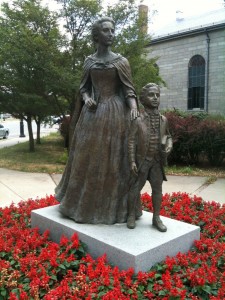 Near the church where the Adams’s are entombed, there is a statue of young John Quincy at around nine years old holding the hand of his mother Abigail. She was a remarkable woman of faith, wisdom and courage. Knowing the stories of John and Abigail Adams it should come as no surprise that their son went on to become America’s sixth president and later a defender of liberty and justice in the case of the Mendi’s. As historian David McCullough wrote,
“While there are indeed great, often unfathomable forces in history before which even the most exceptional of individuals seem insignificant, the wonder is how often events turn upon a single personality, or the quality we call character.”
The Adams’ family was a tremendous example of strength of character in action. I was encouraged learning more about them.
Learning about and celebrating the stories of individuals who have good character is one way we can be encouraged to live up to their example. By developing habits that reflect strength of character in our lives and teaching the stories of role models such as the Adams’s to our children we help them develop good character too.